Hello, students and science enthusiasts! Today, we embark on an extraordinary journey, one that has fundamentally changed how we perceive our universe. In 2022, the James Webb Space Telescope (JWST), one of humanity's most powerful and sophisticated observatories, unveiled its first images to the world. These images were not just visually stunning; they cast a new light on many enigmatic aspects of our universe's formation and evolution.
The first images sent back by the James Webb Telescope were merely the beginning—the dawn of a new scientific era. Through this telescope, we've been able to 'look back in time,' peering into the universe's infancy. Let's delve deeper into this incredible telescope and its initial historic discoveries!
The James Webb Space Telescope: A Marvel of Engineering
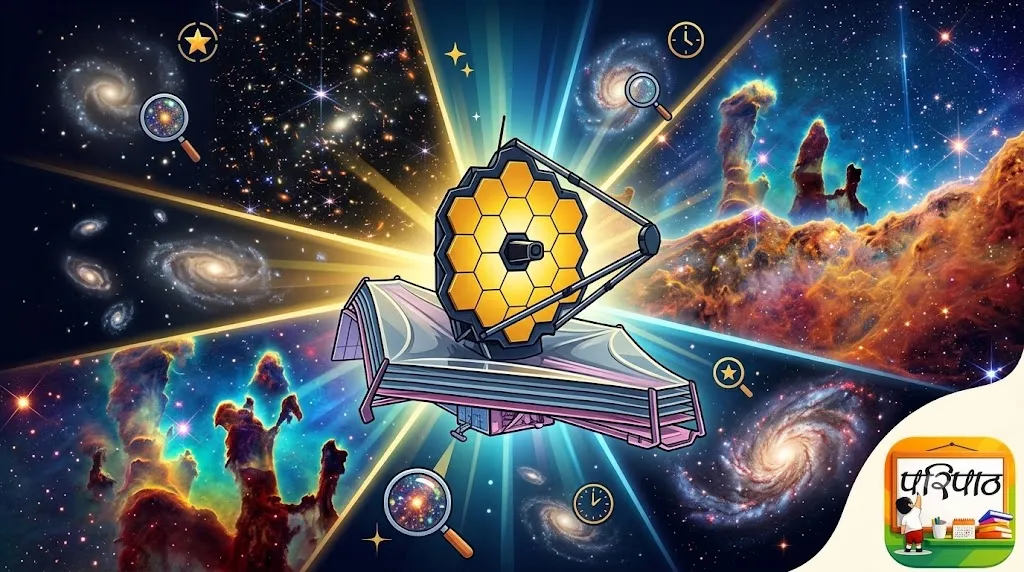
The James Webb Space Telescope (JWST) is an international observatory developed in collaboration by NASA, the European Space Agency (ESA), and the Canadian Space Agency (CSA). Launched on December 25, 2021, and after approximately six months of travel and complex setup procedures, it delivered its first full-color images to the world on July 12, 2022.
JWST is considered the successor to the Hubble Space Telescope, but its capabilities far surpass Hubble's. While Hubble primarily observes in visible and ultraviolet light, James Webb operates in the infrared spectrum. Infrared light allows it to see through clouds of dust and gas, providing information about the early stages of star and galaxy formation, as well as events from the very beginning of the universe.
- Primary Mirror: Webb's primary mirror is 6.5 meters (21 feet) in diameter, composed of 18 hexagonal, gold-coated beryllium segments. This mirror is significantly larger than Hubble's.
- Infrared Capabilities: The telescope houses four main instruments: NIRCam (Near-Infrared Camera), NIRSpec (Near-Infrared Spectrograph), MIRI (Mid-Infrared Instrument), and FGS/NIRISS (Fine Guidance Sensor/Near Infrared Imager and Slitless Spectrograph). All these instruments are highly sensitive to infrared light.
- Location: JWST is positioned approximately 1.5 million kilometers (930,000 miles) from Earth, at the Sun-Earth L2 Lagrange point. This location allows it to remain far from the Sun and Earth, operating at extremely cold temperatures, which is crucial for infrared observations.
First Glimpses of the Universe: Historic Images of 2022
On July 12, 2022, NASA released the first five images and one spectrum captured by the James Webb Telescope. These images astonished the world and marked a new chapter in the history of astronomy.
1. SMACS 0723: The Deepest View of the Universe
This image was Webb's deepest and highest-resolution infrared view of the universe to date. It features the galaxy cluster known as SMACS 0723, located approximately 4.6 billion light-years from Earth. But the most astonishing aspect of this image is the thousands of galaxies visible behind this cluster. Some of these galaxies are over 13 billion years old, dating back to the very early universe.
Due to a natural phenomenon called Gravitational Lensing, the immense gravity of the SMACS 0723 cluster magnifies and bends the light from even more distant galaxies behind it. This allowed James Webb to observe these extremely faint and remote galaxies.
2. Carina Nebula: Birth and Death of Stars
This image of the 'Cosmic Cliffs' within the Carina Nebula, also known as NGC 3324, is a breathtaking view of star formation. Located about 7,600 light-years from Earth, the image reveals vast clouds of gas and dust where new stars are being born. Webb's infrared capabilities allowed scientists to peer through these clouds and study how new stars form. The intense radiation from brilliant, blue stars at the top of these cliffs pushes away the gas and dust below, sculpting these 'mountain-like' structures.
3. Southern Ring Nebula: A Dying Star's Last Breath
The Southern Ring Nebula, also known as NGC 3132, is located approximately 2,500 light-years from Earth. This image depicts the final breath of a dying star. A central star is shedding its outer layers of gas into space, creating this beautiful, expanding cloud. James Webb captured images of this nebula in two different infrared wavelengths, revealing the presence of two stars at its center. One star is dying, while the other remains active. These images provide new insights into the life cycle of stars and their final stages.
4. Stephan's Quintet: A Cosmic Dance of Galaxies
This image showcases Stephan's Quintet, a visual grouping of five galaxies, located about 290 million light-years from Earth. Four of these galaxies are gravitationally interacting, pulling at each other in a cosmic dance, leading to exchanges of gas and stars. James Webb observed detailed features of gas, dust, and star-forming regions within these interacting galaxies. The topmost galaxy (NGC 7320) is much closer to Earth (only 40 million light-years away) and is not part of the interacting group of four.
5. WASP-96b: The Spectrum of an Exoplanet
Beyond stunning images, James Webb also examined the spectrum of the atmosphere of a giant exoplanet named WASP-96b. This planet, located about 1,150 light-years from Earth, orbits a star similar to our Sun. Webb detected the distinct signature of water in the planet's atmosphere, along with evidence of clouds and haze. This spectrum will help astronomers study exoplanet atmospheres and search for the potential for life.
Webb's Incredible Mission and Future Expectations
The primary goals of the James Webb Telescope are to search for the universe's first stars and galaxies, study the evolution of galaxies, understand the process of star and planet formation, and search for signs of life on exoplanets. Its infrared capabilities allow it to see 'redshifted' light (light stretched by the expansion of the universe), enabling us to observe events from the very early universe, just millions of years after the Big Bang.
The telescope has already made numerous incredible discoveries. It has found some of the most distant galaxies ever observed, formed in the universe's infancy. It has conducted more detailed studies of exoplanet atmospheres and unveiled new mysteries in star-forming regions.
The James Webb Telescope offers hope to astronomers and students alike for answering many unanswered questions about the universe. 'Are we alone in the universe?' 'How did the universe begin?' 'How do stars and planets form?' The James Webb Telescope will continue to operate for many years, seeking answers to these and many more profound questions.
Did You Know?
- The James Webb Telescope cost approximately 10 billion dollars to build.
- Its primary mirrors are coated with gold because gold is an excellent reflector of infrared light.
- The telescope is so sensitive that it could theoretically detect the heat signature of a bumblebee on the Moon!
- JWST is often called a 'Time Machine' because it observes objects so distant that their light takes billions of years to reach us, allowing us to see events from the past.
- The telescope's sunshield is the size of a tennis court, protecting the telescope from the Sun's heat and keeping it extremely cold.
Conclusion
The James Webb Space Telescope has ushered in a new revolution in astronomy with the release of its first images in 2022. These images have provided unprecedented insights into early galaxies, the processes of star birth and death, and the atmospheres of distant exoplanets. JWST is not merely a technological achievement; it symbolizes humanity's curiosity and relentless pursuit of knowledge. It is hoped that this telescope will continue to unravel many mysteries of the universe for years to come, inspiring generations to engage with science. The James Webb Telescope teaches us that there are still countless wonders to discover in our universe!