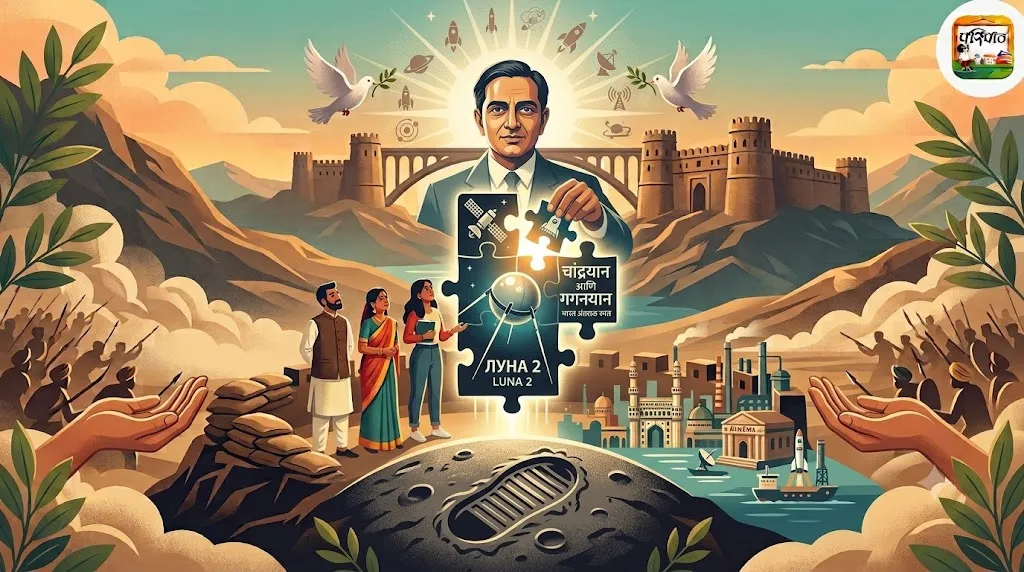
Today, July 27th, we remember and pay tribute to a visionary scientist and India's 11th President, Bharat Ratna Dr. A.P.J. Abdul Kalam, whose passing occurred on this very day. Known as the 'Missile Man of India,' Dr. Kalam's philosophy of 'Dream, Think, Achieve' resonates deeply with the journey of ISRO. It is fitting that on this auspicious day of 'Som Pradosh Vrat,' we delve into the glorious journey of the Indian Space Research Organisation (ISRO). More than just an institution, ISRO embodies the aspirations of millions of Indians, transforming India into a global space power and inspiring a generation to venture into the vast realms of science and technology.
ISRO's journey is not merely a tale of scientific advancement; it is a testament to unwavering determination, relentless innovation, arduous hard work, and profound national pride. From its modest origins in a small church in Thumba, Kerala, this journey has now reached the Moon's south pole. Let us explore ISRO's incredible trajectory and its profound impact on India's youth.
ISRO's Humble Beginnings: A Dream Forged in Determination
In the 1960s, while many developed nations were just taking their first steps in space research, India too dared to dream of its place in the cosmos. This dream was envisioned by Dr. Vikram Sarabhai, the revered father of India's space program. He possessed the foresight to understand that space technology would be crucial for India's development, particularly in education, communication, and natural resource management. His vision laid the cornerstone for India's ambitious space endeavors.
The 'Indian National Committee for Space Research' (INCOSPAR) was established in 1962, which subsequently evolved into the Indian Space Research Organisation (ISRO) on August 15, 1969. In its nascent stages, ISRO operated with extremely limited resources. Its first office was in the St. Mary Magdalene Church in Thumba, Kerala. Rockets parts were transported on bicycles, and equipment on bullock carts to the launch site. These images, though perhaps unbelievable to today's generation, symbolize the humble yet determined foundation upon which India's space program was built.
During these early years, numerous young scientists, including Dr. A.P.J. Abdul Kalam, dedicated themselves tirelessly to the cause. Their unwavering commitment, coupled with the guidance of visionary leaders like Dr. Sarabhai, led to India's first major success. On April 19, 1975, with assistance from the Soviet Union, India successfully launched its first satellite, 'Aryabhata,' into space. This moment was a monumental milestone for India's space program, proving the nation's capability to establish its presence in space.
Facing tight budgets, limited resources, and international technological restrictions, ISRO overcame every obstacle. This beginning was not just about technology; it was about a nation's self-belief and its initial stride towards self-reliance.
Milestones: India's Giant Leaps in Space
Following the success of Aryabhata, India intensified its focus on developing indigenous technology. The first significant fruit of these efforts was the SLV-3 (Satellite Launch Vehicle-3). In 1980, under the leadership of Dr. A.P.J. Abdul Kalam, the team successfully launched the 'Rohini' satellite using the SLV-3. This marked India's first indigenous satellite launch vehicle, granting the nation the capability to send its own satellites into space. This moment truly heralded the beginning of the 'Swadeshi' (self-reliant) revolution in India's space history.
PSLV: The Workhorse of Indian Space
In the 1990s, ISRO developed the Polar Satellite Launch Vehicle (PSLV). This vehicle is famously known as ISRO's 'workhorse' due to its exceptional reliability and cost-effectiveness. The PSLV has successfully completed over 50 missions, launching not only Indian satellites but also numerous foreign satellites into space. In 2017, the PSLV set a world record by launching 104 satellites in a single mission. This vehicle is primarily used for placing Earth Observation, weather forecasting, and remote sensing satellites into polar orbits, which are crucial for agriculture, disaster management, and resource mapping.
GSLV: Reaching for Geostationary Heights
To launch heavier and more complex satellites into geostationary orbit, the Geosynchronous Satellite Launch Vehicle (GSLV) was indispensable. The development of GSLV involved mastering cryogenic engine technology, a highly complex and challenging feat. After persistent efforts, India achieved success in this technology, and now advanced versions like GSLV Mark-II and Mark-III are successfully launching heavy communication satellites and meteorological satellites. These satellites are vital for telecommunications, television broadcasting, and accurate weather forecasting, significantly impacting the lives of ordinary citizens.
The launch vehicle technology developed by ISRO not only fulfills India's needs but also establishes India as a crucial player in the global space market. By launching foreign satellites, India earns significant revenue and demonstrates its technical prowess to the world.
Chandrayaan and Mangalyaan: Scientific Feats and Global Acclaim
The most thrilling and inspiring chapters in ISRO's journey are its interplanetary missions like Chandrayaan and Mangalyaan. These missions not only proved India's scientific capabilities but also captured global attention and brought immense pride to millions of Indians.
Chandrayaan-1: Discovering Water on the Moon
On October 22, 2008, India launched its first lunar probe, Chandrayaan-1. The primary objective of this mission was to study the Moon's surface and create mineralogical maps. Chandrayaan-1 made a historic discovery: it detected water molecules on the lunar surface, a globally significant scientific breakthrough. This discovery greatly enhanced the prospects of future human habitation on the Moon and secured India a prominent position in global space research.
Mangalyaan (Mars Orbiter Mission - MOM): First Attempt Success
One of the most audacious and successful missions in India's space history is the Mars Orbiter Mission (MOM), affectionately known as Mangalyaan. Launched on November 5, 2013, the spacecraft successfully entered Mars' orbit on September 24, 2014. The most remarkable aspect of this mission was that India became the first nation in the world to reach Mars' orbit on its very first attempt. The mission's cost was significantly lower than that of many Hollywood blockbusters, showcasing ISRO's ability to develop high technology at an incredibly low cost. Mangalyaan transmitted crucial data about Mars' surface and atmosphere, enriching our understanding of the Red Planet.
Chandrayaan-2 and Chandrayaan-3: India's Mark on the Lunar South Pole
Launched on July 22, 2019, Chandrayaan-2 was India's first attempt to land on the Moon's south pole. While the orbiter from this mission continues to revolve around the Moon and send valuable data, the lander 'Vikram' and rover 'Pragyan' unfortunately lost communication during the final descent. Though heartbreaking for Indians at the time, ISRO learned valuable lessons from this experience and prepared for its next mission.
Then, on August 23, 2023, India made history! The 'Vikram' lander of the Chandrayaan-3 mission successfully achieved a soft landing on the Moon's south pole, making India the first country in the world to do so. The 'Pragyan' rover explored the lunar surface, making numerous scientific discoveries that significantly advanced our knowledge of the Moon. This mission was not just a scientific triumph; it was a moment of immense pride and jubilation for millions of Indians. It demonstrated that with perseverance and the will to learn from failures, no goal is impossible.
These missions have generated immense excitement among Indian students about science and technology. When they gaze at the night sky now, they don't just see stars; they remember their 'Pragyan' roaming the Moon and their 'Mangalyaan' orbiting Mars. This is the true reward of these successes – inspiring the young generation to dream big and pursue those dreams.
Inspiring the Youth: Limitless Opportunities in Space
ISRO's success is not merely a scientific accomplishment; it is a dream, an inspiration for millions of Indians. The life of great scientists like Dr. A.P.J. Abdul Kalam and the achievements of ISRO encourage students to pursue careers in Science, Technology, Engineering, and Mathematics (STEM).
From carrying rocket parts on bicycles in its early days to landing on the Moon's south pole, ISRO's journey demonstrates that with determination, hard work, and a spirit of innovation, nothing is impossible. ISRO's successes have ignited interest in space science, astronomy, and engineering among countless students. They now not only dream of becoming doctors or engineers but also aspire to become scientists at ISRO and create new history for India in space.
Careers in Science and Technology
- Scientists and Engineers: ISRO offers immense opportunities for aerospace engineers, electronics engineers, mechanical engineers, computer scientists, physicists, and chemists.
- Data Analysts: With the vast amount of data pouring in from satellites, the demand for data scientists is growing exponentially.
- Robotics and Artificial Intelligence: The use of robotics and AI in space missions is increasing, creating significant demand for experts in these fields.
- Researchers and Academics: The role of researchers and academics is crucial in imparting knowledge of space science and technology and nurturing the next generation.
India's future in space holds boundless opportunities. Space tourism, small satellite development, space mining, interplanetary travel, and establishing human habitats in space are future objectives. All these areas will require a vast pool of young scientists and engineers. ISRO has also implemented several educational initiatives, such as the 'Young Scientist Programme' (YUVIKA), which encourages students to develop an interest in space science from an early age.
Marching Towards the Future: ISRO's Next Goals
ISRO's journey doesn't stop here. India has charted ambitious plans to further solidify its position in space. These future objectives will not only brighten India's space future but also create new opportunities for the youth.
1. Gaganyaan: India's Human Spaceflight Mission
ISRO's most prestigious upcoming mission is Gaganyaan. Under this mission, India aims to send its own astronauts (Gaganauts) into space. This mission will place India among an elite group of nations capable of human spaceflight. Training for Gaganyaan astronauts has already begun, and this mission promises a major revolution in India's space technology.
2. Shukrayaan-1: Exploring Venus
After Mars, ISRO's next interplanetary target is the study of Venus. The Shukrayaan-1 mission will involve an orbiter studying Venus's atmosphere and surface. Venus is often considered Earth's twin, yet its environment is vastly different. Studying Venus could provide new insights into the origin and evolution of planets in our solar system.
3. Aditya L1: Unveiling the Sun's Secrets
ISRO has successfully launched Aditya L1, India's first dedicated solar observatory. This satellite will study the Sun's outer atmosphere (corona) and solar storms, providing crucial information about their impact on Earth's climate and satellite communications. Solar studies are a vital area in space science.
4. Next Generation Launch Vehicle (NGLV)
ISRO is developing the Next Generation Launch Vehicle (NGLV) to meet future demands. This vehicle will be more efficient, cost-effective, and reusable, making access to space easier and more affordable.
5. Private Sector Participation
ISRO is now actively encouraging private companies to participate in the space sector. Through organizations like IN-SPACe and NewSpace India Limited (NSIL), private firms are getting opportunities to develop satellites and launch vehicles. This initiative will inject new momentum into India's space sector and create fresh employment opportunities.
Did You Know?
- ISRO operates on a budget significantly smaller than many other global space agencies, yet its achievements are monumental. Its ability to develop high technology at low cost is globally acclaimed.
- India has successfully launched satellites for over 40 different countries, establishing itself as a key player in the global space market.
- ISRO's headquarters are located in Bengaluru, where much of its critical research and development work takes place.
- ISRO developed the 'INSAT' series for satellite communication and the 'IRS' series for Earth observation, which are extensively used for telecommunications, weather forecasting, and disaster management.
- Dr. Vikram Sarabhai, the father of India's space program, established the 'Indian National Committee for Space Research' (INCOSPAR) in 1962, which later became ISRO on August 15, 1969.
ISRO's journey is not just about scientific progress; it is about determination, innovation, and national pride. Fulfilling the dreams of visionaries like Dr. A.P.J. Abdul Kalam, ISRO has secured a significant global position for India. The journey from carrying rocket parts on bicycles to sending humans into space is a testament to ISRO's indomitable spirit.
Young students should draw inspiration from these successes and build their future in the fields of science and technology. ISRO has shown that even with limited resources, if dreams are big and efforts are sincere, nothing is impossible. On this auspicious day of 'Som Pradosh Vrat,' let us pledge to work hard like ISRO's scientists and contribute to the nation's development. “Dream, strive, and the sky is not the limit for you!” – this is the profound lesson ISRO's success teaches us.