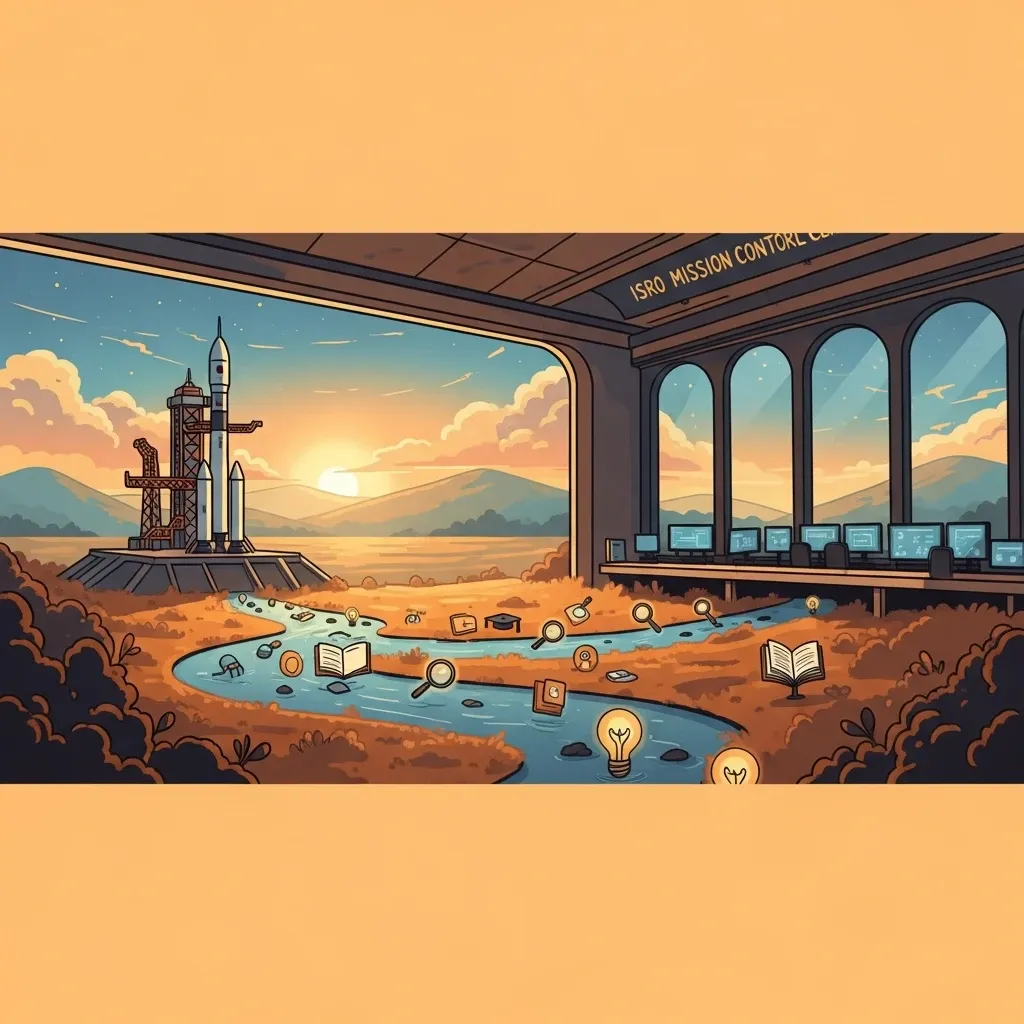
Ignition: The Power of Precision
Imagine the tension at the Satish Dhawan Space Centre in Sriharikota. The mission: Gaganyaan. Thousands of components must work in perfect harmony. A single millisecond of delay or a loose bolt could mean the difference between a historical triumph and a catastrophic failure. Now, transpose this intensity to your 2026-27 academic goals. Your final exams are your 'Launch Window'. To succeed, you don't just need to study; you need a Mission Control Strategy.
The 'Launch Window' Philosophy
In orbital mechanics, a launch window is the specific period during which a spacecraft must be launched to reach its intended target. If ISRO misses the window for Mars, they might have to wait years. Your exams have a fixed 'Launch Window'.
Identifying Your Critical Window
For students appearing for the 2026 boards or competitive exams like JEE/NEET, the window isn't the exam day; it's the 12 weeks leading up to it. Understanding this helps in prioritizing 'Mission Critical' tasks over 'Non-Essential' ones.
Phase 1: Pre-Flight Integration (The Syllabus)
Before a rocket reaches the pad, it undergoes integration. Every stage is checked. You must treat your subjects as stages of a launch vehicle.
- Stage 1 (Solid): Core concepts that provide the initial thrust (Mathematics/Logic).
- Stage 2 (Liquid): Flexible subjects requiring deep understanding (Science/Philosophy).
- Stage 3 (Cryogenic): High-scoring, complex topics that need cold, calculated precision (Language/Advanced Theory).
| Mission Phase | Student Equivalence | Checklist Item |
|---|---|---|
| Design Review | Syllabus Analysis | Map every chapter to weightage. |
| Component Testing | Topic-wise Quizzes | Solve 50 MCQs per sub-topic. |
| Fueling | Resource Gathering | Collect NCERT, Reference books, and PYQs. |
The T-Minus Countdown Protocol
As we approach 2026, your schedule should mirror a NASA or ISRO countdown. This eliminates 'Decision Fatigue'.
T-Minus 6 Months: Structural Integrity
Ensure 80% of the syllabus is covered. This is the 'Assembly' phase. No new major topics should be started after this.
T-Minus 3 Months: Systems Check
Weekly full-length mock exams. This mimics the 'Vibration and Thermal' testing of satellites. If you break here, it's better than breaking on the launch pad.
T-Minus 30 Days: The Final Countdown
Daily revision. No new information. Just refining the trajectory.
[accordion title="What to do during a 'Hold' in the Countdown?"]A 'Hold' happens when something goes wrong. If you fall ill or feel burnt out, do not panic. Like ISRO, you trigger a 'safe mode'. Focus on light reading and sleep. Once the 'fault' is cleared, resume from the last stable point.[/accordion]Building Your Mission Control Center (MCC)
ISRO doesn't launch rockets from a coffee shop. They have a dedicated MCC. Your study desk is your MCC. It must be optimized for peak performance.
- Clean Desk Policy
- Only the books for the current 'Mission' (subject) should be present.
- Telemetry
- Track your progress using charts. If your mock scores are dipping, your 'trajectory' is off.
- Red-Line Parameters
- Define your limits. If you sleep less than 6 hours, your 'Mission' is at risk of human error.
"Thinking should become your capital asset, no matter whatever ups and downs you come across in your life." - Dr. A.P.J. Abdul Kalam
Conclusion: The Orbit of Success
When the Gaganyaan astronauts reach orbit in 2026, it won't be luck. It will be the result of a thousand checklists. By adopting the ISRO 'Mission Control' strategy, you turn your preparation into a scientific process. The pressure won't crush you; it will propel you.