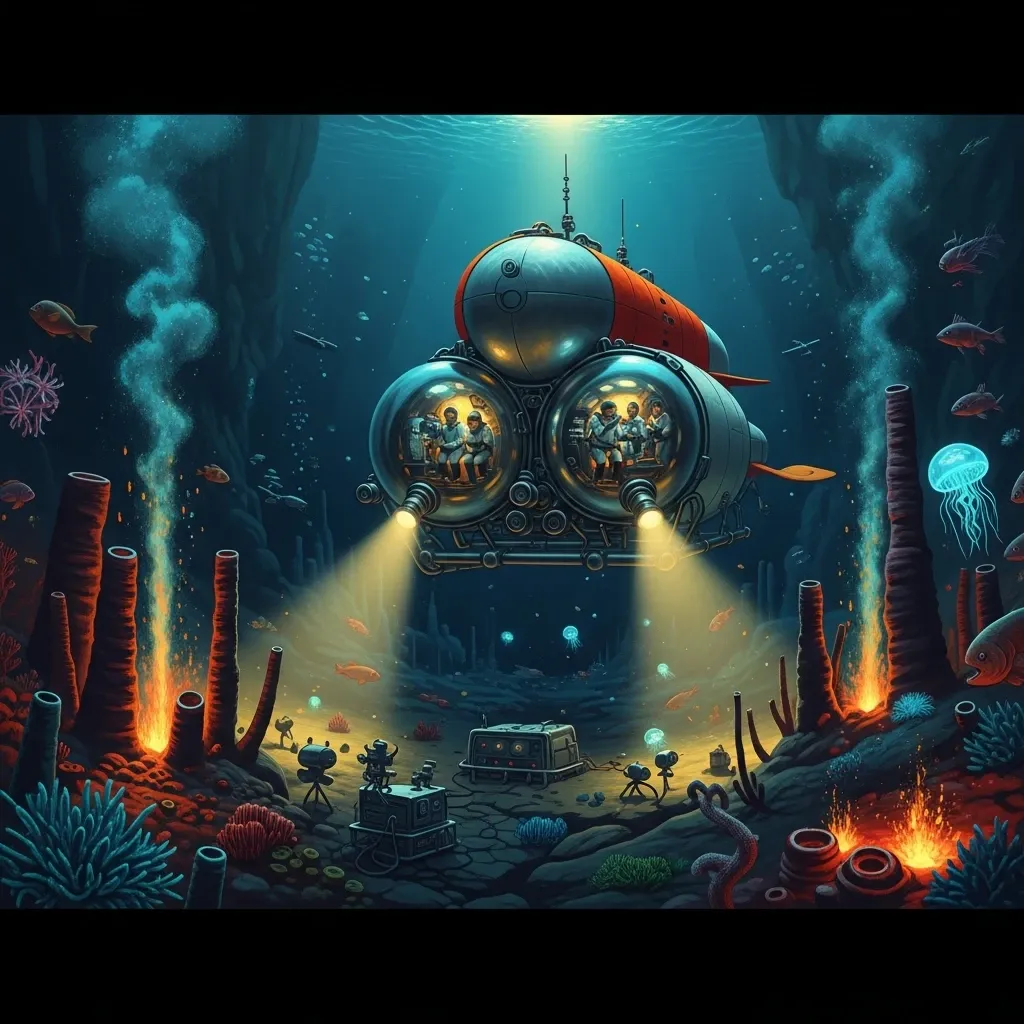
Introduction: Venturing into the Unknown Abyss
While the world looks up at the stars and tracks the progress of Gaganyaan, India is quietly preparing for a mission that is equally, if not more, challenging: a journey to the bottom of the ocean. Known as the Samudrayaan Mission, this project aims to send humans 6,000 meters deep into the Indian Ocean using a specialized submersible called Matsya-6000. This is not just a scientific expedition; it is India's claim to the 'Inner Space' race.
Historical Context: The Deep Ocean Mission (DOM)
The Samudrayaan mission is the flagship project of India's Deep Ocean Mission, sanctioned by the Ministry of Earth Sciences. Historically, deep-sea exploration was the playground of only a few elite nations. India's entry into this club signifies its growing technological prowess. In the late 20th century, the United Nations International Seabed Authority (ISA) allocated India an area in the Central Indian Ocean Basin (CIOB) for exploring Polymetallic Nodules. This mandate laid the groundwork for what would eventually become the Matsya-6000 project.
Why 6,000 Meters?
At 6,000 meters, we reach the 'Abyssal Plains.' This depth is crucial because most of the valuable mineral resources, such as manganese, nickel, cobalt, and copper, are found at these levels. Engineering a vessel to survive here is a monumental task.
The Engineering Marvel: Matsya-6000
The Matsya-6000 is a Manned Submersible developed by the National Institute of Ocean Technology (NIOT), Chennai. Unlike a submarine, which has immense power and can stay underwater for months, a submersible is smaller, has limited power, and requires a mother ship for launch and recovery.
Technical Specifications
| Feature | Specification |
|---|---|
| Maximum Depth | 6,000 Meters |
| Personnel Capacity | 3 (1 Pilot + 2 Scientists) |
| Endurance | 12 Hours (Normal) / 96 Hours (Emergency) |
| Material | Titanium Alloy (80mm thickness) |
| Sphere Diameter | 2.1 Meters |
The Physics of Extreme Pressure
At 6,000 meters depth, the pressure is approximately 600 times the atmospheric pressure at sea level. This is equivalent to having an elephant stand on your thumb for every square centimeter of the submersible's surface. To counter this, NIOT engineers utilized a Titanium Alloy sphere. Titanium offers a high strength-to-weight ratio and is highly resistant to the corrosive nature of seawater.
Scientific Objectives: The Blue Economy
India's mission isn't just about exploration; it's about the Blue Economy. The deep sea holds the key to the future of energy and technology.
"The ocean is the world's last great frontier. By mastering the depths, India ensures its self-reliance in critical minerals and environmental monitoring." – Ministry of Earth Sciences Report
Comparison with Global Missions
India is joining an elite group of nations with manned deep-sea capabilities. Let's look at how Matsya-6000 compares with its global peers:
- USA (Alvin): Capable of 4,500m to 6,500m.
- China (Fendouzhe): Reached the Mariana Trench (11,000m).
- Japan (Shinkai 6500): A veteran in deep-sea research.
- Russia (Mir I & II): Used for exploring the Titanic and North Pole.
Student Trivia and FAQ
[accordion title="Why is it named 'Matsya'?"]The name 'Matsya' refers to the first avatar of Lord Vishnu in Indian mythology, which was a fish that saved the world from a great flood.[/accordion]Conclusion: A New Horizon
The success of the Matsya-6000 and the Samudrayaan mission will place India at the forefront of maritime science. For students interested in STEM, this field offers a blend of Mechanical Engineering, Marine Biology, and Geology. As we move towards 2030, the deep ocean will no longer be a silent, dark void but a vibrant laboratory for Indian innovation.