Introduction: India's Unforgettable Saga in Space
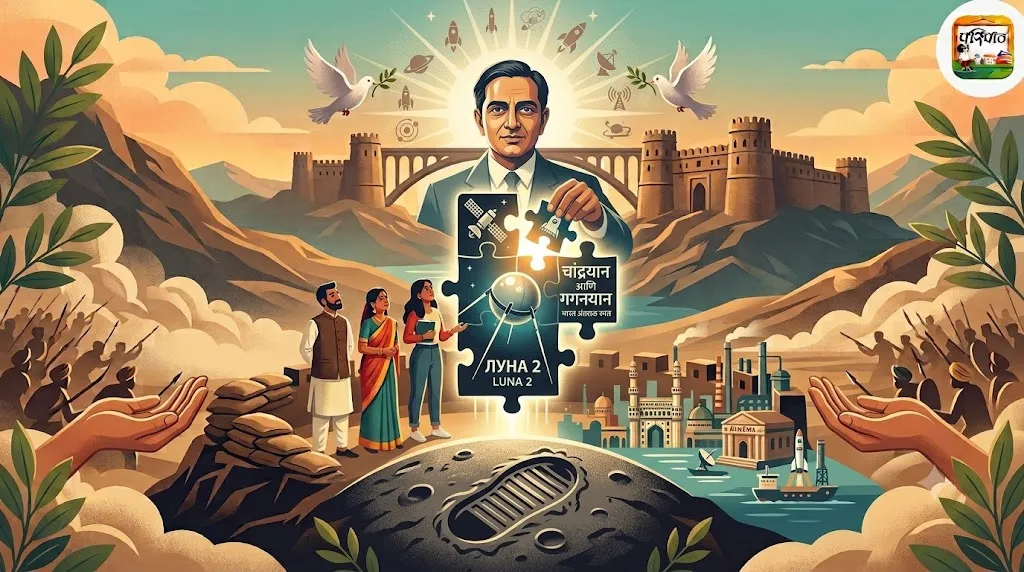
Dear students and readers, India's journey in space exploration is not merely a chronicle of scientific advancement; it is an inspiring saga of determination, foresight, and relentless effort. Within a few decades of gaining independence, India launched itself into space, setting an example for the world. Despite facing numerous socio-economic challenges, India carved its niche in this highly ambitious scientific domain. From its first satellite, Aryabhata, to the historic Chandrayaan-3 lunar mission, India's achievements in space symbolize the brilliance of its scientists and its national aspiration. Today, let us delve into this incredible space odyssey of India, a journey that will ignite your passion for science and fill you with pride for our nation's accomplishments.
The Genesis: Aryabhata and the Birth of ISRO
India's space journey truly began with the visionary leadership of Dr. Vikram Sarabhai, widely regarded as the father of the Indian Space Program. In the 1960s, when India was grappling with many fundamental issues, Dr. Sarabhai recognized the profound importance of space technology. He was convinced that space technology would be crucial for India's development, especially in communication, weather forecasting, and natural resource management.
Driven by his foresight, the Indian Space Research Organisation (ISRO) was established on August 15, 1969. Initially, rocket launches were conducted from a small church in Thumba, Kerala. Rocket parts were transported on bicycles, and work began with simple means, laying the foundation for India's ambitious space endeavors.
On April 19, 1975, India launched its first satellite, 'Aryabhata,' with the assistance of the Soviet Union. This marked a historic milestone in India's space program. Although launched from foreign soil, its design and fabrication were entirely indigenous. Aryabhata placed India on the global space map and heralded future great successes.
Following this, India focused on developing its own launch vehicles. Under the leadership of Dr. A. P. J. Abdul Kalam, the Satellite Launch Vehicle-3 (SLV-3) was developed. On July 18, 1980, SLV-3 successfully launched the Rohini satellite, making India the sixth nation in the world to launch its own satellite from its own soil. This moment was a significant step towards India's self-reliance in space technology.
Dr. Vikram Sarabhai's Vision: “There are some who question the relevance of space activities in a developing nation. To us, there is no ambiguity of purpose. We do not have the fantasy of competing with the economically advanced nations in the exploration of the Moon or the planets or manned spaceflight. But we are convinced that if we are to play a meaningful role nationally, and in the comity of nations, we must be second to none in the application of advanced technologies to the real problems of man and society.”
Expanding Horizons: Satellite Revolution and Diverse Missions
After the success of Aryabhata and Rohini, India emphasized utilizing space technology for its national development. This led to the development of two crucial satellite systems: INSAT (Indian National Satellite System) and IRS (Indian Remote Sensing Satellite System).
- INSAT Series: Initiated in the 1980s, this series proved vital for telecommunication, television broadcasting, and weather forecasting. It extended TV and telephone services to remote areas, accelerating the country's social and economic development.
- IRS Series: These satellites provided India with valuable information for natural resource management, agriculture, forestry, water resource planning, and urban development. Remote sensing technology significantly aided disaster management and environmental monitoring.
Behind these successes lies the significant contribution of two powerful launch vehicles: PSLV (Polar Satellite Launch Vehicle) and GSLV (Geosynchronous Satellite Launch Vehicle). PSLV is known as ISRO's 'workhorse,' having executed numerous successful missions. GSLV provided India with the capability to launch heavier satellites into geosynchronous orbit, significantly boosting communication satellite deployment.
Did You Know?
ISRO has earned billions by launching satellites for other countries. The PSLV is considered one of the most reliable launch vehicles globally, boasting a high success rate.
Martian Triumph: India's Interplanetary Leap with MOM
One of the most thrilling and historic chapters in India's space journey is the Mars Orbiter Mission (MOM), also known as Mangalyaan. Launched on November 5, 2013, Mangalyaan successfully entered Mars' orbit on September 24, 2014. With this achievement, India set several records:
- It became the first Asian nation to reach Mars.
- It was the fourth entity globally (after the USA, Russia, and the European Space Agency) to reach Mars.
- It became the first nation in the world to reach Mars' orbit in its maiden attempt.
- It accomplished this mission at the lowest cost (approximately 450 crore rupees or about $73 million USD).
The Mangalyaan mission not only provided scientific data but also demonstrated India's technological prowess and its ability to conduct cost-effective space missions to the world. This mission captivated the younger generation, drawing them towards science and bolstering national pride.
Lunar Chronicles: Chandrayaan's Journey to the Moon
Stepping on the Moon has been an ancient human dream, and India has relentlessly pursued this dream. The Chandrayaan series is a testament to this pursuit.
Chandrayaan-1: Unveiling Lunar Water
On October 22, 2008, India launched its first lunar mission, Chandrayaan-1. The most significant achievement of this mission was the discovery of water molecules on the lunar surface by its instruments. This finding opened new possibilities for future human habitation and research on the Moon. Chandrayaan-1 gathered significant data for studying the lunar surface.
Chandrayaan-2: The Quest for the Lunar South Pole
Chandrayaan-2 was launched on July 22, 2019. The mission aimed to land a module named 'Vikram' on the Moon's south pole and deploy a rover named 'Pragyan' to study the lunar soil and minerals. Unfortunately, in the final stages of landing, communication with the lander was lost, and it crash-landed. While the mission was not a complete success, Chandrayaan-2's orbiter continues to orbit the Moon, sending back crucial data. This mission provided India with valuable lessons in landing technology.
Chandrayaan-3: India's Historic Soft Landing on the Moon
Launched on July 14, 2023, Chandrayaan-3 marked a golden moment in India's space journey. On August 23, 2023, the 'Vikram' lander successfully executed a 'soft landing' near the Moon's south pole. With this success, India became the fourth nation globally to achieve a soft landing on the Moon and the first nation to successfully land near the Moon's south pole. The 'Pragyan' rover explored the lunar surface, conducting numerous scientific experiments and transmitting valuable information back to Earth.
The success of Chandrayaan-3 was not just a scientific triumph; it was a moment of immense pride and inspiration for billions of Indians. This mission solidified India's technological capabilities on a global stage.
Gaganyaan and Future Plans: Human Spaceflight
India's space program aspirations are not limited to satellite launches and lunar-Mars missions. India has now taken a significant step towards human spaceflight with the Gaganyaan mission.
The objective of the Gaganyaan mission is to send Indian astronauts (Vyomnauts) into Low Earth Orbit, keep them in space for a short duration, and bring them back safely to Earth. If successful, India will become the fourth nation in the world with human spaceflight capabilities. ISRO is working on astronaut training, developing new technologies, and ensuring safety for this mission.
Furthermore, ISRO is planning future missions to study Venus and the Sun. Missions like Shukrayaan (Venus Orbiter Mission) and Aditya-L1 (Solar Mission) will further expand the horizons of India's space research.
Inspiration and National Pride: A Bright Future
India's space journey is not just evidence of scientific and technological progress; it is a symbol of our nation's confidence and foresight. These missions have captivated millions of Indians, especially young students, drawing them towards science. The message gleaned from these successes is that 'nothing is impossible.'
Space technology is not limited to rockets and satellites; it benefits our daily lives in numerous ways. Weather forecasting, GPS navigation, mobile communication, television, and internet services are all made possible by space technology. By achieving self-reliance in this field, India has not only fostered its own development but has also assisted other nations globally.
The country that once used bicycles to transport simple rocket parts has today landed its spacecraft on the Moon's south pole. This journey tells us that with the right direction, relentless effort, and strong willpower, nothing is impossible. India's space program guarantees a bright future for our nation and inspires future generations to dream big in the field of science.
Did You Know?
- Dr. Vikram Sarabhai requested the local bishop to establish the first rocket launching station in Thumba, Kerala, because the location near the equator was ideal for rocket launches.
- The cost of India's 'Mangalyaan' mission was less than the production cost of the Hollywood movie 'Gravity.'
- ISRO created a world record by launching 104 satellites in a single mission (via PSLV-C37 on February 15, 2017).
- Kalpana Chawla, the first Indian-origin woman in space, flew with NASA, the American space agency.
- Rakesh Sharma, India's first cosmonaut, traveled to space aboard a Soviet spacecraft in 1984.
Conclusion
From the initial leap of Aryabhata to the historic soft landing of Chandrayaan-3, India's space journey is a prime example of courage, intellect, and national ambition. It is not just a victory of science but also a triumph of the human spirit and the 'Make in India' ethos. These successes have not only made us technologically advanced but have also elevated India's image on the global stage. As the next generation, we must preserve this legacy and be inspired to delve deeper into the vast ocean of science, discovering new frontiers. India's space odyssey is far from over; it is merely the beginning of a new chapter where even greater achievements await us in the future.