Hello students and esteemed parents!
Today, we embark on a fascinating journey—India's Space Odyssey! Imagine, thousands of years ago, our ancestors gazing at the stars, deciphering celestial movements, and today, we are sending spacecraft to the Moon and Mars. This journey is not just about science; it's about our unwavering determination, tireless hard work, and the belief that 'nothing is impossible.' From Aryabhata's ancient astronomical wisdom to ISRO's modern Chandrayaan missions, let's explore how India soared into space, a remarkable blend of science and dreams.
Ancient India's Celestial Insights: The Dawn of Astronomy
India's space journey is deeply rooted in its ancient past. Thousands of years ago, when many civilizations were still in their infancy regarding astronomy, Indian scholars had already amassed profound knowledge of planets and stars. This knowledge wasn't merely theoretical; it was based on meticulous observation, complex mathematics, and logical reasoning.
- Aryabhata (476 – 550 CE): Regarded as the father of Indian astronomy, Aryabhata is a towering figure in this tradition. His treatise, 'Aryabhatiya,' described the Earth's rotation on its axis, explained lunar and solar eclipses, and provided accurate calculations for planetary motions. His ideas, suggesting that planets revolve around the Sun, resonate with modern heliocentric models.
- Varahamihira (505 – 587 CE): Through his work 'Brihat Samhita,' he presented astonishing knowledge of astronomy, meteorology, and astrology.
- Brahmagupta (598 – 668 CE): He elucidated the concept of zero in mathematics, which became crucial for astronomical calculations.
- Bhaskara II (1114 – 1185 CE): His 'Siddhanta Shiromani' provided detailed information on planetary motions, positions, and orbits. He also laid down some fundamental principles related to gravity.
This ancient knowledge was not confined to texts; it was an integral part of life. Even today, our festivals and auspicious dates are determined using the Panchang (Hindu calendar), which is based on these ancient astronomical calculations. It's fair to say that this rich legacy laid the groundwork for modern India's space program.
ISRO's Genesis and Early Steps: Planting the Seeds of Dreams
After gaining independence, India was committed to advancing in science and technology. This visionary outlook led to the inception of India's space program, largely credited to the foresight of Dr. Vikram Sarabhai.
- Dr. Vikram Sarabhai: He is widely considered the father of the Indian Space Program. He firmly believed that 'if India is to play a meaningful role nationally, and in the comity of nations, we must be second to none in the application of advanced technologies to the real problems of man and society.' He envisioned space technology not just for scientific research but for communication, weather forecasting, education, and agriculture.
- Establishment of INCOSPAR (1962): Under Dr. Sarabhai's leadership, the 'Indian National Committee for Space Research' (INCOSPAR) was established. This committee initiated rocket launches from the Thumba Equatorial Rocket Launching Station (TERLS) with the help of the USA's 'Nike-Apache' rocket.
- Formation of ISRO (1969): INCOSPAR was transformed into the 'Indian Space Research Organisation' (ISRO) in 1969, marking a significant acceleration in India's space journey.
In its early days, ISRO operated with limited resources. Rocket components were transported on bicycles, and satellites were carried on bullock carts. Overcoming these challenges, dedicated scientists worked tirelessly, leading to the launch of India's first satellite, 'Aryabhata,' in 1975, with the assistance of the Soviet Union. This was a historic step in India's space history.
Subsequently, India set its sights on developing its own Satellite Launch Vehicle (SLV-3). Dr. A.P.J. Abdul Kalam, the great scientist and former President of India, played a pivotal role in this endeavor. Under his leadership, the SLV-3 successfully launched the 'Rohini' satellite in 1980. This achievement placed India among the select few nations with indigenous satellite launch capabilities.
India's Major Space Missions: Soaring Towards Success
Over the past few decades, ISRO has successfully executed numerous ambitious missions, etching India's name on the global map of space exploration.
1. Satellite Launches and Communication Revolution (INSAT and IRS)
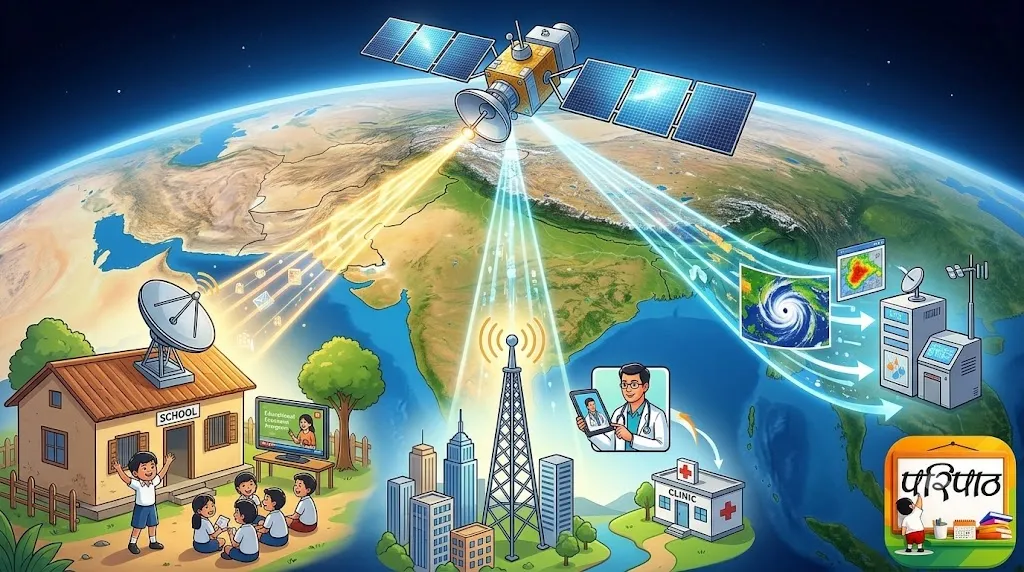
A prime example of how space technology impacts our daily lives is ISRO's INSAT (Indian National Satellite System) and IRS (Indian Remote Sensing Satellite) series.
- INSAT Series: Initiated in the 1980s, this series has been crucial for telecommunications, television broadcasting, weather forecasting, and emergency communication. It's why we can watch TV, make mobile calls, and receive accurate weather updates today.
- IRS Series: These satellites provide detailed information about Earth's surface. They play a vital role in agricultural management, water resource planning, deforestation monitoring, urban planning, and natural disaster management.
2. Chandrayaan Missions: India's Footprints on the Moon
Reaching the Moon is a dream for every space agency. India not only dreamed it but achieved it.
- Chandrayaan-1 (2008): India's first lunar mission. It famously discovered the presence of water molecules on the Moon's surface, a groundbreaking finding for the global scientific community. India hoisted its flag on the Moon, establishing its position in international space research.
- Chandrayaan-2 (2019): This mission included an orbiter, a lander (Vikram), and a rover (Pragyan). Although the lander's soft-landing attempt was unsuccessful, the orbiter continues to orbit the Moon, sending back valuable data. The experience gained from this mission was instrumental in the success of Chandrayaan-3.
- Chandrayaan-3 (2023): This mission is etched in golden letters in India's space history. On August 23, 2023, the 'Vikram' lander successfully performed a 'soft landing' near the Moon's south pole, and the 'Pragyan' rover explored the lunar surface, conducting various scientific experiments. India became the first country in the world to successfully land near the Moon's south pole and the fourth country overall to achieve a soft landing on the Moon. This success filled every Indian heart with immense pride.
3. Mangalyaan Mission (MOM): India's Historic Leap to Mars
Following the Moon, India set its sights on Mars. Launched in 2013, the Mars Orbiter Mission (MOM), or Mangalyaan, proved to be a milestone in India's space history.
- Historic Achievement: India became the first nation in the world to successfully send a mission to Mars on its very first attempt. It also became the first Asian nation and the fourth globally to achieve this feat.
- Cost-Effective Mission: The Mangalyaan mission was one of the most economical Mars missions globally, costing less than a major Hollywood film! This showcased India's capability to achieve significant success with limited resources, often termed 'frugal engineering.'
4. Aditya-L1 Mission: Studying the Sun
After the Moon and Mars, India has now turned its attention to the Sun. Launched in 2023, Aditya-L1 is India's first solar observatory mission. This spacecraft is positioned at the 'Lagrange Point 1' (L1), approximately 1.5 million kilometers from Earth. From this vantage point, it will study the Sun's outer atmosphere, solar storms, and their effects on Earth. This mission will provide invaluable insights into the Sun and its dynamic activities.
5. Gaganyaan Mission: Human Spaceflight
One of India's most ambitious upcoming missions is Gaganyaan. Through this mission, India aims to send Indian astronauts into space aboard an indigenous spacecraft. This achievement will place India among the select few nations capable of conducting human spaceflight missions.
The Heroes Behind the Success: Our Scientists
The monumental success of India's space program is not solely due to technology but is a result of the relentless hard work, intellect, and dedication of thousands of scientists, engineers, and staff. Visionaries like Dr. Vikram Sarabhai, Dr. Satish Dhawan, Dr. A.P.J. Abdul Kalam, K. Sivan, and S. Somanath have guided this program. Beyond these luminaries, countless unsung heroes have worked day and night to turn these dreams into reality.
- Team Power: Everyone working at ISRO is part of a larger team. From the conceptualization of a satellite to its launch, hundreds of people from various departments collaborate seamlessly.
- Contribution of Women Scientists: Many women scientists have played crucial roles in missions like Chandrayaan and Mangalyaan. Women like M. Vanitha, Ritu Karidhal, and Nigar Shaji have led these missions, serving as great inspirations for girls across the nation.
- Overcoming Challenges: There were failures and technical glitches, but our scientists never gave up. Learning from every setback, they pushed forward with renewed vigor and ultimately achieved success.
The success of India's space program is an excellent example of the 'Make in India' and 'Atmanirbhar Bharat' (Self-Reliant India) initiatives. We have established our global standing through our own efforts, relying on indigenous technology and expertise.
National Pride and Inspiration for Students
The success of India's space program is not just a scientific triumph; it is a source of immense pride and inspiration for every Indian. When Chandrayaan-3 landed on the Moon, millions of Indians watched that moment on television, their eyes welling up with tears of joy. This success reminds us of our capabilities and elevates India's image on the world stage.
Dear students, this success encourages you to dream big and work towards achieving those dreams. ISRO's achievements inspire many students to pursue careers in Science, Technology, Engineering, and Mathematics (STEM) fields. You are the future scientists, engineers, and researchers. Some of you will undoubtedly take India to even greater heights in space.
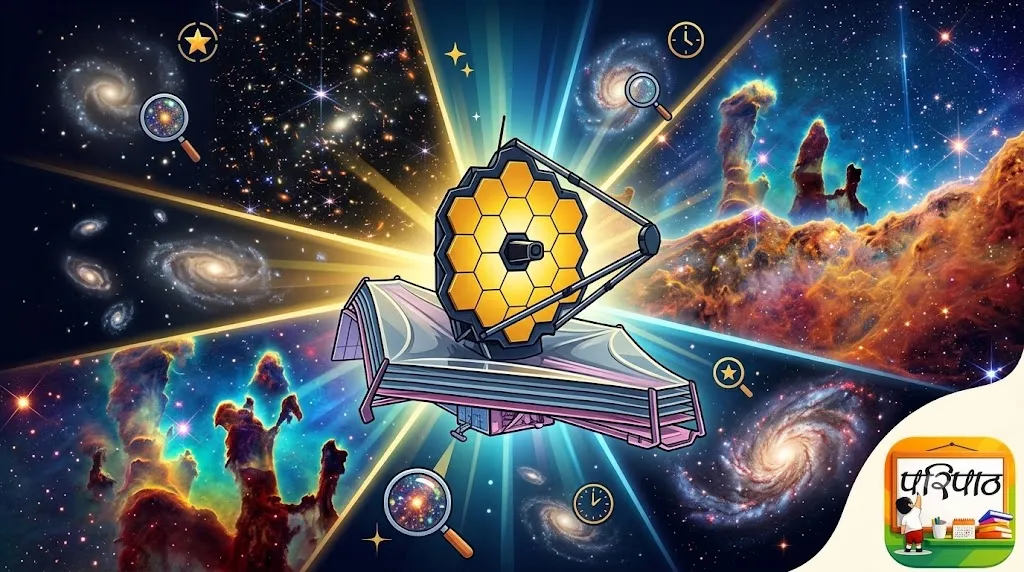
As we reflect on this journey today, July 12, 2026, we remember events like World Paper Bag Day, Masik Shivratri, and the day the James Webb Telescope sent its first images. Just as the James Webb Telescope revolutionized astronomy by capturing distant stars, our scientists continue to make new discoveries, propelling India forward. Like Mithali Raj set a world record in cricket, and legends like Pran and Dara Singh made their mark in their respective fields, our space scientists have brought global recognition to India.
Conclusion
From the ancient wisdom of Aryabhata to the modern triumphs of Chandrayaan-3, India's space journey is truly inspiring. This journey teaches us that with determination, hard work, and collective effort, nothing is impossible. ISRO has not only launched satellites and spacecraft but has also sown seeds of hope and dreams in the hearts of millions of Indians.
Moving forward, India will continue to set new benchmarks in space. Missions like Gaganyaan, Shukrayaan (Venus orbiter), and many future endeavors will solidify India's position as a global space superpower. Let's draw inspiration from this incredible journey, set ambitious goals in our own lives, and strive tirelessly to achieve them! Jai Hind!
Did You Know?
- In 1981, India launched its first indigenous communication satellite, 'APPLE' (Ariane Passenger Payload Experiment), which was transported to the launch site on a bullock cart!
- ISRO set a world record by launching 104 satellites in a single mission (PSLV-C37, 2017), including many foreign satellites.
- The cost of the Mangalyaan mission (approximately ₹450 crores) was less than that of a famous Hollywood movie (e.g., 'Gravity')!
- India has its own regional navigation satellite system called 'NaVIC' (Navigation with Indian Constellation), which functions similarly to America's GPS system.
- India is the first country in the world to land on the Moon's South Pole with Chandrayaan-3, a region considered highly significant scientifically.