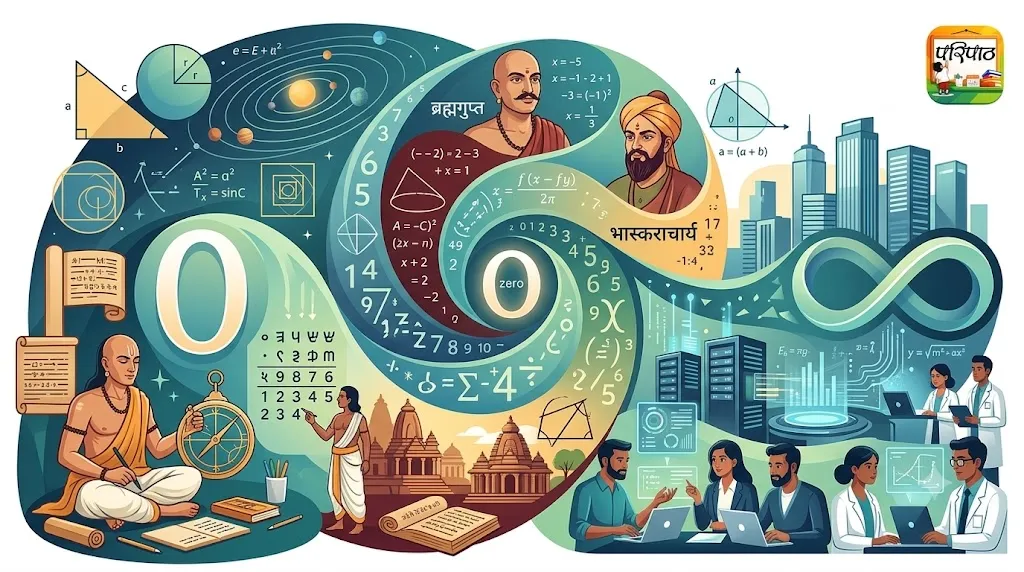
Hello students and esteemed educators! Welcome to this special blog from Paripath. Today, we embark on an exciting journey through the world of mathematics, where numbers, calculations, and abstract concepts have given the world a new direction. This is a journey through the history of mathematics, and India's contribution to it is invaluable. We will explore in detail how India achieved significant milestones in the development of mathematics, from the concept of Zero to the understanding of Infinity.
Mathematics is not just about calculations; it's a powerful tool for unraveling the mysteries of the universe. Ancient India brought about many revolutions in this wonderful world of mathematics. Our ancestors gave us the concept of zero, developed the decimal system, laid down the rules of algebra, and gave new dimensions to trigonometry. These gifts not only benefited India but also paved the way for scientific and technological progress for the entire world.
The Revolutionary Zero: A Concept That Changed Everything
Today, the concept of Zero seems very simple and natural to us. But imagine how difficult it was to count numbers and represent large figures before the discovery of zero! Zero brought about a revolution in mathematics, making the number system more efficient and flexible.
The Concept and Significance of Zero
The word 'Zero' (Shunya in Sanskrit) means 'nothing' or 'empty'. But in mathematics, zero not only represents 'nothing' but also acts as a 'placeholder'. For example, in the number 105, the zero in the 'tens' place clarifies the difference between 'units' and 'hundreds'. Without zero, it would have been very difficult to distinguish between numbers like 105 and 15.
The earliest known use of zero as a placeholder can be traced back to the 3rd century BCE in India, by the sage Pingala in his 'Chandashastra', where he used it in a binary system. However, it was the great mathematician Brahmagupta, in 628 CE, who formally defined zero as a number and established rules for its operations in his treatise 'Brahmasphutasiddhanta'. Brahmagupta laid down rules for addition, subtraction, and multiplication involving zero. He also contemplated division by zero, although its complete explanation was provided by later mathematicians.
Brahmagupta accepted zero as a full-fledged number and laid down its rules. He stated that 'zero plus zero is zero, zero minus zero leaves zero, and zero multiplied by any number is zero.'
Zero's Contribution to the Positional Value System
The discovery of zero made the Positional Value System more effective. In this system, the value of a digit depends on its position. For example, in the number 555, each digit 5 has a different value (units, tens, hundreds). Zero allows these positions to be easily represented, making it simple to write and read large numbers. This revolution enabled the development of the binary system (0 and 1) used in computers today, and many other advanced mathematical concepts.
The Power of the Decimal System and Place Value
Along with zero, ancient India's second greatest gift to the world is the 'Decimal System'. The number system we use today is based on the decimal system, which uses ten digits from 0 to 9.
Origin and Features of the Decimal System
The decimal system originated in India and has been in use for thousands of years. Its main feature is 'Place Value'. The value of each digit depends on the position it occupies. For example, in the number 789, 9 represents units, 8 represents tens, and 7 represents hundreds. This system is so convenient that it can easily represent large numbers and helps in performing any calculation quickly.
The use of the decimal system made it much easier to handle fractions and decimals. This allowed for accuracy in trade, astronomy, and engineering. This system reached the Middle East through Arab traders and then spread to Europe, where it became known as the 'Hindu-Arabic numeral system'. Today, this very system is used worldwide.
Algebra and Arithmetic: The Indian Roots
Arithmetic involves fundamental operations like addition, subtraction, multiplication, and division of numbers. Algebra, on the other hand, involves solving equations using letters (variables) and symbols to find unknown quantities. India has made significant contributions to both these fields.
Aryabhata and Equations
The great mathematician Aryabhata (476-550 CE) presented many concepts of arithmetic and algebra in his treatise 'Aryabhatiya'. He worked on linear and quadratic equations. Using a special technique called 'Kuttaka', he taught how to solve indeterminate equations. This method is still an important part of number theory today.
Brahmagupta's Algebra and Negative Numbers
Brahmagupta (598-668 CE) developed algebra as a separate branch in his 'Brahmasphutasiddhanta'. He discussed positive and negative numbers, rules for zero, and methods for extracting square roots in detail. Brahmagupta clarified the concept of negative numbers by referring to them as 'debts' and positive numbers as 'assets'. He also provided a general formula for solving quadratic equations, which forms part of the foundation of modern algebra.
Bhaskara II and the Chakravala Method
Bhaskara II (1114-1185 CE) discussed many algebraic problems and their solutions in his treatise 'Bijaganita'. He developed the 'Chakravala method' (Cyclic method), an advanced technique for solving indeterminate quadratic equations (Pell's equation). This method predated similar European developments in the 17th century by several centuries and is considered more efficient. His 'Lilavati' contains interesting problems and solutions in arithmetic and geometry, which engage students in mathematics.
Trigonometry and Astronomy: Measuring the Cosmos
Trigonometry is the study of the relationships between the sides and angles of triangles. Ancient Indian mathematicians extensively used trigonometry for the study of astronomy and astrology.
Aryabhata's 'Jya' and 'Kojya'
Aryabhata is considered the father of trigonometry. He introduced the concepts of 'Jya' (sine) and 'Kojya' (cosine). The English word 'sine' is derived from the Sanskrit word 'Jya'. Aryabhata prepared tables of 'Jya' values for every 3.75 degrees from 0 to 90 degrees. These tables were used to determine the positions of planets and stars and to predict solar and lunar eclipses. In his 'Aryabhatiya', he also proposed the modern concept that the Earth rotates on its own axis and stars appear to move, which was revolutionary for his time.
Bhaskara II and Astronomy
Bhaskara II extensively wrote on astronomy and trigonometry in his treatise 'Siddhanta Shiromani'. This work has four parts: 'Lilavati' (arithmetic), 'Bijaganita' (algebra), 'Ganitadhyaya' (mathematical astronomy), and 'Goladhyaya' (spherical trigonometry and astronomy). He put forth significant theories about Earth's gravitational force, planetary orbits, and the motion of celestial bodies. He also studied the concept of 'instantaneous speed', which closely resembles the concept of modern calculus.
The Pillars of Indian Mathematics: Visionary Minds
In the rich tradition of Indian mathematics, many great mathematicians emerged, who astonished the world with their intellect. Let's get acquainted with some of the prominent ones.
Aryabhata (476-550 CE)
- Zero and Decimal System: The use of zero and the decimal system is clearly evident in his work, simplifying calculations.
- Value of Pi (π): He accurately stated the value of π as 3.1416, which is very close to the modern value.
- Trigonometry: He laid the foundation of trigonometry by developing the concepts of 'Jya' (sine) and 'Kojya' (cosine).
- Astronomy: He proposed the theory that the Earth rotates on its axis, causing the apparent movement of stars. He also provided accurate explanations for solar and lunar eclipses.
Brahmagupta (598-668 CE)
- Rules for Zero: He accepted zero as a number and laid down rules for its addition, subtraction, and multiplication.
- Negative Numbers: He clarified the concepts of positive and negative numbers and explained how to perform mathematical operations on them.
- Algebra: He made significant contributions to solving indeterminate and quadratic equations. He is also known for geometrical discoveries like 'Brahmagupta's Theorem' and the formula for the 'area of a cyclic quadrilateral'.
Bhaskara II (1114-1185 CE)
- Lilavati: This treatise on arithmetic and geometry is famous under his daughter's name, containing many interesting mathematical problems.
- Bijaganita: He excelled in solving indeterminate equations and Pell's equation using the Chakravala method.
- Siddhanta Shiromani: This is a comprehensive treatise on astronomy, with in-depth discussions on mathematical astronomy, spherical trigonometry, and planetary motion.
- Concept of Calculus: His work on instantaneous speed and differential coefficients closely resembled modern calculus concepts, showcasing his foresight.
Global Impact and the Foundation of Modern Mathematics
The discoveries made by ancient Indian mathematicians were not limited to India. They reached Europe through the Arab world and became the basis for the development of Western science.
In the 9th century, the Arab mathematician Al-Khwarizmi from Baghdad introduced the Indian numeral system (decimal system and zero) and algebraic knowledge to the Arab world and Europe. After his works were translated into Latin, these concepts spread rapidly in Europe. European mathematicians like Leonardo Fibonacci recognized the importance of the Indian numeral system and promoted its use.
Today, every scientific and technological advancement we use stands on the foundation of Indian mathematics. Computers, space research, engineering, economics – progress in all these fields would have been impossible without zero, the decimal system, and algebra. This gift from India has proven to be a boon for humanity.
Conclusion
India's contribution to mathematics is not just historical; it is an integral part of our lives even today. Be it the revolution of zero, the convenience of the decimal system, the power of algebra, or the precision of trigonometry, what Indian mathematicians gave to the world is unparalleled. Great scholars like Aryabhata, Brahmagupta, and Bhaskara II, with their foresight and tireless efforts, lit lamps of knowledge, in whose light today's modern science and technology have developed.
Dear students, remember this great tradition when studying mathematics. Understand how mathematics is embedded in everything around you. This wonderful world of mathematics will always inspire you to learn new things!
Did You Know?
- The word 'Shunya' in Sanskrit is used both to mean 'empty' and as a 'placeholder'.
- The word 'mathematics' (गणित - Ganit) is derived from the Sanskrit root 'gan', meaning 'to count' or 'to calculate'.
- Aryabhata calculated the Earth's circumference with remarkable accuracy, very close to modern values.
- Bhaskara II presented mathematical problems in poetic form in his 'Lilavati', making them more engaging.
- In ancient India, mathematicians and astronomers were often the same individuals, as understanding the cosmos required profound mathematical knowledge.