Celebrating Imagination on a Special Day
Dear students and esteemed educators, welcome to today's special blog post from Paripath! Today, September 21, 2026, we mark significant occasions like the International Day of Peace and World Alzheimer's Day. Amidst these diverse observances, we turn our attention to a literary titan who, through the sheer power of his imagination, painted vivid pictures of humanity's future and profoundly influenced the trajectory of science and technology. We are, of course, talking about H.G. Wells, widely regarded as the father of science fiction.
H.G. Wells was more than just an author; he was a prophetic visionary whose stories about scientific progress and societal shifts continue to inspire us. His ideas remain remarkably relevant, underscoring the vital role of imagination in shaping our world. In this comprehensive article, we will delve into Wells's life, his most celebrated works, and the profound impact his imaginative concepts had, and continue to have, on global thought and innovation.
The Early Life and Influences of a Future Visionary
Herbert George Wells was born on September 21, 1866, in Bromley, Kent, England, into a lower-middle-class family. His father, Joseph Wells, was a shopkeeper and professional cricketer, while his mother, Sarah Neal, worked as a housekeeper. Wells's early life was marked by financial struggles, which often forced him to leave school and work various jobs, including as a draper's apprentice. However, his insatiable curiosity and love for reading never waned. A leg injury during his childhood confined him to bed, a period he used to devour books, further fueling his burgeoning imagination.
Despite his family's financial constraints, Wells's intellectual prowess shone through. In 1884, he secured a scholarship to the Normal School of Science (now part of Imperial College London) to study biology. Here, he had the privilege of being taught by the eminent biologist Thomas Henry Huxley, a staunch advocate of Darwin's theory of evolution. Huxley's scientific rigor and evolutionary theories profoundly influenced Wells, providing a solid scientific foundation for his imaginative narratives and shaping his unique approach to science fiction.
After a brief stint as a teacher, Wells decided to pursue writing full-time. His early works included numerous short stories and essays, which hinted at the genius to come. In 1895, he published his first major science fiction novel, 'The Time Machine,' which catapulted him to international fame and established him as a groundbreaking author.
The Birth of Science Fiction: Wells's Immortal Works
H.G. Wells is rightly celebrated as the progenitor of modern science fiction. He masterfully used his stories not just for entertainment, but as vehicles to explore scientific concepts, offer social commentary, and delve into the multifaceted nature of humanity. His most iconic and enduring works include:
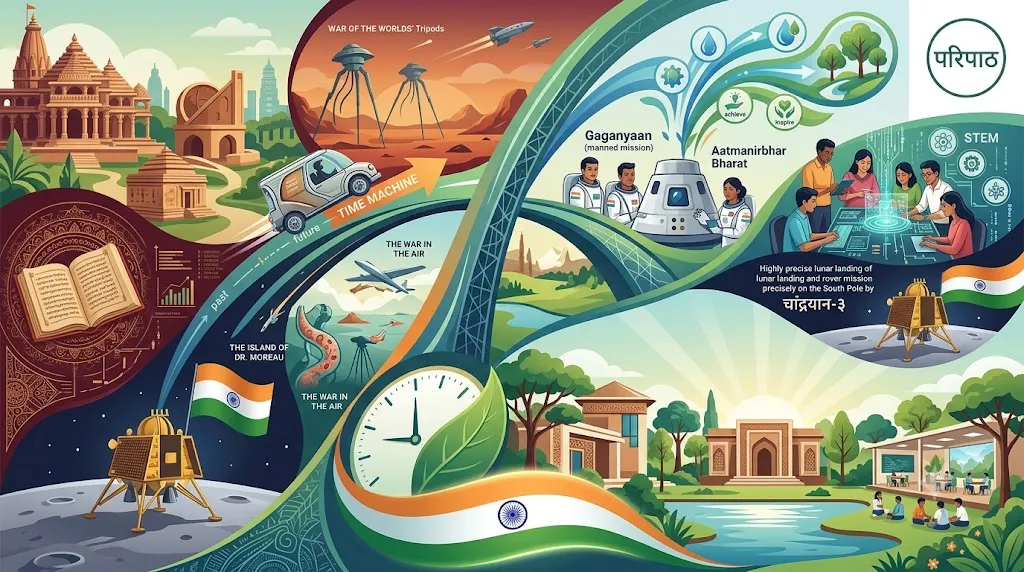
- The Time Machine (1895): This seminal work introduced the concept of a 'Time Traveller' who journeys to the year 802,701 AD. There, he encounters two divergent human species, the idyllic Eloi and the subterranean Morlocks, representing a stark class divide and a chilling vision of human evolution. Wells's vivid depiction of time travel remains a cornerstone of the genre.
- The Island of Doctor Moreau (1896): A dark and thought-provoking novel where a mad scientist, Dr. Moreau, performs horrific vivisection experiments on animals, attempting to transform them into human-like 'Beast Folk.' The story raises profound ethical questions about scientific hubris, morality, and the boundaries of human intervention in nature.
- The Invisible Man (1897): Griffin, a brilliant but megalomaniacal scientist, discovers a formula for invisibility but descends into madness and uses his power for criminal acts. This narrative explores the dangers of unchecked scientific ambition, the corrupting influence of power, and the darker aspects of human nature.
- The War of the Worlds (1898): Perhaps Wells's most famous work, this novel depicts a devastating invasion of Earth by technologically superior Martians. It popularized the alien invasion trope and remains one of the most influential works of science fiction, inspiring countless adaptations and continuing to resonate with fears and fascinations about extraterrestrial life.
- The First Men in the Moon (1901): This adventure tale follows two English explorers, Mr. Cavor and Mr. Bedford, who travel to the Moon using a gravity-defying substance called 'Cavorite.' They discover a complex civilization of insect-like beings called Selenites. The story blends scientific speculation with social satire, envisioning space travel and alien societies.
"Imagination is the only engine of the world. Without it, we could never move forward." – H.G. Wells
Wells's Prescient Vision: Foreshadowing Future Science and Technology
H.G. Wells did not merely craft exciting narratives; he possessed an uncanny ability to predict future scientific and technological advancements with remarkable accuracy. His foresight was truly astonishing. Here are some of his key predictions and their connections to our modern world:
- Time Travel: 'The Time Machine' introduced the concept of traversing through time. Today, theoretical physicists continue to explore possibilities like wormholes and black holes as potential pathways for time travel, aligning with Wells's imaginative leap. Einstein's theories of relativity further underscore the elasticity of space-time, giving a scientific basis to Wells's fantasy.
- Alien Invasion: 'The War of the Worlds' vividly depicted an invasion by extraterrestrials. Modern scientific endeavors like SETI (Search for Extraterrestrial Intelligence) actively seek alien life, and the ongoing public discourse about their potential existence and interaction echoes Wells's narrative.
- Invisibility: 'The Invisible Man' explored the idea of rendering oneself unseen. Contemporary research in metamaterials and advanced camouflage technologies is actively pursuing methods to bend light and create invisibility, making Wells's fictional concept a potential future reality.
- Atomic Warfare: In 'The World Set Free' (1914), Wells chillingly predicted the 'atomic bomb' and its devastating power. When atomic bombs were actually deployed during World War II, many were struck by the eerie accuracy of Wells's prophecy.
- Tanks and Aerial Warfare: Wells envisioned modern tanks in his short story 'The Land Ironclads' (1903), long before they became a reality in World War I. He also foresaw the widespread use of aircraft in warfare and the strategic importance of air power.
- Global Information Network: In his essay 'World Brain,' Wells conceptualized a universal, accessible information network where all human knowledge would be centralized and readily available. This vision bears a striking resemblance to our modern internet and platforms like Wikipedia.
A Social Commentator and Futurist
Beyond his prowess as a science fiction writer, H.G. Wells was a keen social commentator and a passionate futurist. Many of his works critiqued contemporary societal issues, class divisions, poverty, and the destructive nature of warfare. He articulated numerous ideas about humanity's future, advocating for concepts like a world government, educational reform, and social justice.
- Views on War: During the periods of World War I and II, Wells wrote extensively on the horrors and consequences of war. In 'The World Set Free,' he not only predicted atomic war but also passionately called for humanity to embrace peace. On this International Day of Peace, Wells's thoughts on conflict and cooperation remain profoundly relevant.
- Education and Social Reform: Wells was a strong proponent of universal education and equal opportunities for all. He believed that education was the most crucial tool for human progress and that science should be used for the betterment of life, not its destruction.
- Future Societies: He depicted various future societies, exploring how technology would transform human life. While some of his predictions were dystopian and cautionary, others were hopeful, consistently challenging readers to contemplate the future.
It's important to note that Wells's approach differed significantly from his contemporary, Jules Verne. While Verne grounded his stories in existing scientific possibilities, Wells ventured beyond, imagining future technologies and their profound social implications. This distinction earned him the title of a 'Scientific Prophet.'
The Enduring Legacy and Inspiration of H.G. Wells
H.G. Wells's legacy is vast and multifaceted. He not only pioneered a new genre but also left an indelible mark on literature, science, and the intellectual landscape. His works continue to inspire countless authors, filmmakers, and scientists today.
- Literature and Film: Wells's stories have been adapted into numerous films, television series, and plays. Orson Welles's 1938 radio adaptation of 'The War of the Worlds' famously caused widespread panic in the United States, as listeners believed a real alien invasion was underway. His narratives continue to captivate new generations.
- Scientific Inspiration: Wells's imaginative concepts spurred many scientists and researchers to explore and develop future technologies. Robert Oppenheimer, the 'father of the atomic bomb,' reportedly acknowledged Wells's 'The World Set Free' for giving him an early glimpse into the potential of atomic power. Visionaries like Elon Musk, founder of SpaceX and Tesla, have also praised Wells's foresight.
- The Power of Imagination: Wells demonstrated that imagination is not merely a tool for entertainment but a powerful engine for human progress and the creation of the future. It is essential for discovering new solutions, overcoming challenges, and making the world a better place.
Did You Know?
- H.G. Wells was a contemporary of Albert Einstein, and their intellectual exchanges were notable.
- Wells was a member of the Fabian Society, a socialist organization, and actively campaigned for political and social reforms throughout his life.
- The 'Tripods' from 'The War of the Worlds' remain one of the most iconic and terrifying images in science fiction.
- Wells wrote extensively on world history, with 'The Outline of History' being one of his most famous non-fiction works.
- Throughout his lifetime, Wells authored over 50 novels and hundreds of short stories, essays, and social commentaries.
Conclusion
H.G. Wells was far more than just a science fiction writer; he was a visionary futurist, a keen social commentator, and a devout worshipper of imagination. His stories introduced us to groundbreaking concepts like time travel, alien invasions, invisibility, and the atomic bomb, many of which later transformed into scientific realities. He taught us that imagination knows no bounds and is the key to unlocking the doors of the future.
Wells's enduring legacy encourages us to not merely live in the present but to think about the future, to ask questions, and to use our imagination to create new possibilities. Through Paripath, we urge you to read, reflect, and let your imagination soar, for you are the Wells of tomorrow, poised to envision and shape the future!
Thank you!