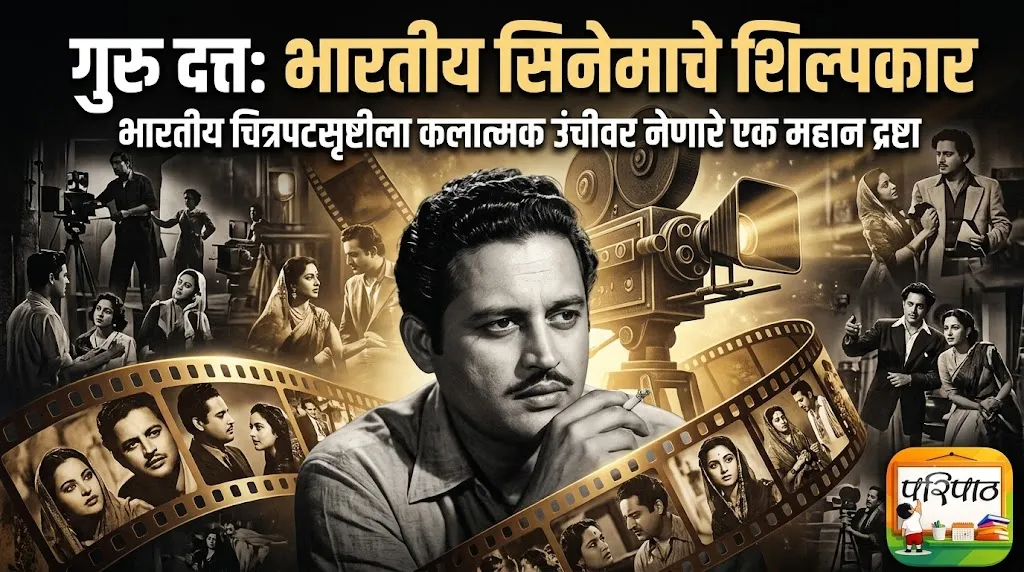
In the illustrious history of Indian cinema, some names transcend time, not merely for their body of work, but for their visionary outlook and profound artistic contributions. Guru Dutt stands as one such luminary. During the 'Golden Age' of Indian cinema (roughly the 1940s to 1960s), his unparalleled work as a director, producer, actor, and writer continues to inspire generations. His films were not just narratives; they were mirrors reflecting society, deep analyses of human emotions, and artistic masterpieces far ahead of their time. Today, we embark on a journey through Guru Dutt's artistic odyssey, exploring his unique storytelling style, his invaluable contribution to Indian cinema, and the enduring relevance of his films that continue to resonate with audiences.
For school students, understanding the rich heritage of Indian art and culture is crucial. Guru Dutt’s work is not merely a source of entertainment; it serves as an excellent medium for studying sociology, psychology, and artistic expression. Through his films, we catch glimpses of the societal conditions of his era, the complexities of human relationships, and the inner struggles of an artist. Let’s delve into the extraordinary world of this legendary artist.
The Making of a Maestro: Guru Dutt's Early Journey
Guru Dutt was born on July 9, 1925, in Mysore, Karnataka. His full name was Vasanth Kumar Shivashankar Padukone. He spent his early childhood in Kolkata (then Calcutta), where he was exposed to Bengali culture and literature, an influence that significantly shaped his artistic sensibilities. From a young age, he harbored a deep passion for arts and literature. In the 1940s, defying his family's wishes, he decided to pursue a career in filmmaking, a decision that would change the course of his life and Indian cinema.
He began his career at the renowned 'Prabhat Film Company' in Pune, where he initially worked as a choreographer. It was at Prabhat Studios that he forged lasting friendships with Dev Anand and Rehman, relationships that proved instrumental in his cinematic journey. After the closure of Prabhat Studios, Guru Dutt moved to Mumbai, facing numerous struggles as he tried to establish himself in the film industry. He started as an assistant director, choreographer, and took on minor acting roles, steadily building his experience.
Recognizing Guru Dutt’s immense talent, Dev Anand offered him the opportunity to direct 'Baazi' (1951). 'Baazi', a crime thriller, was a commercial success, marking Guru Dutt's debut as a director. The film offered the first glimpse of his distinctive directorial style: fast-paced narration, captivating cinematography, and realistic portrayal of urban settings. Following 'Baazi', he directed films like 'Jaal' (1952) and 'Baaz' (1953), in which he also played the lead roles. 'Aar Paar' (1954) was another commercial hit that solidified his position as a director.
Guru Dutt wasn't content with just directing; he established his own production company, 'Guru Dutt Films'. Under this banner, he produced several iconic films that redefined Indian cinema. While his early works focused on entertainment, he always harbored a desire to create something deeper and more meaningful. This artistic ambition manifested in his later masterpieces, earning him the reputation of a 'visionary filmmaker'.
A Distinctive Narrative Voice: Storytelling Beyond the Obvious
Guru Dutt's directorial style was markedly different from his contemporaries. His films weren't just stories; they were profound emotional and social commentaries. He delved into the complexities of the human mind and the paradoxes of society with remarkable sensitivity. His storytelling style was unique due to several key characteristics:
1. Visual Storytelling:
Guru Dutt often communicated more through visuals than through dialogue. Every frame in his films was meticulously crafted to convey the characters' emotions and the essence of the story to the audience. He was a master of using light and shadow (chiaroscuro). For instance, to depict Vijay's loneliness in 'Pyaasa', he would often show him in darkness or shadow, while using light to signify hope or love. This allowed the audience to experience the characters' inner struggles more deeply.
2. Realistic Portrayal and Social Commentary:
He shed light on the marginalized sections of society, the struggles of artists, materialism, and the emptiness in human relationships. His films were reflections of contemporary society, yet their themes remain relevant today. In 'Pyaasa', he critiqued the conflict between art and commerce through the struggle of a poet, while 'Kaagaz Ke Phool' exposed the harsh realities and loneliness within the film industry.
3. Depth of Characters and Emotional Complexity:
The characters in Guru Dutt's films were not mere figures on screen; they were relatable individuals from our everyday lives. His characters were multi-layered, their emotions and motivations complex. Vijay ('Pyaasa'), Suresh Sinha ('Kaagaz Ke Phool'), and Aarti ('Aar Paar') continue to resonate with audiences because they were incredibly realistic, and viewers could easily connect with their emotions.
4. Innovative Cinematography:
Guru Dutt and his cinematographer V.K. Murthy introduced many innovative techniques and styles to Indian cinema. 'Kaagaz Ke Phool' was the first Indian film shot in Cinemascope, adding a new dimension to visual aesthetics. They effectively used close-ups, long shots, and tracking shots, which enhanced the narrative pace and emotional depth. His emphasis on visual beauty makes his films appear fresh and modern even today.
Iconic Creations: 'Pyaasa' and 'Kaagaz Ke Phool'
Two pivotal milestones in Guru Dutt's artistic journey are 'Pyaasa' (1957) and 'Kaagaz Ke Phool' (1959). These two masterpieces elevated Indian cinema to new heights and established Guru Dutt as a profound artist.
'Pyaasa' (1957): The Struggle Between Art and Materialism
'Pyaasa' is considered a landmark film in Guru Dutt's career. It tells the story of Vijay, a poet whose art is unappreciated by society. He constantly faces failure and neglect. The film offers a poignant commentary on societal hypocrisy, the growing grip of materialism, and the lack of human empathy. Vijay finds genuine human connection and appreciation for his art only in Gulab (Waheeda Rehman), a courtesan.
The songs in this film, especially those penned by Sahir Ludhianvi and composed by S.D. Burman, are integral to the narrative. The song "Yeh Duniya Agar Mil Bhi Jaye To Kya Hai" ("Even if I get this world, what's the use?") still articulates the artist's neglect in society and the plight of a world driven by money. 'Pyaasa' is not just a story; it's a mirror to an artist's soul, which continues to provoke thought. This film brought Guru Dutt recognition not only in India but also on an international stage.
'Kaagaz Ke Phool' (1959): A Glimpse into Loneliness and the Reality of Cinema
'Kaagaz Ke Phool', directed by and starring Guru Dutt, is often considered autobiographical. The film tells the story of Suresh Sinha (Guru Dutt), a successful film director who struggles in both his professional and personal life. His wife leaves him, his daughter grows distant, and the actress he loves (Shanti – Waheeda Rehman) also moves away from him.
This film profoundly comments on the loneliness behind the glamour of the film industry, the transience of human relationships, and the price of success. 'Kaagaz Ke Phool' was the first Indian film shot in Cinemascope, which added a new dimension to visual beauty. The cinematography by V.K. Murthy was outstanding. Unfortunately, the film was a commercial failure. This setback deeply affected Guru Dutt, leading him to vow never to direct another film. However, over time, the film gained recognition as a 'classic' and is now considered one of the most important films in Indian cinema.
The Symphony of Soul: Music, Poetry, and Cinema in Guru Dutt's Films
Another defining characteristic of Guru Dutt's films was their music. The songs in his movies were not merely for entertainment; they were an integral part of the narrative. They expressed the characters' emotions, the mood of the story, and the very essence of the film. His collaborations with music director S.D. Burman and lyricist Sahir Ludhianvi represent a golden chapter in Indian cinema.
1. Sahir Ludhianvi: The Magician of Words
Sahir Ludhianvi penned lyrics for many of Guru Dutt's films. His songs were rich in profound meaning, social commentary, and poetic beauty. Through songs like "Yeh Duniya Agar Mil Bhi Jaye To Kya Hai" ("Even if I get this world, what's the use?"), "Jaane Woh Kaise Log The Jinke Pyar Ko Pyar Mila" ("Who were those people whose love received love?"), and "Jinhe Naaz Hai Hind Par Woh Kahaan Hain" ("Where are those who are proud of India?"), he effectively commented on the inconsistencies of contemporary society, the decline of human values, and the feelings of love and loneliness. Sahir's words elevated Guru Dutt's visuals to a different level.
2. S.D. Burman: The Enchantment of Melody
S.D. Burman's music gave Guru Dutt's films a unique identity. His compositions possessed a simplicity and honesty that directly connected with the characters' emotions. His music in films like 'Pyaasa', 'Kaagaz Ke Phool', and 'Chaudhvin Ka Chand' continues to resonate with audiences today. Burman Da's music bestowed a timeless quality upon Guru Dutt's films.
3. Geeta Dutt: The Magic of Voice
Guru Dutt's wife, Geeta Dutt, was an exceptional singer. Her voice carried a unique blend of melancholy and emotional depth, perfectly expressing the inner feelings of characters in Guru Dutt's films. Songs like "Aaj Sajan Mohe Ang Laga Lo" and "Waqt Ne Kiya Kya Haseen Sitam" are still revered for Geeta Dutt's voice and the emotional intensity they convey. The songs in Guru Dutt's films were not just background scores; they were an integral part of the narrative, conversing with the very soul of the characters.
A Vision Ahead of Its Time: Enduring Relevance
One of the most significant aspects of Guru Dutt's films is their timelessness. The themes he explored, and the questions he posed, are as relevant today as they were over six decades ago. His films continue to attract audiences and provoke thought. Here are some key reasons:
1. Portrayal of Universal Human Emotions:
Guru Dutt profoundly depicted universal human emotions such as love, loneliness, hope, despair, success, failure, betrayal, and empathy. These emotions are an integral part of human life and do not change with time. Consequently, his films resonate with audiences of any generation.
2. Social and Moral Questions:
His films shed light on serious issues like societal hypocrisy, excessive materialism, the neglect of art, the complexities of human relationships, and the decline of moral values. These questions still exist in our society today. Whether it's the artist's struggle in 'Pyaasa' or the harsh reality of the film industry in 'Kaagaz Ke Phool', these themes remain just as important.
3. Artistic and Technical Excellence:
The visual language, innovative cinematography, and editing techniques Guru Dutt employed in his films were far ahead of their time. His technical prowess makes his films feel fresh and modern even today. His emphasis on visual storytelling continues to inspire many young filmmakers.
The Unfading Legacy: Impact on Indian Cinema
Guru Dutt passed away on October 10, 1964, at the young age of 39. His untimely demise robbed Indian cinema of a great artist. However, the artistic legacy he left behind remains vibrant and is a golden chapter in the history of Indian cinema.
1. Source of Inspiration:
Guru Dutt continues to be a source of inspiration for countless film directors, writers, and artists. His storytelling style, visual aesthetics, and the depth of his characters inspire many young artists to view him as their ideal. Directors like Shyam Benegal, Govind Nihalani, and Anurag Kashyap have acknowledged the influence of Guru Dutt's work.
2. International Recognition:
Guru Dutt's films have garnered recognition not only in India but also internationally. Films like 'Pyaasa' and 'Kaagaz Ke Phool' have been honored at numerous international film festivals. Western film critics have also praised his work, placing him among the ranks of the world's greatest directors.
3. Part of Film Curricula:
Even today, Guru Dutt's films are studied in many film schools and universities. The study of his directorial style, storytelling techniques, and technical prowess introduces students to various facets of filmmaking.
4. Timeless Classics:
Films like 'Pyaasa', 'Kaagaz Ke Phool', 'Sahib Bibi Aur Ghulam', and 'Chaudhvin Ka Chand' are recognized as 'classics' of Indian cinema. These films are still watched on television, OTT platforms, and at film festivals, and their charm remains undiminished.
Conclusion
Guru Dutt was more than just a film director; he was a visionary artist who gave Indian cinema a new direction. His films not only entertained but also shed light on many societal issues and explored the complexities of the human mind. His unique storytelling style, innovative visual language, and effective use of music ensure that his films continue to resonate with audiences today.
For school students, Guru Dutt's work is an excellent medium for studying art, culture, and history. Through his films, we learn not just good stories, but also understand various aspects of society, human emotions, and the importance of art. Guru Dutt's legacy is not limited to Indian cinema; it is a significant treasure for global cinema. His masterpieces continue to provoke thought and help us understand the truth, beauty, and inconsistencies of life more deeply.
Did You Know?
- Guru Dutt's original name was Vasanth Kumar Shivashankar Padukone. He changed his name to 'Guru Dutt' as 'Guru' was a name given by his parents.
- Actress Waheeda Rehman was introduced to the Hindi film industry by Guru Dutt himself through the film 'C.I.D.' (1956). Her talent was recognized by Guru Dutt.
- After 'Kaagaz Ke Phool' (1959) failed commercially, Guru Dutt never directed another film. However, he produced 'Sahib Bibi Aur Ghulam' (1962), which was both critically and commercially successful.
- Guru Dutt was an excellent dancer and had choreographed for several films in his early career.
- Many of his films' stories were based on his own life experiences, which lends a sense of authenticity and depth to his works.