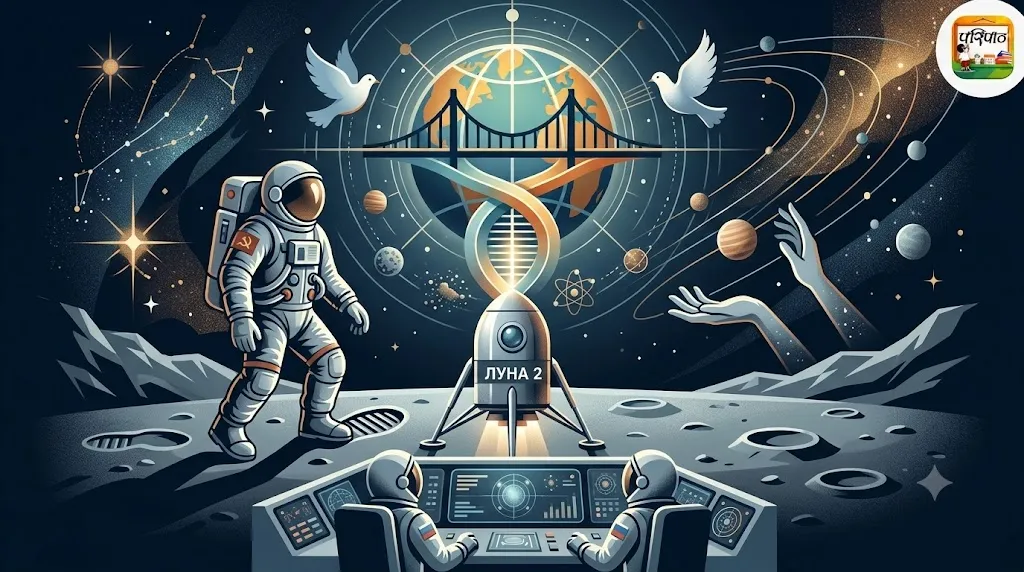
Today, July 29, 2026, marks a significant date for multiple reasons. In India, it's observed as Guru Purnima, a day to honor our teachers, mentors, and the pursuit of knowledge. It's a day when we reflect on the wisdom passed down through generations, illuminating our paths forward. Coincidentally, it's also the 68th anniversary of one of humanity's greatest endeavors in the pursuit of knowledge: the establishment of the National Aeronautics and Space Administration (NASA).
Born out of the Cold War's space race on July 29, 1958, NASA's journey has been nothing short of extraordinary. From the first human steps on the Moon to gazing at the universe's oldest light, NASA has consistently pushed the boundaries of what's possible. Its missions have not only advanced scientific understanding but have also ignited the imaginations of millions worldwide, inspiring countless students, particularly in countries like India, to delve into the fascinating realms of Science, Technology, Engineering, and Mathematics (STEM). As we celebrate Guru Purnima, let's embark on a journey through NASA's pivotal moments, recognizing its role as a global mentor in space exploration.
The Dawn of a New Era: NASA's Genesis (1958)
The mid-20th century was a period of intense geopolitical tension. When the Soviet Union launched Sputnik 1, the world's first artificial satellite, in October 1957, it sent shockwaves across the United States. This event, coupled with Sputnik 2 carrying the dog Laika a month later, underscored the urgent need for the U.S. to accelerate its own space capabilities. In response, President Dwight D. Eisenhower signed the National Aeronautics and Space Act on July 29, 1958, officially establishing NASA. This marked a strategic shift from military-led space efforts to a civilian agency dedicated to peaceful scientific exploration.
NASA's initial years were characterized by the ambitious 'Project Mercury' and 'Project Gemini' programs. Project Mercury aimed to put the first American into space. On May 5, 1961, Alan Shepard became the first American in space with a sub-orbital flight aboard 'Freedom 7'. This was followed by John Glenn's historic orbital flight on February 20, 1962, making him the first American to orbit Earth. Building on this, Project Gemini was designed to develop techniques for future lunar missions, including long-duration spaceflights, extravehicular activities (spacewalks), and orbital rendezvous and docking. These early programs were crucial in laying the groundwork, testing technologies, and training astronauts for the monumental challenges that lay ahead in the race to the Moon.
The Giant Leap for Mankind: The Apollo Program
The Apollo program remains NASA's most iconic and defining achievement. On May 25, 1961, President John F. Kennedy famously declared the national goal of "landing a man on the Moon and returning him safely to the Earth" before the decade was out. This audacious challenge mobilized hundreds of thousands of scientists, engineers, and technicians across the nation. Despite setbacks, including the tragic Apollo 1 fire, NASA pressed on, learning from failures and refining its technology.
The culmination of these efforts came on July 20, 1969, just 11 years after NASA's founding, with the Apollo 11 mission. Neil Armstrong became the first human to step onto the lunar surface, famously uttering, "That's one small step for man, one giant leap for mankind." Buzz Aldrin joined him shortly after, while Michael Collins orbited above in the command module. This monumental achievement captivated the world, demonstrating humanity's incredible capacity for innovation and determination. The Apollo missions not only fulfilled a national promise but also brought back invaluable lunar samples, providing critical insights into the Moon's geology and formation, profoundly shaping our understanding of Earth's closest celestial neighbor.
Unveiling the Cosmos: The Hubble Space Telescope and Beyond
With the Moon conquered, NASA turned its gaze further into the cosmos. The need for a powerful telescope positioned above Earth's atmospheric distortions led to the conception of the Hubble Space Telescope (HST). Launched on April 24, 1990, aboard the Space Shuttle Discovery, Hubble initially faced a significant flaw in its primary mirror. However, a daring repair mission by astronauts in 1993 rectified the issue, transforming Hubble into one of the most productive scientific instruments in history.
For over three decades, Hubble has delivered breathtaking images and groundbreaking data, revolutionizing astronomy. It helped determine the age of the universe (approximately 13.8 billion years), provided stunning views of galaxy formation and evolution, confirmed the presence of supermassive black holes, and aided in the discovery of exoplanets. Iconic images like the 'Pillars of Creation' have not only advanced science but also inspired art and culture globally. Hubble's observations have led to thousands of scientific papers, reshaping theories about the universe.
As Hubble continues its legacy, its successor, the James Webb Space Telescope (JWST), launched on December 25, 2021, represents the next generation of space observatories. Operating primarily in infrared light, JWST is designed to peer even further back in time, observing the first galaxies that formed after the Big Bang. Its initial images have already unveiled previously unseen details of the early universe, promising to deepen our understanding of cosmic origins and the formation of stars and planetary systems.
Red Planet Explorers: A Legacy of Mars Rovers
The quest for life beyond Earth has long been a driving force for NASA, with Mars being a primary target. NASA's Mars rover missions have been particularly successful in this endeavor. The 'Viking' landers in the 1970s performed the first successful landings on Mars, though direct evidence of life remained elusive. In 1997, the 'Pathfinder' mission, with its small 'Sojourner' rover, provided the first close-up, mobile exploration of the Martian surface, offering new insights into its geology and atmosphere.
The early 2000s saw the deployment of 'Spirit' and 'Opportunity' in 2004. Designed for a mere 90-day mission, these twin rovers far exceeded expectations, operating for years. Opportunity, in particular, worked for nearly 15 years, providing conclusive evidence that Mars once had liquid water, significantly increasing the planet's potential for hosting life. In 2012, the 'Curiosity' rover successfully landed in Gale Crater and continues its mission today, having found evidence of ancient habitable environments capable of supporting microbial life.
NASA's latest and most advanced rover, 'Perseverance', landed on Mars on February 18, 2021. Perseverance is collecting rock and soil samples that will eventually be returned to Earth for detailed analysis. Accompanying Perseverance was the 'Ingenuity' helicopter, which made history by achieving the first controlled, powered flight on another planet. These rovers have collectively transformed our understanding of Mars' past climate, geological history, and its potential for past or present life.
Beyond Earth: International Space Station and Future Endeavors
NASA's influence extends beyond individual missions to fostering global collaboration. The International Space Station (ISS) stands as a testament to this, a collaborative project involving NASA, Roscosmos (Russia), ESA (Europe), JAXA (Japan), and CSA (Canada). This orbiting laboratory has hosted astronauts from various nations, conducting groundbreaking research in microgravity and serving as a stepping stone for future long-duration space travel.
Looking ahead, NASA is spearheading the 'Artemis' program, aiming to return humans to the Moon by the mid-2020s, including the first woman and the first person of color. Artemis is not just about returning to the Moon; it's about establishing a sustainable lunar presence and using the Moon as a proving ground for the ultimate goal of sending humans to Mars. This ambitious program involves international partners and commercial companies, symbolizing a new era of space exploration.
Igniting Minds: NASA's Global Inspiration and India's Space Journey
NASA's achievements resonate far beyond the scientific community; they serve as a powerful source of inspiration for students globally, including in India. The stories of astronauts like Kalpana Chawla and Sunita Williams, both of Indian origin, who flew with NASA, have particularly motivated countless young Indians to pursue careers in STEM. NASA's commitment to public outreach and education makes complex scientific concepts accessible, sparking curiosity and encouraging critical thinking among the youth.
India's own space agency, ISRO (Indian Space Research Organisation), has made remarkable strides in recent decades, with missions like Chandrayaan (lunar exploration) and Mangalyaan (Mars Orbiter Mission) garnering global acclaim. ISRO's cost-effective and innovative approaches have positioned India as a significant player in the global space arena. There's a strong spirit of collaboration between NASA and ISRO, with joint missions and data sharing agreements that benefit both nations and advance global space science. This shared vision for space exploration underscores the universal appeal of unraveling cosmic mysteries.
As we observe Guru Purnima and reflect on the importance of knowledge, NASA's journey reminds us that the pursuit of understanding is boundless. Each discovery, each mission, opens new doors to knowledge and opportunity. India's National Education Policy 2020 (NEP 2020) places a significant emphasis on STEM education, aiming to equip students with the skills needed for future challenges. Institutions like NASA exemplify the potential unlocked by such a focus.
Just as we acknowledge historical events like the arrival of Rafale jets in India, World Tiger Day, or remember figures like Maharani Gayatri Devi and Nandini Satpathy, NASA's journey highlights the profound impact of human endeavor. It inspires us to look beyond immediate horizons, to dream big, and to explore the unknown, knowing that the universe holds infinite secrets waiting to be discovered by future generations.
Did You Know?
- NASA has successfully conducted over 200 crewed missions to date.
- NASA's Voyager 1 spacecraft is the farthest human-made object from Earth, currently traveling in interstellar space.
- When Neil Armstrong took his first step on the Moon, his heartbeat was recorded at 110 beats per minute.
- The Hubble Space Telescope has made over 1.5 million observations and has supported more than 10,000 scientific papers.
- The Perseverance rover on Mars carries a small piece of a meteorite from Mars, brought to Earth by a previous mission, as a calibration target.
Conclusion
From its foundation on July 29, 1958, NASA has embarked on an unparalleled journey of discovery and innovation. From the early Mercury and Gemini programs to the monumental Apollo Moon landings, and from the cosmic insights provided by Hubble and James Webb to the relentless search for life on Mars by its intrepid rovers, NASA has continuously redefined the boundaries of human achievement. Its work is not just a testament to scientific prowess but a powerful symbol of human ambition, perseverance, and the unyielding quest for knowledge. On this Guru Purnima, NASA's inspiring journey reminds us that knowledge is the ultimate power, and its pursuit can lead us to unimaginable heights. NASA has inspired, and will continue to inspire, generations of students worldwide, including in India, to embrace STEM and look towards the stars, recognizing that space is not just a frontier, but an endless realm of opportunity for human progress.