
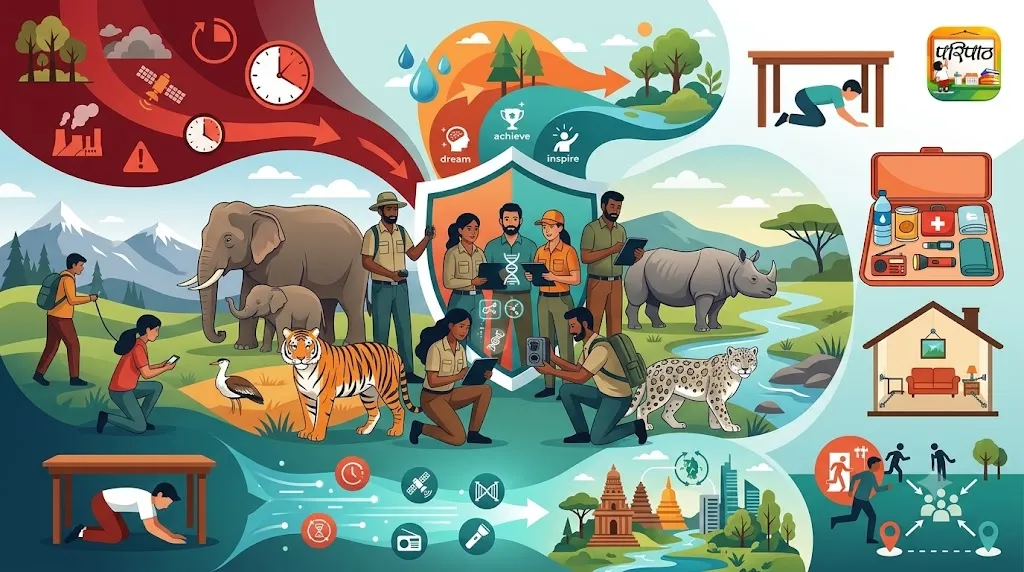
Hello, young learners!
India is a country blessed with an astonishing array of natural beauty and biodiversity. From towering mountains and gushing rivers to dense forests and vast coastlines, our land supports countless species of plants and animals. This rich biodiversity is not just a part of our identity; it's a precious heritage. But did you know that many of these magnificent creatures are facing severe threats? Their very existence is at risk, and if we don't act now, they could vanish forever.
Today, we're going on an exciting journey to learn about some of India's most iconic endangered species. We'll explore why their numbers are dwindling, what factors are responsible for their decline, and what conservation efforts are underway to protect them. Let's understand our role in safeguarding this invaluable natural legacy!
What is Biodiversity and Why is it Important?
Biodiversity refers to the variety of life on Earth. It encompasses everything from microscopic organisms to giant trees, and from tiny insects to large animals. Every living organism plays a unique role in its environment. For instance, bees help plants produce fruits and seeds through pollination, while predators like tigers help control the population of herbivores like deer, maintaining a natural balance in the forest.
When a species becomes extinct, this natural balance is disrupted. The impact isn't limited to that single species; it affects the entire ecosystem. Human life itself depends on this biodiversity. We get food, water, medicine, and clean air from nature, all of which are sustained by biodiversity. Therefore, protecting biodiversity is crucial for all of us.
Why Do Species Become Endangered? Reasons for Dwindling Numbers
Several factors contribute to the endangerment of species in India. Here are some of the primary reasons:
1. Habitat Loss
An animal's habitat is its natural home. Deforestation, conversion of forest land for agriculture, urbanization, and industrial development are destroying these natural homes. When animals lose their living spaces, their populations decline, and survival becomes challenging. For example, large predators like tigers need vast territories for hunting and roaming. When forest areas shrink, they don't find enough food, and conflicts with humans increase.
2. Poaching and Illegal Trade
Many animals are illegally hunted for their body parts (e.g., tiger skins and bones, rhino horns, elephant tusks). These parts fetch high prices in the international black market. This poaching and illegal trade is a major cause of species extinction. The Indian Pangolin, for instance, is one of the most trafficked mammals globally due to demand for its scales and meat in traditional medicine and cuisine, leading to a rapid decline in its numbers.
3. Climate Change
Global warming and changes in weather patterns are severely impacting many animal species. Some animals find it difficult to survive in their natural habitats due to rising temperatures. For example, snow leopards require cold climates, but their habitats are changing due to global warming. Similarly, rising sea temperatures affect coral reefs and marine life, which are food sources for many sea turtles.
4. Pollution
Pollution of water, air, and land poses a significant threat to the health of many animals. Pesticides, industrial waste, and plastic litter endanger numerous species. Chemical waste dumped into rivers kills fish and other aquatic life, subsequently threatening animals that depend on them for food.
5. Human-Wildlife Conflict
When human settlements and wildlife habitats overlap, conflicts increase. Tigers or elephants may raid farms, destroying crops, or sometimes even attack people. This can lead to local communities retaliating against animals, further reducing their numbers.
Iconic Endangered Species of India
Let's get acquainted with some of India's most significant and beautiful endangered animals:
1. Royal Bengal Tiger
- Scientific Name: Panthera tigris tigris
- Status: Listed as 'Endangered' by IUCN.
Our national animal, the tiger, is the king of India's forests. Once found in large numbers across most parts of India, their population drastically declined due to deforestation and poaching. In the early 20th century, there were an estimated 40,000 tigers in India, but by the 1970s, their numbers had plummeted to just 1,800. Thanks to initiatives like 'Project Tiger', their population has now increased to around 3,682 (as per 2022 census), but they are still not entirely safe.
"Only if the forests survive, will the tigers survive; and only if the tigers survive, will the forests survive."
2. Asiatic Lion
- Scientific Name: Panthera leo persica
- Status: Listed as 'Endangered' by IUCN.
The Asiatic Lion is found exclusively in India, primarily in the Gir National Park and surrounding areas of Gujarat. They are slightly different from African lions. Their population was critically low in the 19th century. Through rigorous conservation efforts, their numbers have risen to 674 (as per 2020 census). Since their habitat is restricted to a single location, any natural disaster (like an epidemic) could threaten their existence. Efforts are ongoing to establish a second home for them.
3. Indian One-Horned Rhinoceros
- Scientific Name: Rhinoceros unicornis
- Status: Listed as 'Vulnerable' by IUCN (previously 'Endangered').
This magnificent creature is predominantly found in Assam's Kaziranga National Park. They are extensively poached for their single horn, which is mistakenly believed to have medicinal properties. Strict laws and programs like 'India Rhino Vision 2020' have helped increase their population, moving them from 'Endangered' to 'Vulnerable' status, but the threat still persists.
4. Snow Leopard
- Scientific Name: Panthera uncia
- Status: Listed as 'Vulnerable' by IUCN (previously 'Endangered').
This beautiful and elusive animal inhabits the remote, snowy regions of the Himalayas. Poaching, habitat loss, and climate change threaten their numbers. They are often called the 'Ghost of the Mountains' because they are rarely seen. The Indian government has launched 'Project Snow Leopard' to aid in their conservation.
5. Indian Pangolin
- Scientific Name: Manis crassicaudata
- Status: Listed as 'Endangered' by IUCN.
This nocturnal mammal protects itself by rolling into a tight ball, covered in tough scales. They are heavily poached because their scales and meat are highly valued in traditional medicine and as a delicacy, especially in Asian countries. They are one of the most trafficked mammals globally. Strict enforcement of laws is crucial for their survival.
6. Great Indian Bustard
- Scientific Name: Ardeotis nigriceps
- Status: Listed as 'Critically Endangered' by IUCN.
The Great Indian Bustard is one of the largest flying birds in India. They are found in the grasslands of Rajasthan and Gujarat. Their population has drastically declined (fewer than 150 individuals remaining). Habitat loss, poaching, and collisions with power lines are pushing them towards extinction. 'Project Great Indian Bustard' has been initiated for their conservation.
Conservation Efforts in India
To save India's endangered species, the government, NGOs, and local communities are making extensive efforts. Here are some key initiatives:
1. Legal Protection and Legislation
- Wildlife Protection Act, 1972: This act completely bans the hunting of many animals and the trade of their body parts. Violators face severe penalties.
- National Parks and Wildlife Sanctuaries: The government has designated numerous National Parks and Sanctuaries where animals can live safely in their natural habitats. Currently, India has 106 National Parks and 567 Wildlife Sanctuaries.
2. Species-Specific Projects
- Project Tiger: Launched in 1973, this is considered one of the world's most successful conservation projects for tigers, leading to a significant increase in their numbers.
- Project Elephant: Initiated in 1992 for the protection of elephants.
- Project Crocodile: Ongoing for the conservation of aquatic reptiles like crocodiles and gharials.
- Project Snow Leopard: Dedicated to the conservation of the snow leopard.
3. International Cooperation
India is a party to several international agreements, such as CITES (Convention on International Trade in Endangered Species of Wild Fauna and Flora), which regulates the international trade of endangered animals and plants. This helps curb illegal trafficking.
4. Public Awareness and Education
The government and many NGOs conduct various programs to educate people about the importance of wildlife and encourage their participation in conservation. Students in schools are informed about these issues, fostering a love for nature and a sense of responsibility from a young age.
What Can You Do? The Role of Students
As students, how can you contribute to this vital cause? Here are some simple things you can do:
- Learn and Share: Learn more about endangered animals and share this information with your friends, family, and neighbors. The more people you make aware, the more people will join the conservation efforts.
- Reduce Waste and Recycle: Minimize plastic use and dispose of waste properly. Plastic waste can be extremely dangerous for many animals. Follow the principles of Reduce, Reuse, and Recycle.
- Conserve Natural Resources: Avoid wasting water and electricity. Conserving natural resources is good for the environment.
- Avoid Wildlife Products: Refrain from buying products made from animal parts (e.g., ivory, animal skins). If there's no demand for such items, poaching will automatically decrease.
- Visit Nature Parks: Connect with nature and wildlife by visiting national parks or sanctuaries. This will deepen your appreciation for them.
- Support Local Conservation Efforts: If there are NGOs working on wildlife conservation in your area, you can volunteer or support their work.
Did You Know?
- India is home to approximately 8% of the world's biodiversity.
- India has the largest population of the Panthera tigris tigris (tiger) subspecies globally.
- Gir National Park in India is the only natural habitat for Asiatic Lions in the world.
- The Great Indian Bustard is the state bird of Rajasthan and is considered one of the heaviest flying birds.
- The Gangetic Dolphin is India's national aquatic animal and is also an endangered species.
Conclusion
The endangered species of India are an integral part of our nation's natural beauty and environment. Protecting them is not just the responsibility of the government, but of each one of us. If we don't come together today to protect them, future generations might only see these beautiful animals in pictures. Even our small efforts can help safeguard this invaluable natural heritage. Let's pledge today to care for our environment and conserve wildlife!
Thank you!
