
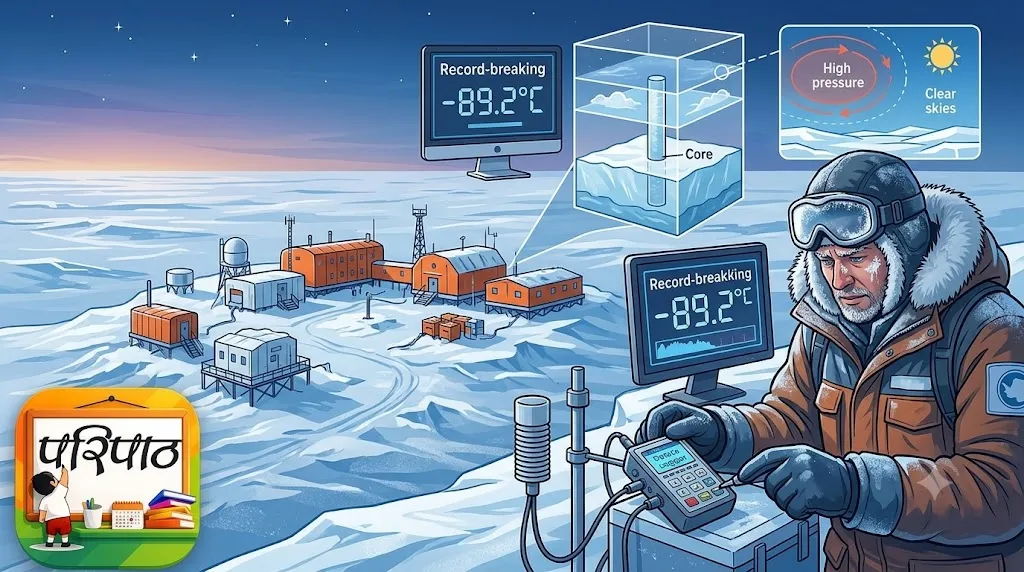
Introduction: Journey to Earth's Coldest Frontier
Our planet Earth is a realm of incredible diversity, from scorching deserts to the bone-chilling poles. Among its many wonders, some places push the boundaries of human imagination when it comes to cold. One such place is Vostok Station in Antarctica. On July 21, 1983, this remote research outpost recorded the lowest natural temperature ever measured on Earth: a staggering -89.2°C (-128.6°F). As we mark the 43rd anniversary of this historic event on July 21, 2026, let us delve into the fascinating science behind such extreme cold, its profound impact on the environment, and the incredible resilience of life, including human scientific endeavor, in these formidable conditions.
Vostok Station is more than just a record-holder; it is a vital scientific hub for studying Earth's climate, geology, and the remarkable adaptations of life. Join us on an expedition to Earth's frozen heart, where science unravels the mysteries of extreme cold.
Vostok Station: Unveiling Earth's Deep Freeze
Vostok Station is situated on the high plateau of East Antarctica, approximately 1,300 kilometers (800 miles) from the South Pole and at an elevation of 3,488 meters (11,444 feet) above sea level. Established by the Soviet Union in 1957 during the International Geophysical Year (IGY), the station takes its name from the Russian word 'Vostok,' meaning 'East,' signifying its location in the eastern part of the Antarctic continent.
This station lies in one of the most remote and hostile environments on Earth. The climate here is not only intensely cold but also extremely dry, and the high altitude results in significantly reduced oxygen levels. These combined factors make human habitation and research exceptionally challenging. Yet, for decades, scientists have tirelessly worked here, primarily focusing on 'ice core' drilling. These ice cores provide invaluable data on Earth's past climate and atmospheric conditions, spanning hundreds of thousands of years.
The record temperature of -89.2°C, set on July 21, 1983, is not just a number; it represents the absolute extreme of Earth's natural cold. To put it into perspective, this temperature is colder than the average temperature on Mars (-63°C)! This remarkable feat has earned Vostok Station the moniker 'Pole of Cold.'
Why So Cold? The Science Behind Vostok's Extreme Temperatures
The extraordinary cold at Vostok Station is the result of a unique confluence of several scientific factors, working in concert to create one of the planet's coldest spots.
1. High Altitude and Dry Air
At an elevation of approximately 3,488 meters (11,444 feet), Vostok Station experiences significantly lower atmospheric pressure. As altitude increases, air becomes thinner, meaning there are fewer air molecules to absorb and retain heat. This phenomenon, known as 'adiabatic cooling,' causes air to cool as it rises and expands. Consequently, the ambient temperature naturally decreases with elevation.
Furthermore, Antarctica is the driest continent on Earth, receiving very little precipitation and having extremely low atmospheric water vapor. Water vapor is a potent greenhouse gas that efficiently traps heat within the atmosphere. With minimal water vapor, heat readily escapes into space from Vostok's dry air, contributing significantly to its frigid temperatures.
2. Prolonged Polar Night
Due to its proximity to the South Pole, Vostok Station experiences an extended winter period known as 'polar night,' lasting for several months. During this time, the sun does not rise above the horizon, depriving the region of any direct solar radiation. The absence of sunlight, the primary source of heat, allows the Earth's surface and atmosphere to continuously radiate heat into space, a process called 'radiative cooling.' Without any new heat input, temperatures plummet steadily over the long, dark winter.
3. High Pressure Systems and Temperature Inversions
Antarctica is characterized by a persistent 'high-pressure system' that hovers over the continent year-round. This system causes cold, dense air to sink and spread across the surface, trapping it in place. This leads to an unusual atmospheric phenomenon called a 'temperature inversion.' Normally, air temperature decreases with altitude. However, in a temperature inversion, the coldest air is found at the surface, with temperatures gradually increasing as one ascends to higher altitudes. This strong temperature inversion effectively traps the extremely cold air near the ground at Vostok Station, preventing it from mixing with warmer air above.
4. Continentality and Ice Sheet Dynamics
Vostok Station is located deep within the Antarctic continent, far from the moderating influence of the ocean. Oceans act as thermal reservoirs, absorbing and releasing heat slowly, which helps to stabilize coastal temperatures. Lacking this oceanic moderation, continental interiors, especially at high latitudes, experience more extreme temperature swings. The vast distance from the sea contributes to Vostok's intense cold.
Moreover, Antarctica's surface is covered by an ice sheet thousands of meters thick. The pristine white surface of the ice has a very high 'albedo,' meaning it reflects over 90% of incoming solar radiation back into space. This reflective quality prevents the absorption of heat, keeping the ice sheet itself, and consequently the air above it, extremely cold. The thick ice also acts as an insulator, preventing any geothermal heat from escaping the Earth's crust and contributing to surface warming.
5. Geographic Isolation
Its location near the geographic South Pole means that the sun's rays strike the Earth's surface at a very low angle, spreading the solar energy over a larger area and reducing its intensity. Coupled with the axial tilt of Earth, this results in significantly less heat received and the prolonged polar night, further exacerbating the cold.
Life on the Edge: Adapting to Extreme Cold
The extreme environment of Vostok and its surrounding areas has profound effects on the environment and the life forms that manage to exist there. Survival in such conditions is a testament to nature's adaptability.
1. Environmental Impacts
- Formation of Ice Sheets and Glaciers: The persistently low temperatures mean that any precipitation, primarily snow, immediately freezes and accumulates. Over millennia, this has led to the formation of the massive Antarctic ice sheet and numerous glaciers, which hold about 90% of the world's fresh water.
- Lack of Atmospheric Moisture: The extremely cold air holds very little moisture, making the environment incredibly dry, akin to a desert. This leads to phenomena like 'diamond dust,' where tiny ice crystals form directly from atmospheric water vapor, scattering light and creating shimmering effects.
- Wind Chill Factor: Although Vostok itself doesn't typically experience high winds, when they do occur, the 'wind chill' effect can be devastating. Wind rapidly removes heat from exposed surfaces, making the perceived temperature feel much colder than the actual air temperature.
2. Biological Adaptations
While the immediate vicinity of Vostok Station is largely barren of complex life, the coastal regions and surrounding Southern Ocean teem with an astonishing array of organisms. These creatures have developed incredible adaptations to thrive in the frigid Antarctic environment:
- Penguins and Seals: Iconic Antarctic animals like Emperor Penguins and various species of seals possess thick layers of blubber (fat) that act as excellent insulation, trapping body heat. Their dense feathers or fur also provide additional protection. Emperor Penguins, for instance, huddle together in massive colonies during winter to share warmth and protect themselves from the biting cold.
- Microorganisms: Beneath the ice and within unique environments like Lake Vostok, extremophilic microorganisms (such as bacteria and archaea) have been discovered. These organisms have evolved specialized proteins, known as 'antifreeze proteins,' which prevent ice crystals from forming within their cells, allowing them to survive in sub-zero temperatures.
- Krill: The cold waters of the Southern Ocean are home to vast swarms of Antarctic krill, small crustaceans that form the base of the Antarctic food web. Krill also have mechanisms to resist freezing, including specialized chemicals in their blood.
For human cells, exposure to temperatures like -89.2°C would lead to immediate freezing and severe cellular damage, making specialized protection paramount for researchers.
Human Endeavor: Research and Survival at Vostok
Vostok Station is not merely a site of record-breaking cold; it is a critical outpost for global climate research and understanding Earth's history. The scientists who work here face unparalleled challenges.
1. Historical Milestones and Research
Since its establishment by the Soviet Union in 1957, Vostok Station has been a hub for meteorological and geophysical research. Its most significant contribution has been 'ice core' drilling. Researchers have drilled deep into the ice sheet, retrieving ice cores over 3,769 meters (12,366 feet) in length. These cores contain trapped air bubbles, dust, and other particles from millennia past.
- Climate History: By analyzing these ice cores, scientists can reconstruct Earth's climate history over the past 420,000 years, studying atmospheric concentrations of greenhouse gases like carbon dioxide (CO2) and methane, and identifying past ice ages. This data is crucial for understanding natural climate cycles and predicting future climate change.
- Lake Vostok: Beneath the Vostok Station, buried under approximately 3.7 kilometers (2.3 miles) of ice, lies Lake Vostok – a vast, freshwater subglacial lake. This lake has been isolated from the Earth's surface for an estimated 15 million years, existing in perpetual darkness with extremely low oxygen levels. Scientists are studying water samples from this unique environment to determine if any life forms exist there. Any discovered organisms could represent a unique branch of life on Earth and offer insights into the potential for extraterrestrial life in similar isolated environments.
2. The Daily Life of a Researcher
Working at Vostok Station is one of the most demanding and perilous jobs on the planet. Researchers confront a multitude of physical and psychological challenges:
- Extreme Cold: At -89.2°C, exposed skin can suffer frostbite in mere seconds. Researchers wear specialized, multi-layered thermal clothing designed to provide maximum insulation and protection against the cold.
- Hypoxia: Due to the high altitude, oxygen levels in the air are about 30% lower than at sea level. This can lead to altitude sickness symptoms such as headaches, fatigue, and shortness of breath, requiring acclimatization and sometimes supplemental oxygen.
- Polar Night and Isolation: The prolonged period of darkness during the polar night can lead to 'Seasonal Affective Disorder' (SAD) and other psychological stresses. The extreme isolation from the outside world, with limited communication and no possibility of evacuation during winter, takes a significant toll on mental well-being.
- Specialized Equipment and Technology: All equipment, vehicles, and infrastructure at Vostok are specially designed to withstand and operate in the extreme cold. Fuels and lubricants must be specially formulated to prevent freezing.
- Diet and Health: Researchers require a high-calorie diet (often exceeding 5,000 calories per day) to maintain body heat and energy levels. With limited medical facilities, robust health and careful monitoring are essential.
Vostok in a Warming World: Climate Change and Future Research
Today, the world grapples with the pressing issues of global warming and climate change. Antarctica, particularly its coastal regions, is highly sensitive to these changes. While the central regions like Vostok Station still experience record-low temperatures, the broader Antarctic ice sheet is showing signs of impact from global warming.
Melting sea ice, accelerating glacier movement into the ocean, and rising sea levels are critical consequences of global climate change. The ice core data collected at Vostok Station provides an invaluable historical record of Earth's climate patterns, helping scientists to understand past changes and project future trends. Research conducted at this station is vital for informing climate change policies and protecting Earth's delicate environment.
Vostok Station stands not just as a symbol of extreme cold but as a natural laboratory for studying climate change. Its research helps us comprehend the fragile balance of our planet and the profound impact of human activities on its future.
Did You Know?
- The name 'Vostok' means 'East' in Russian, referring to its location in East Antarctica.
- The record temperature of -89.2°C is so low that if carbon dioxide were present in the air in large enough quantities, it could freeze into 'dry ice,' though this does not naturally occur at these atmospheric pressures.
- Lake Vostok, beneath the station, is one of the largest subglacial lakes in the world, covered by about 3.7 km (2.3 miles) of ice, isolating it for millions of years.
- Researchers at Vostok Station need to consume roughly 5,000 to 6,000 calories per day to simply maintain their body temperature and energy levels in the extreme cold, which is double the intake of an average person.
- The ice cores extracted at Vostok Station provide a continuous record of Earth's climate and atmospheric composition dating back over 400,000 years, revealing four major ice ages, each lasting approximately 100,000 years.
Conclusion: A Frozen Testament to Science and Resilience
Vostok Station, as one of Earth's coldest places, continues to challenge our imagination. The record temperature recorded on July 21, 1983, not only showcased the extreme limits of cold but also introduced us to the complex climate system of Earth and the incredible resilience of life in the most formidable conditions.
This station stands as a testament to human curiosity, endurance, and the spirit of scientific exploration. The research conducted here provides crucial insights into our planet's climate history, helping us understand and address the future challenges of climate change. The work of scientists at Vostok Station is not just limited to meteorology; it inspires various fields, including biology, geology, and astrobiology.
For students, the story of Vostok is not just about science; it's about determination, courage, and the human desire to unravel the mysteries of nature. By studying Earth's frozen heart, we learn how to better protect our planet and ensure its health for future generations.

