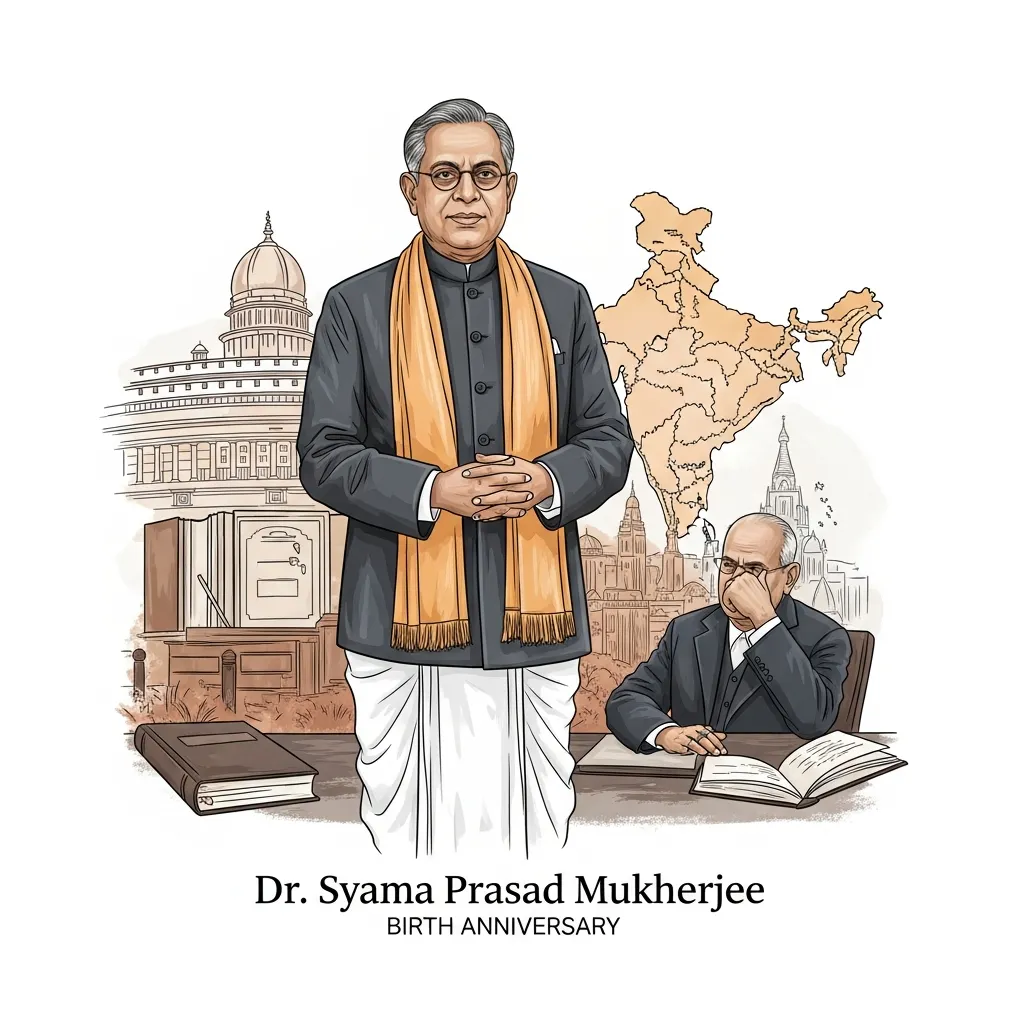
Introduction: Celebrating a Nation-Builder's Legacy
Dear students,
Imagine a leader who excelled in academics, law, and politics, all while holding a deep love for his country. Such was the remarkable life of Dr. Syama Prasad Mukherjee, whose 125th Birth Anniversary we proudly commemorate on July 6, 2026. Born into an era of great change and challenge for India, Dr. Mukherjee emerged as a towering figure whose vision, courage, and dedication left an indelible mark on the nation's destiny.
Often remembered as a brilliant educationist, a visionary politician, and an unwavering champion of national unity, Dr. Mukherjee's journey is a beacon of inspiration. He was not just a participant in India's freedom struggle and early nation-building; he was an architect, shaping its foundations with his strong principles and farsighted ideas. This article aims to explore the various facets of his extraordinary life – his academic brilliance, his crucial role in Indian politics, his pioneering educational reforms, and above all, his unwavering dream of a strong, united, and prosperous India. Let's embark on this journey to understand the legacy of a true patriot.
Early Life and Education: Roots of Brilliance
Syama Prasad Mukherjee was born on July 6, 1901, in a distinguished Bengali family in Calcutta (now Kolkata). His lineage itself spoke volumes; his father was Sir Ashutosh Mukherjee, a legendary figure in Bengal, known as the 'Tiger of Bengal,' an eminent jurist, and a visionary Vice-Chancellor of Calcutta University. Growing up in such an intellectual and patriotic environment naturally shaped young Syama Prasad's mind and character.
From a very young age, Syama Prasad displayed exceptional academic prowess. He was a bright student who consistently topped his classes. He completed his matriculation from Mitra Institution in 1917 and went on to study at Presidency College, Calcutta, where he earned a first-class honours degree in English in 1921. His thirst for knowledge didn't stop there. He pursued an M.A. in Bengali from Calcutta University in 1923 and then, following in his father's footsteps, completed his B.L. (Bachelor of Law) in 1924.
His academic journey then took him to England, where he became a Barrister-at-Law from Lincoln's Inn, London, in 1926. This period of study abroad not only broadened his legal understanding but also exposed him to different political and social ideas, further strengthening his resolve to contribute to his homeland. His early life was a testament to the power of education and the importance of a strong intellectual foundation.
A Brilliant Mind: Academic and Legal Career
Upon returning to India, Dr. Mukherjee quickly established himself as a prominent figure in both the legal and academic fields. He enrolled as an advocate in the Calcutta High Court in 1927, where his sharp intellect and persuasive arguments quickly earned him recognition. However, his true passion lay in education, a field where his father had left an unparalleled legacy.
His association with Calcutta University began much earlier, when he was elected a Fellow of the Senate in 1923, at the incredibly young age of 23. This was just the beginning of his remarkable journey in academic administration. In 1934, at merely 33 years old, Dr. Syama Prasad Mukherjee became the youngest Vice-Chancellor of Calcutta University. This was a monumental achievement, especially considering the university's prestigious standing.
As Vice-Chancellor, Dr. Mukherjee introduced several path-breaking reforms. He emphasized the importance of Indian languages, making Bengali a compulsory subject and promoting research in vernacular literature. He believed that education should not just impart knowledge but also instill a sense of national pride and cultural identity. He modernized the curriculum, encouraged scientific research, and worked tirelessly to make education accessible to a wider section of society. His tenure as Vice-Chancellor from 1934 to 1938 is still remembered as a golden period of academic innovation and growth for Calcutta University.
"Education is the foundation upon which a nation builds its future." - Dr. Syama Prasad Mukherjee
Entry into Politics: A Call to Serve
While his academic career flourished, Dr. Mukherjee felt an undeniable pull towards public service and politics, especially as India grappled with the final stages of its independence struggle. He believed that intellectuals had a crucial role to play in guiding the nation's destiny. His political journey began in 1929 when he was elected to the Bengal Legislative Council as a representative of Calcutta University.
His political career gained significant momentum in the 1930s and 40s. He became a prominent leader of the Hindu Mahasabha, a political party advocating for Hindu interests and a united India. During this period, he fearlessly spoke out against the divisive politics of the Muslim League and championed the cause of national unity. He was also a strong voice for the rights of minorities and opposed any form of discrimination.
One of his most critical contributions during this tumultuous period was his tireless effort to prevent the entire province of Bengal from being merged into East Pakistan during the Partition of India in 1947. He rallied support, organized protests, and negotiated with various leaders to ensure that West Bengal remained a part of India. His strategic vision and leadership were instrumental in saving a significant portion of Bengal for the Indian Union, a fact often overlooked but of immense historical importance.
Role in the Interim Government: Shaping Industrial India
After India gained independence in 1947, Dr. Syama Prasad Mukherjee was invited by Mahatma Gandhi to join the first Union Cabinet as the Minister for Industry and Supply. This was a significant gesture, as Dr. Mukherjee belonged to a different political party (Hindu Mahasabha) than the ruling Congress. It reflected his widely acknowledged administrative capabilities and his commitment to nation-building, transcending party lines.
Working alongside Prime Minister Jawaharlal Nehru, Dr. Mukherjee played a pivotal role in laying the foundations of independent India's industrial policy. He was a staunch advocate for rapid industrialization, believing it was essential for India to achieve economic self-reliance and become a strong, modern nation. He championed the establishment of several key industries, promoting both large-scale public sector enterprises and encouraging private sector growth.
His vision for industrial development was balanced, focusing on both heavy industries for foundational strength and small-scale industries for employment generation. He understood that a robust industrial base was crucial for India's defense, economic stability, and overall progress. His contributions in this sector helped shape the early economic direction of the newly independent nation.
Champion of National Unity: The Kashmir Issue
Perhaps one of the most defining aspects of Dr. Mukherjee's political career was his unwavering commitment to India's unity and integrity, especially concerning the state of Jammu & Kashmir. He firmly believed that Jammu & Kashmir was an integral part of India and that it should be treated no differently than any other state.
He strongly opposed the special status granted to Jammu & Kashmir under Article 370 of the Indian Constitution, arguing that it created a "state within a state" and hindered complete integration with the rest of India. His famous slogan, "Ek Vidhan, Ek Nishan, Ek Pradhan" (One Constitution, One Flag, One Head), encapsulated his vision for a truly unified nation where all states were governed by the same laws and shared a common national identity.
His differences with Prime Minister Nehru on this issue, among others, led to his resignation from the Union Cabinet in 1950. Undeterred, he launched a powerful agitation against Article 370 and the permit system that restricted entry into Jammu & Kashmir for other Indian citizens. In 1953, he decided to personally lead a peaceful protest into Jammu & Kashmir without a permit, challenging the existing restrictions. He was arrested on May 11, 1953, upon entering the state and was subsequently detained. Tragically, he passed away in custody on June 23, 1953, under mysterious circumstances. His sacrifice for the cause of national unity remains a poignant chapter in India's history, highlighting his deep conviction and courage.
Educational Reforms: A Passion for Learning
Even amidst his intense political activities, Dr. Syama Prasad Mukherjee's passion for education never waned. His tenure as Vice-Chancellor of Calcutta University was marked by significant, progressive reforms that continue to influence Indian education today. He understood that a nation's progress is directly linked to the quality and accessibility of its education system.
He introduced practical changes like promoting vocational training and research, recognizing that education should prepare students not just for academic pursuits but also for real-world challenges. He was a strong advocate for women's education and worked towards making universities more inclusive. Dr. Mukherjee believed that the curriculum should be dynamic, incorporating modern scientific advancements while remaining rooted in India's rich cultural heritage. He emphasized the importance of a holistic education that nurtured both the mind and the character of students.
His vision was to create educational institutions that were centers of excellence, fostering critical thinking, innovation, and a spirit of inquiry. He believed that through education, India could overcome its socio-economic challenges and emerge as a leader on the global stage. His educational philosophy was truly ahead of its time, advocating for a blend of traditional values and modern scientific temper.
The Ideological Foundation: Bharatiya Jana Sangh
Following his resignation from the Nehru cabinet, Dr. Syama Prasad Mukherjee felt the need for a strong, nationalist political voice that could represent his vision for India. In 1951, he founded the Bharatiya Jana Sangh (BJS), which later became the precursor to the Bharatiya Janata Party (BJP), one of India's major political parties today.
The establishment of the BJS was a significant moment in Indian politics, as it aimed to offer an alternative ideological framework. The core principles of the Bharatiya Jana Sangh, as articulated by Dr. Mukherjee, included:
- Cultural Nationalism: Emphasizing India's unique cultural identity and heritage as the binding force of the nation.
- Integral Humanism: A philosophy that sought to balance the needs of the individual, society, and nature, advocating for a holistic approach to human development.
- United India: A firm belief in the complete integration of all states, including Jammu & Kashmir, into the Indian Union.
- Democracy and Social Justice: Commitment to a democratic system that ensured justice and equality for all citizens, irrespective of caste, creed, or religion.
- Decentralization: Advocating for empowering local self-governments to ensure development reaches the grassroots.
Dr. Mukherjee envisioned the BJS as a constructive opposition, playing a vital role in a healthy democracy by providing alternative viewpoints and holding the government accountable. His efforts laid the groundwork for a distinct ideological stream in Indian politics that continues to influence the national discourse.
Principles and Legacy: Lessons for Today
Dr. Syama Prasad Mukherjee's life was a testament to his unwavering principles, which continue to resonate today. His legacy offers invaluable lessons for students and future leaders:
- Unwavering Nationalism: His deep love for India and his commitment to its unity were paramount. He believed in a strong, self-reliant India that commanded respect on the world stage.
- Courage of Conviction: He never shied away from standing up for what he believed was right, even if it meant opposing powerful figures or making personal sacrifices. His resignation from the cabinet and his journey to Kashmir are prime examples of his moral courage.
- Visionary Leadership: Whether in education or industry, he always looked ahead, anticipating the needs of the nation and proposing solutions that had long-term impact.
- Commitment to Education: He recognized education as the most powerful tool for national development and social upliftment. His reforms at Calcutta University reflect his profound belief in its transformative power.
- Democratic Values: Despite ideological differences, he worked within the democratic framework, advocating for a strong opposition and respectful debate.
His life reminds us that true leadership is about serving the nation with integrity, vision, and an unshakeable belief in its potential.
Dr. Mukherjee's Vision for India
Dr. Syama Prasad Mukherjee envisioned an India that was:
- United and Integrated: A nation where all states and regions felt a strong sense of belonging and were governed by common laws, fostering national cohesion.
- Economically Strong and Self-Reliant: An India with a robust industrial base, capable of producing its own goods and not dependent on foreign powers, thus ensuring economic sovereignty.
- Culturally Rooted and Modern: A country that preserved its ancient heritage and values while embracing scientific progress and modern thought.
- Educated and Enlightened: A society where knowledge was accessible to all, fostering critical thinking, innovation, and a sense of national purpose.
- Democratic and Just: A vibrant democracy where every citizen had equal rights and opportunities, and social justice prevailed.
His vision was not merely political; it was a holistic dream for a prosperous, powerful, and culturally proud India that stood tall in the comity of nations.
Did You Know? Interesting Facts About Dr. Syama Prasad Mukherjee
- Youngest Vice-Chancellor: Dr. Mukherjee became the youngest Vice-Chancellor of Calcutta University at the age of 33, a record that still stands.
- A Family of Visionaries: His father, Sir Ashutosh Mukherjee, was also a legendary Vice-Chancellor of Calcutta University and a legal luminary. Education and public service ran deep in their family.
- Resigned from Cabinet: He was one of the first ministers to resign from Prime Minister Jawaharlal Nehru's cabinet in 1950, citing differences over the Nehru-Liaquat Pact and the government's Kashmir policy.
- Saved West Bengal: His efforts were crucial in ensuring that a significant portion of Bengal (West Bengal) remained with India during the Partition, against plans that might have seen the entire province go to Pakistan.
- A Barrister from Lincoln's Inn: Like many prominent Indian leaders, he pursued his legal studies in London, becoming a Barrister from Lincoln's Inn.
- Champion of Indian Languages: As Vice-Chancellor, he made Bengali a compulsory subject for the Matriculation examination, emphasizing the importance of vernacular languages.
Conclusion: An Enduring Inspiration
As we reflect on Dr. Syama Prasad Mukherjee's 125th Birth Anniversary, his life stands as a powerful reminder of what a single individual, armed with conviction and a profound love for the nation, can achieve. From his early brilliance as an academic to his courageous stand as a politician, Dr. Mukherjee consistently prioritized the welfare and unity of India.
His contributions to education laid the groundwork for future generations, his industrial vision aimed at making India self-reliant, and his unwavering advocacy for national unity continues to inspire debates and discussions about the very fabric of our nation. For students today, Dr. Mukherjee's life offers a compelling narrative of leadership, sacrifice, and an unyielding commitment to principles.
Let us remember him not just as a historical figure, but as a guiding light whose vision for a strong, united, and prosperous India remains a timeless aspiration. May his legacy inspire each one of us to contribute to the nation's progress with the same dedication and patriotism he exemplified.