Introduction: The Lion of Bengal
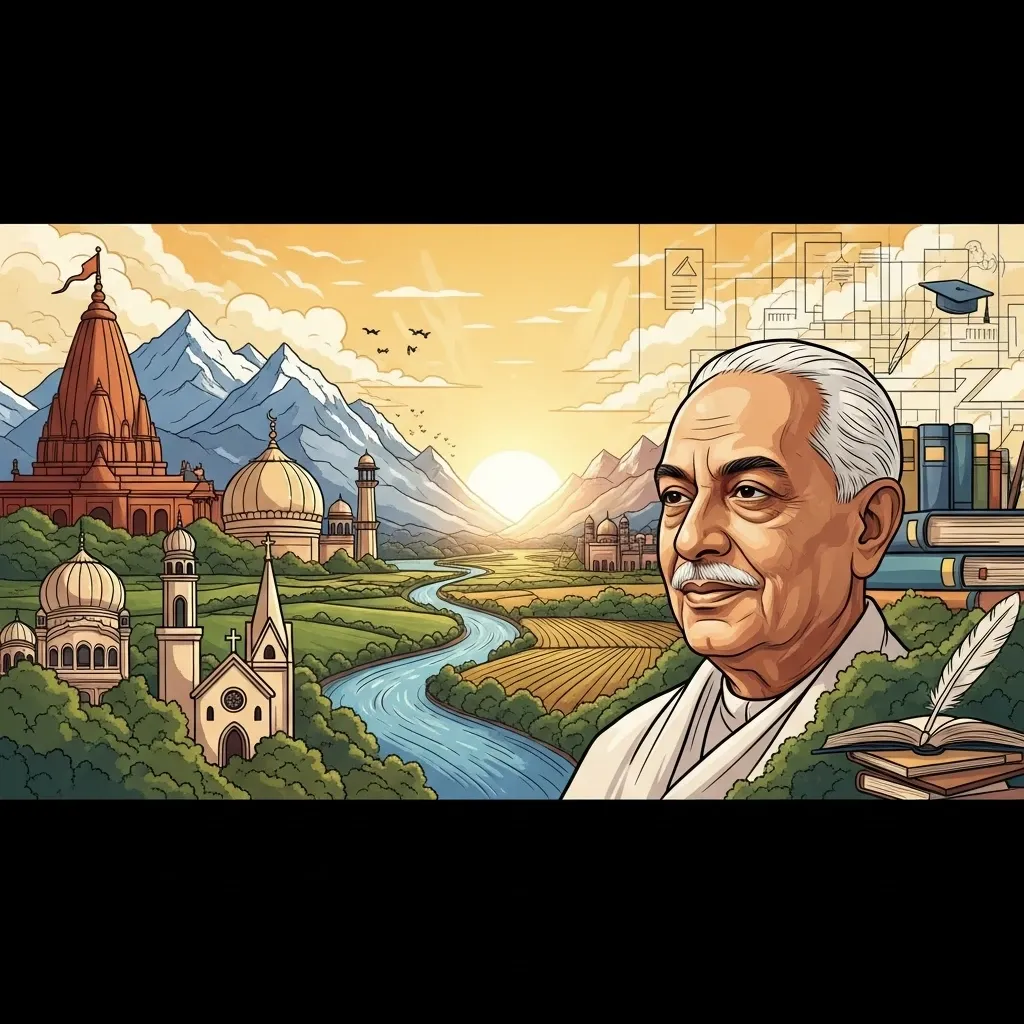
Dr. Syama Prasad Mookerjee was not merely a politician; he was a titan of intellect, a visionary educationist, and a fierce defender of India's integrity. Born into a family of profound academic lineage, his life became a testament to the synthesis of traditional Indian values and modern democratic principles. In this exhaustive exploration, we delve into the life of the man who famously declared, "Ek desh mein do Vidhan, do Pradhan aur do Nishan nahi chalenge" (One country cannot have two constitutions, two prime ministers, and two flags).
Early Life and Academic Brilliance
Born on July 6, 1901, in Calcutta (now Kolkata), Syama Prasad was the son of the legendary Sir Ashutosh Mookerjee, often called the 'Tiger of Bengal'. His father was a judge of the High Court and the Vice-Chancellor of Calcutta University. Growing up in such an environment, Syama Prasad inherited a deep love for Sanskrit and the Bengali language, alongside a rigorous scientific temperament.
Educational Milestones
- 1921: Graduated in English with first-class honors.
- 1923: Completed his MA in Bengali.
- 1924: Qualified as a Barrister-at-Law from Lincoln's Inn, London.
His academic career was so stellar that he was appointed to the Senate and the Syndicate of Calcutta University while still in his early twenties. His tenure as Vice-Chancellor was marked by the introduction of several vocational courses and the promotion of Indian languages in higher education.
Entry into Politics and the Fight for Bengal
Dr. Mookerjee entered the Bengal Legislative Council in 1929 as a Congress candidate but resigned when the party decided to boycott the councils. He later joined the Hindu Mahasabha, where he rose to become the National President. His political philosophy was rooted in the protection of the rights of minorities—specifically the Hindu minority in Bengal during the communally charged 1940s.
"Political liberty is a delusion if it is not accompanied by economic and social security." - Dr. Syama Prasad Mookerjee
During the Great Bengal Famine of 1943, Dr. Mookerjee worked tirelessly, organizing relief efforts and criticizing the British government's callousness. He was instrumental in ensuring that if India were to be partitioned, the Hindu-majority areas of Bengal remained with India, leading to the creation of West Bengal.
Minister of Industry and the Resignation
After independence, Prime Minister Jawaharlal Nehru invited him to join the first Union Cabinet as the Minister for Industry and Supply. He laid the foundation for India's industrial policy, emphasizing a mix of public and private sectors. He was the force behind the Chittaranjan Locomotive Works and the Sindri Fertilizer Factory.
| Project | Significance | Established |
|---|---|---|
| Sindri Fertilizer | First major industrial plant for agriculture | 1951 |
| Chittaranjan Locomotive | India's first step toward rail self-reliance | 1950 |
| Hindustan Aircraft | Nationalization and expansion | 1940s/50s |
However, ideological rifts appeared. The Nehru-Liaquat Pact of 1950, which Dr. Mookerjee felt failed to protect the Hindus of East Pakistan, led to his resignation from the cabinet. This was a turning point in Indian political history.
The Crusade for Kashmir and Martyrdom
The most defining chapter of his life was his opposition to Article 370. He believed that Jammu and Kashmir should be fully integrated into India without any special status or a separate flag and constitution. He challenged the permit system that required Indians to obtain a permit to enter J&K.
The Final Journey
In May 1953, he entered Kashmir without a permit as a mark of protest. He was arrested by the Sheikh Abdullah government and detained in a house in Srinagar. His health deteriorated rapidly, and on June 23, 1953, he passed away under mysterious circumstances. His death triggered a national outcry and solidified his status as a martyr for national unity.
Legacy and Impact on Modern India
Dr. Mookerjee's legacy is visible in the modern Indian political landscape. The eventual revocation of Article 370 in 2019 is seen by many as the fulfillment of his lifelong mission. He was a champion of civil liberties and a staunch advocate for a strong, united, and culturally rooted India.
Key Contributions:
- Educationist
- Modernized the curriculum and promoted indigenous languages.
- Statesman
- Conceptualized India's industrial growth model.
- Nationalist
- Sacrificed his life for the principle of 'One India'.