
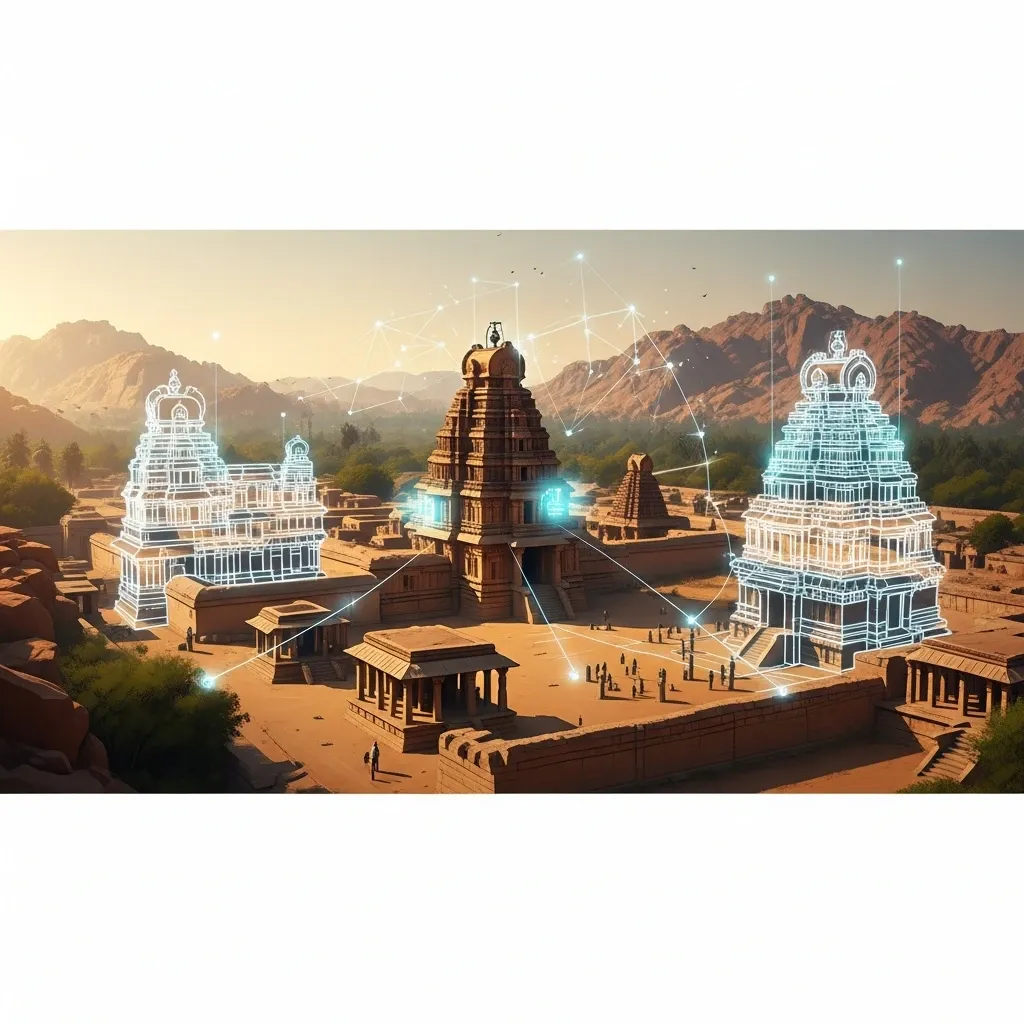
Introduction: Bringing the Past into the Future
Imagine standing amidst the sprawling ruins of Hampi, not as they appear today—weathered by centuries of sun and rain—but as they were in the 1500s. Picture the bustling markets of Hampi Bazaar, the vibrant colors of the Vitthala Temple, and the majestic presence of the Vijayanagara royalty. For decades, this was only possible through the imagination or academic sketches. However, with the advent of Digital Twin technology, 3D Laser Scanning, and Virtual Reality (VR), the 14th-century Vijayanagara Empire is being meticulously resurrected in the digital realm.
Historical Context: The Splendor of Vijayanagara
The Vijayanagara Empire (1336–1646) was a pinnacle of South Indian history. Founded by brothers Harihara I and Bukka Raya I, it became a bastion of Hindu culture, art, and architecture. Hampi, the capital, was described by medieval travelers like Abdul Razzaq and Domingo Paes as one of the most beautiful and prosperous cities in the world, rivaling Rome and Beijing.
The Dynastic Rule
The empire saw the rise of four major dynasties:
| Dynasty | Period | Key Contribution |
|---|---|---|
| Sangama | 1336–1485 | Foundation and initial expansion | Saluva | 1485–1505 | Consolidation of power | Tuluva | 1491–1570 | The Golden Age (Krishnadevaraya) | Aravidu | 1570–1646 | Post-Talikota recovery attempts |
The architecture at Hampi is characterized by massive granite blocks, intricate carvings, and an evolved irrigation system that demonstrated advanced civil engineering for its time.
The Technology: From Laser Pulses to Immersive Worlds
Creating a digital twin of a site as vast as Hampi (spanning over 4,100 hectares) requires a combination of sophisticated technologies. The primary tool is Terrestrial Laser Scanning (TLS), often referred to as LiDAR (Light Detection and Ranging).
How it Works: LiDAR and Photogrammetry
- LiDAR: A scanner emits millions of laser pulses per second. These pulses bounce off surfaces (pillars, ceilings, statues) and return to the sensor. By calculating the time taken, the system generates a 'Point Cloud'—a collection of millions of 3D coordinates.
- Photogrammetry: High-resolution photographs are taken from thousands of angles. These images are 'stitched' onto the LiDAR point cloud to provide realistic textures and colors.
The Virtues of Virtual Reality (VR) in Education
For students and teachers, VR technology transforms history from a dry textbook subject into an experiential journey. Using VR headsets, a student in a rural Indian school can "walk" through the Stone Chariot at the Vitthala Temple or explore the Elephant Stables as if they were physically present in Karnataka.
Case Study: The Vitthala Temple Complex
The Vitthala Temple is perhaps the most scanned structure in Hampi. Known for its 56 'musical pillars' that produce melodic sounds when tapped, it represents the zenith of Vijayanagara craftsmanship. Through digital twinning, researchers have analyzed the acoustic properties of these pillars in a virtual environment to understand how the ancient builders tuned the stone.
"Digital Hampi is not just about preservation; it is about democratizing heritage. It ensures that even if the physical stone crumbles, the knowledge and glory of our ancestors remain eternal." - Leading Heritage Tech Expert
Frequently Asked Questions
[accordion title="Why is Hampi called a 'UNESCO World Heritage Site'?"]Hampi was designated by UNESCO in 1986 due to its unique architectural style and its representation of the Vijayanagara Empire's cultural height.[/accordion]Conclusion: The Future of Indian Heritage
The integration of AI, VR, and 3D scanning marks a new era for Indian archaeology. As we move towards 2030, the goal is to create a National Digital Heritage Archive. Hampi serves as the flagship project for this movement, proving that while empires may fall, their digital twins can live forever, inspiring generations of students and historians to come.
