
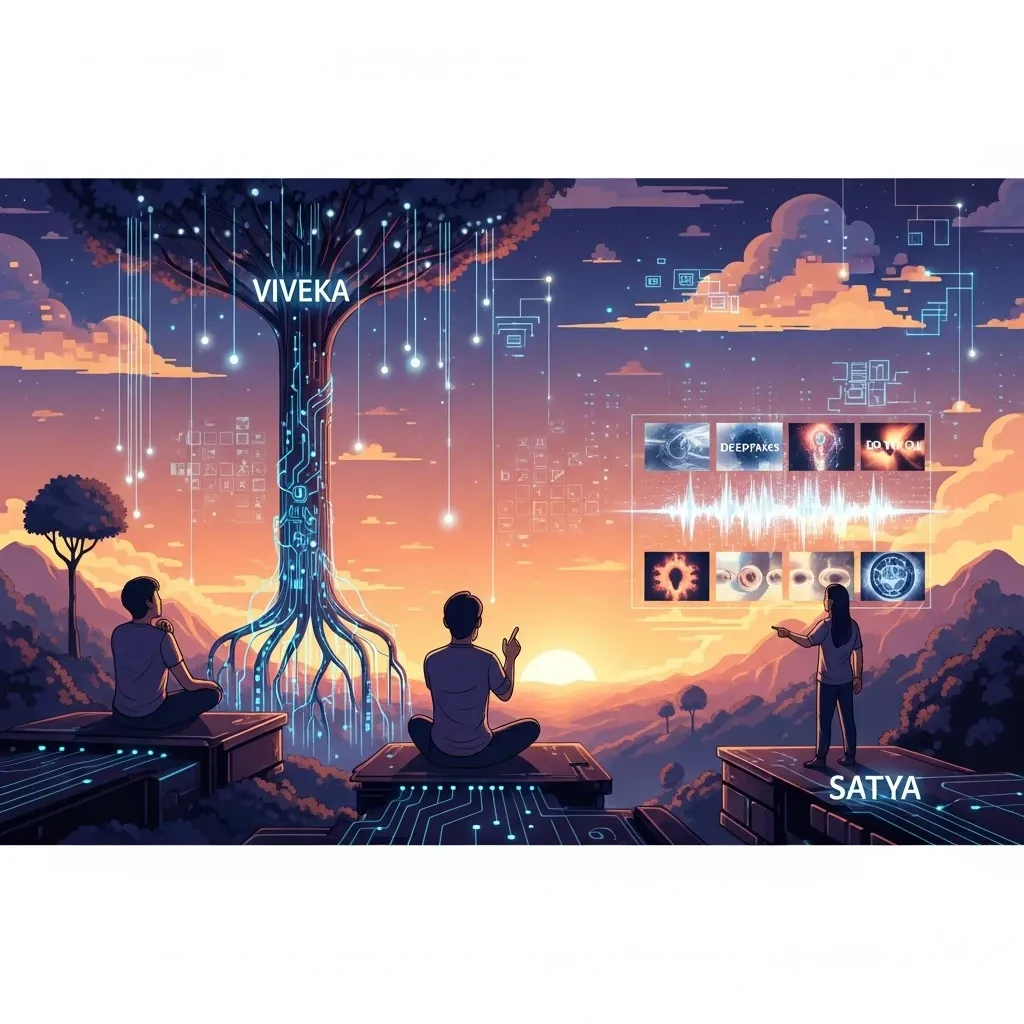
Introduction: The Intersection of Ancient Wisdom and 2026 Technology
Welcome to the year 2026. As we navigate a world where artificial intelligence (AI) has moved beyond simple chatbots to sophisticated agents capable of generating hyper-realistic deepfakes, the line between reality and simulation has blurred. For Indian students, this era presents a unique challenge: How do we maintain our moral compass in a digital landscape governed by algorithms? The answer lies in our ancient heritage. By reimagining the concepts of Viveka (Discernment) and Satya (Truth), we can establish a 'Digital Dharma' that guides our actions and protecting our minds.
Section 1: The Maya of 2026 - Understanding Deepfakes
In classical Indian philosophy, Maya refers to the illusion that prevents us from seeing the true nature of reality. In 2026, Maya takes the form of deepfakes. These are AI-generated videos, audios, or images that are indistinguishable from real recordings. Imagine receiving a video call from your teacher asking for sensitive information, only to find out it was a synthetic clone. This is the challenge of our time.
The Mechanics of Deception
Deepfakes utilize Generative Adversarial Networks (GANs), where two AI models compete: one creates the fake, and the other tries to detect it. By 2026, the 'creator' models have become so advanced that detection requires specialized software. This makes the human faculty of Viveka more critical than ever.
| Feature | Traditional Information | 2026 AI Content |
|---|---|---|
| Authenticity | Verified by reputable sources | Often synthesized by algorithms |
| Trust Factor | Based on history and reputation | Based on visual and auditory realism |
| Verification | Easy via cross-referencing | Requires cryptographic proof |
Section 2: Reimagining Viveka (Discernment)
Viveka is the ability to distinguish between the real (Sat) and the unreal (Asat). In the context of 2026, Viveka is the digital literacy skill of critical thinking. When we encounter information online, we must apply a 'Viveka Filter'.
The Three Pillars of Digital Viveka
- Source Scrutiny: Who is the author? Is the AI platform known for transparency?
- Intent Analysis: Why was this content created? Does it aim to provoke anger or spread misinformation?
- Technological Skepticism: Looking for subtle artifacts in AI-generated media, such as unnatural lighting or mismatched lip-syncing.
Section 3: Satya (Truth) in a Post-Truth World
Satya is often translated as truth, but in the context of Dharma, it also means integrity and alignment with reality. In 2026, staying true to Satya means more than just not lying; it means actively combating the spread of algorithmic bias and false narratives.
"Satyam eva jayate nanrtam" (Truth alone triumphs, not falsehood). This ancient motto is the ultimate battle cry for the 2026 student.
Algorithmic Bias: The Hidden Enemy of Satya
Algorithms are not neutral. They are trained on historical data that often contains human prejudices. When an AI system suggests career paths or grades essays, it might be biased against certain demographics. Recognizing this bias is a form of pursuing Satya. It requires us to demand transparency from tech giants.
Section 4: Implementing Digital Dharma
How does a student practice Digital Dharma daily? It involves a set of ethical commitments designed for the digital age.
- Non-Maleficence (Ahimsa): Not using AI to bully, harass, or create non-consensual imagery of others.
- Veracity: Fact-checking every piece of information before internalizing or sharing it.
- Data Mindfulness: Being aware of how our data (the 'digital self') is being used and harvested by AI models.
Frequently Asked Questions
Conclusion: The Path Forward
As we stand in 2026, the fusion of Indian ethics and modern technology offers a pathway to a better society. By practicing Viveka, we protect ourselves from the illusions of deepfakes. By upholding Satya, we ensure that our digital world remains grounded in reality. This is your Digital Dharma. Embrace it, share it, and let it guide you through the complex algorithms of the future.