Introduction: The Dawn of a Connected World
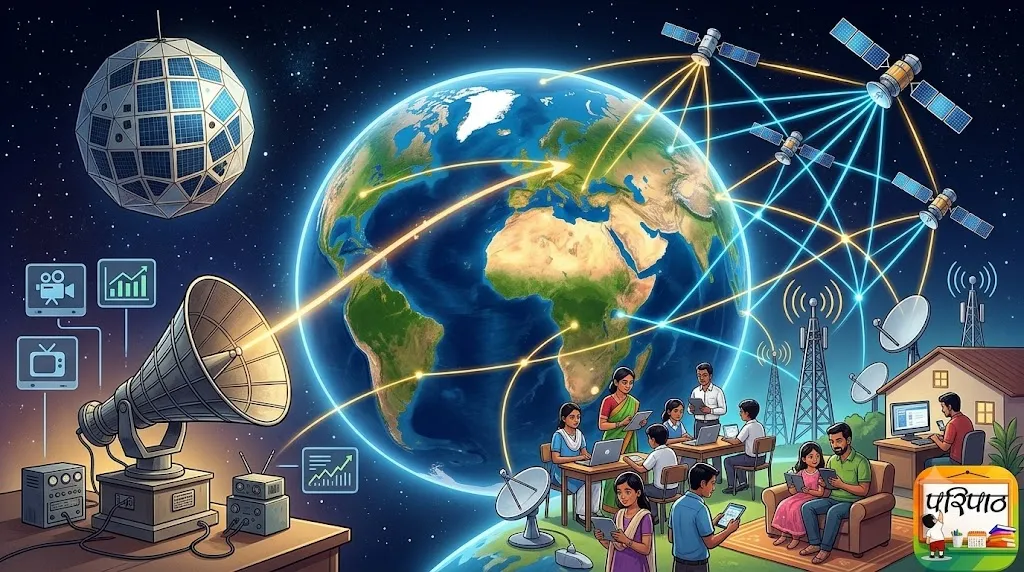
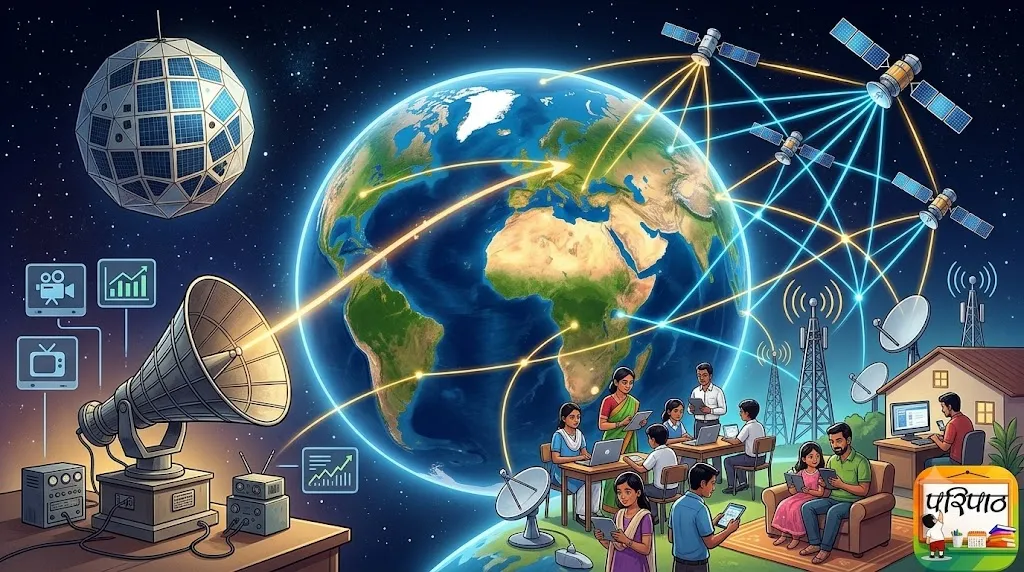
Hello students! Today, July 10, 2026, marks a significant date, not just for the auspicious occasion of Yogini Ekadashi, but also as a reminder of a scientific breakthrough that forever changed our world. We're talking about communication satellites – the celestial marvels that have seamlessly connected people across the globe.
Exactly 64 years ago, on July 10, 1962, a small satellite named 'Telstar 1' soared into space. Little did anyone know then that this unassuming orbiter would become a monumental milestone in the history of global communication. Telstar 1 made history by relaying the first live transatlantic television broadcast, bridging the vast expanse between America and Europe. This moment was not just a testament to scientific prowess but also a new chapter in human history, fostering global unity.
Today, we embark on an incredible journey tracing the evolution of communication satellites, starting with the pioneering Telstar 1. We will explore how these 'eyes in the sky' have transformed television, radio, telephony, and the internet, highlighting India's significant contributions through the Indian Space Research Organisation (ISRO). So, let's dive into this captivating story!
Telstar 1: Pioneering a New Era of Communication
On July 10, 1962, Telstar 1 was launched aboard a Delta rocket from Cape Canaveral, USA. This satellite was the culmination of collaborative efforts by Bell Labs, NASA, and AT&T. Telstar 1 was more than just an experimental satellite; it was the key to unlocking future global communication.
The primary objective of this satellite was to transmit television signals across the Atlantic Ocean. Within hours of its launch, Telstar 1 successfully relayed the first live television broadcast from Andover, Maine, in the United States, to Pleumeur-Bodou, France. This broadcast featured segments of a speech by then-US President John F. Kennedy and snippets of a baseball game. Millions worldwide watched this historic event, a truly unforgettable experience.
Telstar 1 was an 'active' satellite, meaning it received signals from Earth (uplink), amplified them, and then retransmitted them back to Earth (downlink). This was a significant advancement over previous 'passive' satellites, like Echo 1, which merely reflected signals. Telstar 1 operated in an elliptical orbit, meaning it was only visible from ground stations for specific periods. This necessitated multiple ground stations to maintain continuous communication.
Did You Know? Telstar 1 weighed approximately 77 kilograms and had a diameter of just 87 centimeters. Its surface was covered with solar panels to generate power.
Beyond television, Telstar 1 also successfully relayed telephone calls and fax messages. Its success demonstrated the immense potential of satellites as an effective medium for global communication. Telstar 1 laid the groundwork for the development of subsequent, more advanced communication satellites that truly connected the world in the decades that followed.
Types of Communication Satellites and Their Functions
Since Telstar 1, communication satellite technology has advanced dramatically. Today, we primarily find satellites in three main types of orbits, each with unique characteristics and applications:
1. Geostationary Satellites (GEO)
- Orbit: Approximately 36,000 kilometers above the Earth's equator.
- Characteristic: These satellites orbit at a speed that matches the Earth's rotation, making them appear stationary from the ground.
- Applications: Crucial for television broadcasting (DTH), radio, weather forecasting, internet services, and long-distance telephone communication. A single GEO satellite can cover roughly one-third of the Earth's surface.
2. Low Earth Orbit Satellites (LEO)
- Orbit: Between 160 and 2,000 kilometers above the Earth's surface.
- Characteristic: Being closer to Earth, these satellites offer lower signal travel time, resulting in higher data transfer speeds and reduced latency. However, they are not stationary but orbit the Earth rapidly.
- Applications: Used for mobile communication, remote sensing, scientific research, and increasingly for satellite internet constellations like Starlink. Many LEO satellites work together to form a 'constellation,' providing broad coverage.
3. Medium Earth Orbit Satellites (MEO)
- Orbit: Between 2,000 and 36,000 kilometers.
- Characteristic: These satellites combine features of both GEO and LEO orbits, covering more area than LEOs and offering lower latency than GEOs.
- Applications: Primarily used for Global Positioning Systems (GPS), India's NavIC system, and other navigation services.
All these satellites are equipped with 'transponders.' These devices receive signals (uplink) from Earth, change their frequency, amplify them, and then retransmit them back to Earth (downlink). This process ensures that distant signals are transmitted clearly and quickly.
India's Contribution to Space: ISRO's Soaring Achievements
India has played an immensely significant role in the development of communication satellite technology. The Indian Space Research Organisation (ISRO) is recognized globally as a leading space agency. India's space journey began in the 1960s, driven by the visionary leadership of Dr. Vikram Sarabhai.
Early Milestones and the INSAT Revolution
India launched its first satellite, 'Aryabhata,' in 1975. While not a communication satellite, it provided significant impetus to India's space program. Subsequently, in 1980, with the launch of the Rohini satellite, India achieved the capability to launch satellites from its own soil.
In the realm of communication satellites, the 'Indian National Satellite System' (INSAT) series proved to be a game-changer for India. INSAT-1A was launched in 1982, and despite some initial technical glitches, this series revolutionized India's communication sector. INSAT satellites have made significant contributions to television broadcasting, radio services, weather forecasting, emergency communication, and extending telephone services to rural areas. The nationwide reach of Doordarshan and connecting thousands of villages by telephone were made possible by INSAT.
GSAT Series and Indigenous Capabilities
Following the INSAT series, ISRO developed the 'Geosynchronous Satellite' (GSAT) series. These satellites are more advanced and powerful, providing high-quality communication and broadband internet services. Satellites like GSAT-11, GSAT-19, and the upcoming GSAT-20 (formerly GSAT-11) are bolstering India's Digital India initiative.
India has not only built satellites but has also developed its own rocket technology for launching them. Launch vehicles like PSLV (Polar Satellite Launch Vehicle) and GSLV (Geosynchronous Satellite Launch Vehicle) have made India self-reliant in the satellite launch domain. Notably, on this very day, July 10, 2026, ISRO has successfully launched five British satellites, further solidifying its position in the global space market and demonstrating India's growing prowess.
Impact on Daily Life: An Invisible Revolution
Communication satellites have brought such profound changes to our daily lives that we often take them for granted. It's challenging to imagine modern life without these 'eyes in the sky.'
- Television and Entertainment: Satellites allow us to watch any television channel from around the world live. Whether it's a cricket match, the Olympic Games, or breaking news, satellites make it possible to watch it all live. Direct-To-Home (DTH) services are a prime example.
- Internet and Connectivity: In rural and remote areas where fiber optic cables cannot reach, satellite internet is a boon. Services like Starlink are now providing high-speed internet access from almost any corner of the Earth, facilitating education, business, and social interaction.
- Mobile Communication: While satellites don't directly facilitate every mobile phone call, they are crucial for connecting mobile towers and extending mobile services to remote regions. In emergencies, when terrestrial networks fail, satellite phones become indispensable.
- Weather Forecasting and Disaster Management: Satellites provide accurate weather forecasts and timely information about natural disasters like storms, floods, and tsunamis. This saves millions of lives and enables efficient disaster relief efforts.
- Navigation and GPS: The Global Positioning System (GPS) relies on satellites, allowing us to pinpoint our location anywhere in the world with accuracy. It's used in cars, ships, airplanes, and even smartphones. India's 'NavIC' system is a significant step in this direction.
- Education and Healthcare: Satellites have enabled distance learning and telemedicine. Students in remote areas can access e-learning, and doctors can consult patients from afar.
Future of Satellite Technology and Challenges
The journey of communication satellites, though starting with Telstar 1, is far from over. In the future, this technology is set to become even more advanced and revolutionary.
1. Mega-Constellations
Companies like Starlink, OneWeb, and Amazon's Project Kuiper are launching thousands of small satellites into LEO orbits. These 'mega-constellations' promise to deliver ultra-low-latency, high-speed internet globally, even to the most remote areas. This will open new possibilities for 5G and 6G technologies.
2. Quantum Communication
In the future, satellites will be used for quantum communication, making data transfer incredibly secure. China has already tested quantum communication with its 'Mozi' satellite, which is crucial for cybersecurity.
3. Miniaturization of Satellites
Today, satellites are being designed to be smaller, lighter, and more powerful. Small satellites like CubeSats and NanoSats can be launched at lower costs and used for specific tasks, making space technology more accessible.
4. The Challenge of Space Debris
As the number of satellites in space increases, the problem of 'space debris' is becoming severe. Old satellites, rocket parts, and fragments from collisions pose a threat to other operational satellites. Managing and mitigating this debris is a major future challenge.
5. New Applications
The use of satellites will continue to expand into areas like the Internet of Things (IoT), agricultural monitoring, climate change studies, and advanced emergency response systems. Satellite technology will continue to connect every industry and every individual on Earth.
Did You Know?
- First Artificial Satellite: Russia launched 'Sputnik 1,' the world's first artificial satellite, on October 4, 1957.
- Fastest Satellite: The International Space Station (ISS) orbits Earth at approximately 28,000 kilometers per hour, completing one orbit every 90 minutes.
- Communication on the Moon: To realize the dream of human settlements on the Moon, NASA and other space agencies are planning to establish communication satellites around the Moon.
- Satellite Graveyard: Inactive geostationary satellites are often moved to a 'graveyard orbit' much higher than the operational GEO belt to prevent them from interfering with active satellites.
- India's Record: India's PSLV rocket set a world record in 2017 by launching 104 satellites in a single mission.
Conclusion
The journey of communication satellites, which began with the launch of Telstar 1, is a magnificent testament to human ingenuity and relentless effort. These satellites have truly transformed the world into a 'global village,' facilitating seamless information exchange, bringing cultures closer, and opening the doors to knowledge.
India, through ISRO, has not only participated in this journey but has also made significant contributions, establishing itself as a global space power. Communication satellites are not just technological marvels; they are symbols of human unity and progress. In the future, this technology will become even more advanced, profoundly impacting every aspect of our lives. By overcoming challenges like space debris, satellites will continue to play an invaluable role in creating a more connected and prosperous future for humanity.
As we commemorate this historic day of Telstar 1 on July 10, let's appreciate these unseen heroes who have connected us to each other and to the world. Thank you!