
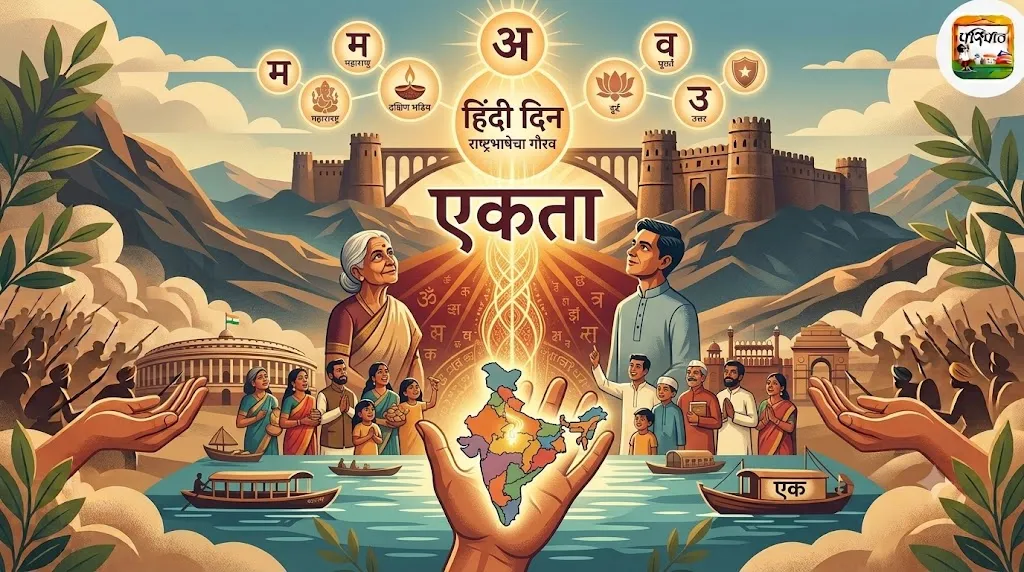
Introduction: Celebrating Hindi Diwas – A Day for India's Official Language
India, a land of unparalleled diversity, is a vibrant tapestry woven with countless languages, cultures, and traditions. Among this rich linguistic fabric, Hindi holds a significant position. Every year on September 14th, the nation joyfully celebrates ‘Hindi Diwas’ or Hindi Day. This day is not merely an observance of a language; it is a celebration of India's linguistic richness, a tribute to national unity, and an acknowledgment of Hindi's crucial role as a medium of communication.
It was on this very day in 1949 that the Constituent Assembly of India officially adopted Hindi (written in Devanagari script) as one of the official languages of the Union. This decision was a landmark moment in the journey of independent India, shaping its linguistic policy. This article aims to explore the historical context of Hindi Diwas, the profound importance of Hindi, its literary contributions, and its place within India's diverse linguistic landscape. Furthermore, it seeks to inspire students to appreciate the beauty of Hindi and recognize its multifaceted benefits.
The Journey to Official Status: Hindi in the Constituent Assembly
After gaining independence, India faced numerous challenges, and one of the most significant was deciding on a national language. The newly formed nation needed a language that could bind its diverse populace, facilitate smooth communication across regions, and foster a strong sense of national identity. The Constituent Assembly, responsible for drafting the Indian Constitution, engaged in extensive debates and discussions on this very sensitive topic.
Debates and the Historic Decision of September 14, 1949
Even before independence, leaders like Mahatma Gandhi advocated for Hindi to be recognized as the national language, given its widespread usage, particularly in North India. However, this proposal faced considerable resistance from the southern states, where there were concerns that promoting Hindi might undermine their regional languages and cultural identities. The framers of the Constitution, recognizing the need for a balanced approach, sought a compromise.
On September 14, 1949, the Constituent Assembly made a momentous decision. It declared Hindi, written in the Devanagari script, as the Official Language of the Union, while English was to continue as an associate official language for a period of 15 years. Article 343 (1) of Part XVII of the Indian Constitution states: “The official language of the Union shall be Hindi in Devanagari script.”
This decision established Hindi not as the 'National Language' (as India does not have one), but as the primary 'Official Language' for the Union's administrative and communication purposes. This day was subsequently designated as ‘Hindi Diwas’ to honor the language and commemorate this historic adoption. This move provided a clear direction for India's linguistic policy and cemented Hindi's role as a vital instrument of national integration.
Hindi as a Unifying Force: Communication, Education, and National Unity
Hindi has played a pivotal role not only at governmental and administrative levels but also in the daily lives of ordinary people. Its contributions to communication, education, and national unity are immense and invaluable.
A Bridge for Communication
Across India's vast geography, where hundreds of languages and dialects are spoken, Hindi acts as a crucial link. It is widely used in North, West, and Central India, and many non-Hindi speaking states learn it as a second language. This facilitates communication between people from diverse regions, fostering cultural exchange and mutual understanding.
Mass media, including cinema, television, and radio, have significantly propelled Hindi into every household. Hindi films, popularly known as 'Bollywood,' enjoy immense popularity not just in India but globally. These mediums have contributed to the widespread reach of Hindi, making it an important source of entertainment and information for many non-Hindi speakers.
Hindi's Place in Education
In the realm of education, Hindi holds a significant position. It is taught as a compulsory or optional subject in central government schools and many state schools. The Three-Language Formula encourages students to learn three languages: their mother tongue, Hindi, and English. This policy aims to promote multilingualism among students, connecting them with various cultures.
The availability of educational material, textbooks, and research in Hindi stimulates knowledge creation and dissemination. Numerous universities offer higher education in Hindi literature, linguistics, and journalism, contributing to its academic growth.
Symbol of National Integration
Hindi stands as a powerful symbol of national integration. When people from different linguistic backgrounds communicate in Hindi, a bond is forged. The use of Hindi during national festivals, government programs, and public events evokes a sense of national pride and belonging. Through Hindi, we can better understand our country's history, culture, and traditions. It is an integral part of India's rich cultural heritage, working to weave the nation together into a single thread.
A Literary Legacy: Hindi's Contribution to India's Cultural Fabric
The strength of any language is best reflected in its literature, and Hindi literature is no exception. It boasts an incredibly rich and diverse tradition that has been an integral part of India's cultural and spiritual life for centuries.
From Ancient Bhakti to Modern Narratives
The history of Hindi literature traces back to the Bhakti (devotional) period, where saints like Kabir, Tulsidas, Surdas, and Meera Bai conveyed spiritual wisdom and social messages through their dohas, chaupais, and padas. Tulsidas's 'Ramcharitmanas' remains an invaluable gem of Hindi literature, revered even today.
In the modern era, literary giants such as Premchand, Jaishankar Prasad, Suryakant Tripathi 'Nirala', Mahadevi Verma, Harivansh Rai Bachchan, and Ramdhari Singh 'Dinkar' elevated Hindi literature to new heights. Premchand's stories and novels vividly depicted rural Indian life, social issues, and profound human emotions. His works like 'Godaan', 'Karmabhoomi', and 'Kafan' remain as poignant and relevant today as they were when written.
Modern Hindi literature encompasses a wide array of genres, including poetry, short stories, novels, plays, essays, and travelogues. Hindi literature played a crucial role in social reform, the freedom struggle, and nation-building. Many litterateurs used their pens to awaken public consciousness and inspire people to fight for the country's independence.
Literary Awards and Recognition
For their outstanding contributions to Hindi literature, many writers have been honored with prestigious awards like the Sahitya Akademi Award and the Jnanpith Award. These accolades have brought Hindi literature international recognition and continue to inspire new generations of writers.
Hindi literature is not just entertaining; it is a vital medium for social, ethical, and philosophical thought. It offers deep insights into human experience, relationships, and the various facets of life. Encouraging students to read and understand Hindi literature is crucial for their cultural and intellectual development.
Beyond Hindi: Cherishing India's Linguistic Diversity
The true essence of Hindi Diwas lies not just in celebrating Hindi but in honoring India's rich linguistic diversity. India is not a country of Hindi speakers alone; it is home to millions who speak Marathi, Bengali, Tamil, Telugu, Kannada, Malayalam, Gujarati, Punjabi, and numerous other languages. All these languages are an integral part of India's cultural heritage.
Constitutional Provisions for Language
The Indian Constitution respects this linguistic diversity profoundly. The Eighth Schedule of the Constitution currently includes 22 languages, all of which are officially recognized. All these languages are given equal importance and respect. When Hindi was adopted as an official language, it was ensured that the development of other languages would not be neglected.
On Hindi Diwas, we must remember that promoting Hindi does not mean undermining any other Indian language. On the contrary, Hindi serves as a link language, bringing people from different linguistic backgrounds together to understand each other's cultures. It is a symbol of unity that connects diversity.
Benefits of Multilingualism
Being multilingual is a significant advantage. Students who master their mother tongue, Hindi, and English gain numerous benefits:
- Wider Communication Reach: The ability to communicate with a broader range of people.
- Deeper Cultural Understanding: A profound insight into diverse cultures, literatures, and traditions.
- Enhanced Cognitive Development: Learning multiple languages boosts brain development and problem-solving skills.
- Career Opportunities: Multilingual individuals are often preferred in various professional fields.
Therefore, on Hindi Diwas, let us pledge to respect all Indian languages. Each language possesses its unique beauty and significance. India's true strength lies in this diversity, where every language adds a beautiful hue, collectively creating a magnificent picture.
For Young Minds: Why Learning Hindi Matters
Dear students, Hindi Diwas is not just a national celebration; it is an opportunity for you. An opportunity to become a part of India's rich linguistic heritage, to acquire new skills, and to become a responsible citizen.
Benefits of Learning Hindi:
- Connect with People Across India: Whether you are traveling to different parts of India or interacting with people from various states, Hindi will serve as a crucial medium. This will expand your social and professional network.
- Enhance Cultural Understanding: Learning Hindi will provide you with in-depth knowledge of Hindi literature, cinema, music, and traditions. This will connect you with India's diverse cultures and history.
- Educational and Professional Opportunities: Good proficiency in Hindi can be beneficial for your education and career. Knowledge of Hindi is essential in many central services, journalism, teaching, tourism, and translation sectors.
- Cognitive Development: Learning a new language is an excellent exercise for your brain. It enhances your memory, problem-solving abilities, and creativity.
- Fosters National Integration: By learning Hindi, you actively contribute to the process of national integration. This language connects us to the concept of 'Ek Bharat, Shreshtha Bharat' (One India, Great India).
Did You Know?
- On September 14, 2015, the first direct detection of Gravitational Waves was made, a phenomenon predicted by Albert Einstein a century earlier.
- Renowned Hollywood actor Patrick Swayze passed away on September 14, 2009. He was famous for his roles in films like 'Dirty Dancing' and 'Ghost.'
- Veteran Marathi actor Chandrakant Mandare passed away on September 14, 2010. He played significant roles in numerous Marathi films and plays.
- Microsoft opened its first office in Albuquerque, New Mexico, on September 14, 1975, marking a crucial milestone in its historic journey.
- Today, September 14th, is the birthday of popular Bollywood actor Ayushmann Khurrana, who has won hearts with his acting and unique choice of films.
Conclusion: The Enduring Spirit of Hindi Diwas
Hindi Diwas is more than just a celebration of a language; it is an ode to India's rich cultural heritage, linguistic diversity, and the spirit of national unity. With its adoption as an official language on September 14, 1949, Hindi became an integral part of India's administrative, educational, and cultural life. It has played a crucial role in fostering communication, promoting education, and building a sense of national identity.
As students, it is vital to understand the importance of the Hindi language and strive to embrace it. Simultaneously, we must also respect and appreciate all other regional languages of our country. For India's true strength lies in its diversity, where each language adds a beautiful color, collectively creating a magnificent picture. On Hindi Diwas, let us honor all languages and further strengthen the vision of 'Ek Bharat, Shreshtha Bharat'.
