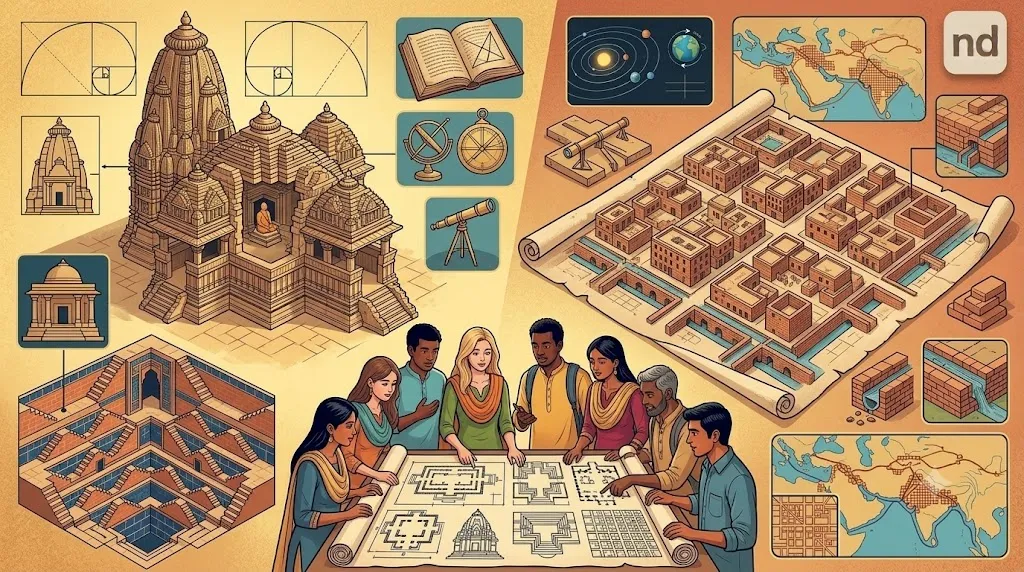
Hello students! Today, October 10, 2026, marks the auspicious occasion of Sarvapitru Amavasya and Mahalaya Amavasya. As we remember luminaries like Ghazal Samrat Jagjit Singh, renowned actress Manorama, former Defence Minister Mulayam Singh Yadav, and Christopher Reeve, let's also journey back in time to explore a remarkable aspect of our rich heritage: Ancient Indian Architecture.
When we think of ancient buildings, do we just picture old stone structures? Think again! Ancient Indian architecture was far more than mere construction; it was a profound fusion of science, mathematics, astronomy, engineering, and art. Our ancestors, thousands of years ago, created marvels that stand today as enduring testaments to their foresight, skill, and deep knowledge. Let's delve into this incredible world!
The Scientific & Mathematical Backbone: Unlocking Architectural Secrets
A closer look at ancient Indian architecture immediately reveals that its beauty wasn't just aesthetic; it was rooted in deep scientific and mathematical principles. Vastu Shastra is a prime example, a comprehensive science that balanced energy, space, light, and air, extending far beyond simple directional guidelines.
- Vastu Shastra: Harnessing Natural Energies: Ancient architects meticulously studied directions, terrain, water sources, and natural energy flows. Temples and homes were designed to maximize sunlight and airflow, ensuring natural cooling and a positive energy flow within the structures.
- Geometry and Astronomy: Many temples were designed based on intricate geometric patterns, such as mandalas and Sri Yantras. These weren't merely artistic; they held significant astronomical importance. For instance, the Konark Sun Temple was engineered to align with the sun's movement, allowing specific sun rays to illuminate the sanctum at precise times of the day – a stunning display of ancient astronomical knowledge.
- Precision of Proportions: The mathematical precision in the proportions of every part of a temple—its height, width, and angles—continues to astound modern engineers. These precise ratios not only ensured structural stability but also created a harmonious and aesthetically balanced form.
“Ancient Indian architecture was not just an art form; it was an integral part of life, philosophy, and science.”
Engineering Marvels of Yesteryears: Stone That Spoke Volumes
Even today, when we gaze upon ancient Indian monuments, a question often arises: How were such grand and complex structures built without modern tools? The answer lies in their advanced engineering prowess.
Stone Masonry and Interlocking Techniques
Ancient Indian builders were master stonemasons. They employed unique joining techniques that often didn't require cement or mortar. Stones were carved with such precision that they fit together perfectly, creating an incredibly strong interlocking system. This provided immense stability to the structures. The rock-cut caves of Ajanta and Ellora in the Deccan Plateau are prime examples, carved out of massive single rocks, showcasing unparalleled engineering skill.
Water Management and Stepwells
Water management was a crucial aspect of ancient Indian engineering. Stepwells (Baolis or Vavs) are magnificent examples of this. Found predominantly in Rajasthan and Gujarat, these weren't just water sources but architectural wonders. Rani ki Vav, a UNESCO World Heritage site, is a breathtaking stepwell renowned for its beauty and engineering. These multi-storied structures descended deep into the earth to reach groundwater levels, ensuring a year-round water supply. Their design was carefully planned to minimize water evaporation and maintain a cool microclimate.
The water management systems in the Indus Valley Civilization cities, like Harappa, were so advanced they would impress modern urban planners. Every house had a bathroom and toilet, complemented by an elaborate underground drainage system for wastewater. This underscores the high priority given to hygiene and public health.
Sustainable Living, Ancient Style: Harmony with Nature
Today, we talk extensively about sustainable architecture, but ancient Indians had mastered this concept thousands of years ago. Their designs were in perfect harmony with nature, demonstrating profound respect for the environment.
- Use of Local Materials: Ancient architects consistently used locally available materials such as stone, earth, timber, and lime. This reduced transportation costs and environmental impact. These materials were naturally durable and adapted to local climatic conditions.
- Natural Ventilation and Lighting: Many ancient buildings incorporated excellent natural ventilation and lighting. Jali work (perforated screens), strategically placed windows, and verandas were designed to allow hot air to escape and cool air to enter, reducing the need for artificial cooling. This saved energy and maintained comfortable indoor temperatures.
- Afforestation and Green Spaces: Extensive tree planting and green spaces were common around temples and palaces. This was not merely for aesthetics but also crucial for temperature regulation, air purification, and water conservation.
Art, Aesthetics, and Deep Meanings: A Story in Every Carving
Another profound aspect of ancient Indian architecture is its artistry and symbolism. Every temple, every carving, and every sculpture tells a story, conveying a philosophy.
- Sculpture and Iconography: The intricate carvings on temples like Khajuraho, Konark, and Hampi are not just stone sculptures; they are mirrors reflecting the society, culture, religion, and life of their times. Deities, mythological narratives, dance, and music depicted were not only visually pleasing but imbued with deep religious and cultural meanings.
- Colors and Murals: The murals and frescoes in the Ajanta and Ellora caves are exquisite examples of ancient Indian painting. The natural pigments used in these paintings have retained their vibrancy for centuries, indicating advanced knowledge of chemistry.
- Symbolic Designs: Many temples were designed around specific symbols. For instance, the erotic sculptures at Khajuraho are believed by some scholars to represent not merely sensuality, but various facets of life and stages on the path to spiritual liberation.
Pioneering Urban Planning: Seeds of Modernity
Beyond temples, ancient Indian cities boasted remarkably advanced urban planning. The cities of Harappa and Mohenjo-Daro from the Indus Valley Civilization stand as prime examples.
- Planned Layouts: These cities were built on a grid layout, with roads intersecting at right angles. Residential and public buildings were meticulously planned.
- Sanitation and Water Management: Each house had a bathroom, toilet, and an underground drainage system for wastewater. Public baths, like the 'Great Bath' of Mohenjo-Daro, and granaries testify to a sophisticated social and economic system.
- Public Spaces: Designated areas for public gatherings and markets facilitated social cohesion and trade.
Fortresses like Daulatabad Fort also exhibit incredible defensive engineering, featuring multi-layered fortifications, secret passages, and unique water management systems.
Conclusion
Ancient Indian architecture was far more than just buildings or monuments; it was a living testament to the intelligence, foresight, and profound connection our ancestors had with the natural world. It beautifully blended science, mathematics, engineering, art, and environmental respect. These structures have not only withstood the test of time but continue to inspire the world today. We must cherish and learn from this incredible heritage. This glorious chapter of our history will always be a source of pride and inspiration.
Did You Know?
- Konark Sun Temple's Wheels: The magnificent wheels on the Konark Sun Temple are not just decorative; they are accurate sundials that can tell the time of day with remarkable precision!
- Ajanta-Ellora Caves: Carved out of a single massive rock, these temples and monasteries have endured for thousands of years, showcasing the pinnacle of ancient construction skill.
- The Iron Pillar of Delhi: Located in the Qutub Minar complex, this iron pillar is over 1500 years old and has not rusted yet! It's an astounding example of ancient Indian metallurgy.
- Musical Pillars of Hampi: The Vittala Temple in Hampi features 'musical pillars' that produce distinct musical notes when gently tapped, a marvel of acoustic engineering.
- Mohenjo-Daro's 'Great Bath': This public bath from the Indus Valley Civilization was so waterproof that it could still hold water today. It's an excellent example of ancient waterproofing technology.