Introduction: Lokmanya Tilak – Architect of Indian Nationalism and Self-Rule
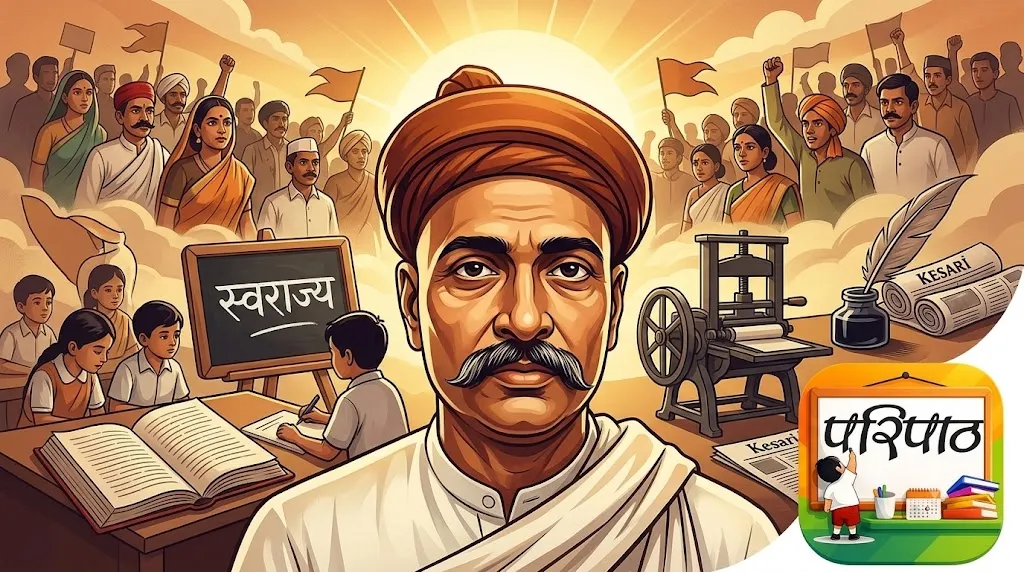
In the annals of India's freedom struggle, certain luminaries shine with an unparalleled brilliance, their contributions forever etched in the nation's collective memory. Bal Gangadhar Tilak, affectionately known as 'Lokmanya', was one such visionary leader. His iconic declaration, 'Swaraj (Self-Rule) is my birthright, and I shall have it!', was not merely a slogan; it was a potent mantra that ignited the dormant spark of freedom in the hearts of millions of Indians. Tilak was far more than a political leader; he was a foresighted educationist, an influential journalist, a social reformer, and a profound scholar of Indian culture. Through his indomitable courage, sharp intellect, and deep connection with the common people, he laid the foundational stones of Indian nationalism and infused the independence movement with a new, vibrant energy. His work and philosophy continue to resonate deeply, shaping the very identity of modern India.
Early Life, Education, and the Dawn of a Revolutionary Spirit
Born on July 23, 1856, in Chikhali village, Ratnagiri district, Maharashtra, Bal Gangadhar Tilak's original name was Keshav, but he was fondly called Bal. His father, Gangadharpant, was a renowned Sanskrit scholar and a dedicated teacher. From a young age, Tilak displayed an exceptional academic prowess and a keen intellect, with mathematics and Sanskrit being his favorite subjects. He completed his schooling in Pune and went on to earn a B.A. degree in Mathematics in 1877, followed by an L.L.B. degree. During his student years, a fervent desire to liberate his homeland from British colonial rule took root. He firmly believed that education was the key to societal progress and national awakening, leading him to dedicate his life to the service of the nation.
Tilak critically observed that the prevailing British education system merely produced clerks, failing to instill self-respect and national pride among Indians. To counter this, in 1880, he co-founded the 'New English School' with Gopal Ganesh Agarkar and Mahadev Ballal Namjoshi. This initiative further blossomed into the 'Deccan Education Society' in 1884, which subsequently established 'Fergusson College' in 1885. His vision was to nurture patriotic and character-driven citizens through these institutions. His efforts in education were not isolated; they were the genesis of a larger social and national transformation.
“Education is not merely gathering information; it is about shaping the mind and developing character.” – Lokmanya Tilak
Journalism as a Catalyst for National Awakening: 'Kesari' and 'Mahratta'
Tilak's contributions extended beyond the realm of education into the powerful domain of journalism, which he used as a potent tool for national awakening. In 1881, he launched two newspapers: 'Kesari' (in Marathi) and 'Mahratta' (in English). 'Kesari' was aimed at the common Marathi-speaking populace, while 'Mahratta' catered to the educated elite. Through these publications, Tilak fearlessly critiqued British policies, articulated the grievances of the people, and urged them to unite. His pen was sharp and incisive, directly challenging the colonial administration.
His newspapers did not limit themselves to political discourse; they also championed social reforms, addressed economic issues, and promoted cultural revival. He educated the masses about their rights and responsibilities, fostering a sense of national pride, self-respect, and confidence through his writings. 'Kesari' quickly became the most popular newspaper in Maharashtra and emerged as a powerful voice against British rule. His fearless journalism often led to imprisonment, but he never compromised on his principles or convictions.
Revitalizing Public Festivals: Ganesh Utsav and Shiv Jayanti
Tilak astutely recognized that the freedom struggle needed to involve not just the educated elite but also the common masses. To achieve this, he transformed traditional festivals into platforms for national mobilization. In 1893, he initiated the public celebration of 'Ganesh Utsav'. Through this festival, people gathered, sang patriotic songs, delivered speeches, and engaged in discussions about freedom. What began as a religious observance quickly evolved into a powerful social and political forum.
Similarly, in 1895, he initiated 'Shiv Jayanti' (Shivaji's birthday) celebrations to commemorate the legacy of Chhatrapati Shivaji Maharaj. Shivaji's struggle for 'Swaraj' served as a profound source of inspiration for Indians. Through Shiv Jayanti, Tilak presented ideals of valor, courage, and patriotism to the public. Both these festivals transcended caste and religious barriers, uniting people and instilling a strong sense of national identity. These initiatives stand as testament to Tilak's foresight and his exceptional ability to mobilize the masses.
The 'Swaraj' Mantra: Home Rule Movement and Imprisonment
Following the partition of Bengal in 1905, Lokmanya Tilak intensified the 'Swadeshi' (use of indigenous goods) and 'Boycott' movements. He broadened the meaning of 'Swaraj', asserting that it encompassed not only political freedom but also social, economic, and cultural autonomy. In 1906, he delivered his historic declaration, 'Swaraj is my birthright, and I shall have it!', a powerful statement that continues to inspire generations. This slogan provided a new direction to the entire nation and fueled the struggle for independence.
In 1908, Tilak was once again arrested on charges of sedition and sentenced to six years of imprisonment, which he served in Mandalay Jail (Burma, now Myanmar). Even in confinement, his intellect remained restless. During this period, he penned the monumental treatise 'Gita Rahasya', a commentary on the Bhagavad Gita, emphasizing the philosophy of Karma Yoga and selfless action. 'Gita Rahasya' was not merely a religious text; it was a philosophy of active nationalism.
Upon his release from prison, Tilak immediately plunged back into the freedom struggle. In 1916, he founded the 'All India Home Rule League'. 'Home Rule' signified self-governance, advocating for greater autonomy for Indians within the British Empire, leading eventually to complete self-rule. Alongside Annie Besant, he propagated this movement across the country. His public meetings drew massive crowds, and his ideas resonated deeply with the populace.
A Visionary Leader and Architect of Modern India
Lokmanya Tilak was not just a freedom fighter; he was a crucial architect in the making of modern India. He educated society about the importance of learning, awakened the masses through his newspapers, and united them through communal festivals. His ideas inspired a generation of young leaders, including Mahatma Gandhi, Jawaharlal Nehru, and Subhas Chandra Bose. Gandhi ji himself referred to Tilak as 'the Maker of Modern India'.
Tilak never tolerated any form of oppression or injustice. He believed that it was imperative for the people to fight for their rights. Through 'Kesari', he raised his voice against the problems faced by farmers, the plight during famines, and the government's indifference during epidemics like the plague. His work was not merely political; it was deeply rooted in the pursuit of social justice and the welfare of the common man.
Tilak's thoughts continue to inspire us today. His visionary educational ideas, fearless journalism, ability to mobilize people, and the philosophy of 'Swaraj' remain as relevant as ever. It was largely due to his efforts that the Indian freedom movement transformed into a mass movement.
Conclusion: Lokmanya Tilak's Place in Shaping Modern India
Lokmanya Tilak passed away on August 1, 1920, but his ideas and work live on, forever etched in our national consciousness. His demise plunged the entire nation into profound grief. Mahatma Gandhi hailed him as 'the Maker of Modern India', while Jawaharlal Nehru honored him as 'the Father of the Indian Revolution'. Tilak's life demonstrated how an individual, through sheer determination, intellect, and sacrifice, can awaken an entire society and fundamentally alter the course of a nation's history.
Even today, when we contemplate the concepts of 'Swaraj' and 'Nationalism', Lokmanya Tilak's name stands at the forefront. His life teaches us the profound importance of fighting for our rights, recognizing the value of education, uniting society, and taking pride in our culture. Lokmanya Tilak is not just a name; he is an idea, an inspiration that continues to motivate us to work for the progress of our nation. Paripath encourages all students to draw inspiration from the lives of great leaders like Lokmanya Tilak and contribute to the advancement of our beloved country.
Did You Know?
- The title 'Lokmanya' was bestowed upon Bal Gangadhar Tilak by his followers, meaning 'respected by the people'.
- While imprisoned in Mandalay, he wrote 'Gita Rahasya', a renowned philosophical treatise based on the Bhagavad Gita, considered a significant contribution to Indian philosophy.
- Tilak played a pivotal role in establishing the 'Deccan Education Society' (1884) and 'Fergusson College' (1885), which revolutionized education in Maharashtra.
- He initiated the public celebration of Ganesh Utsav in 1893 with the aim of uniting people and fostering a sense of nationalism.
- Though considered a leader of the 'Extremist' faction, Tilak also respected leaders of the 'Moderate' faction and collaborated with them when necessary for the greater good.