Hello, young learners!
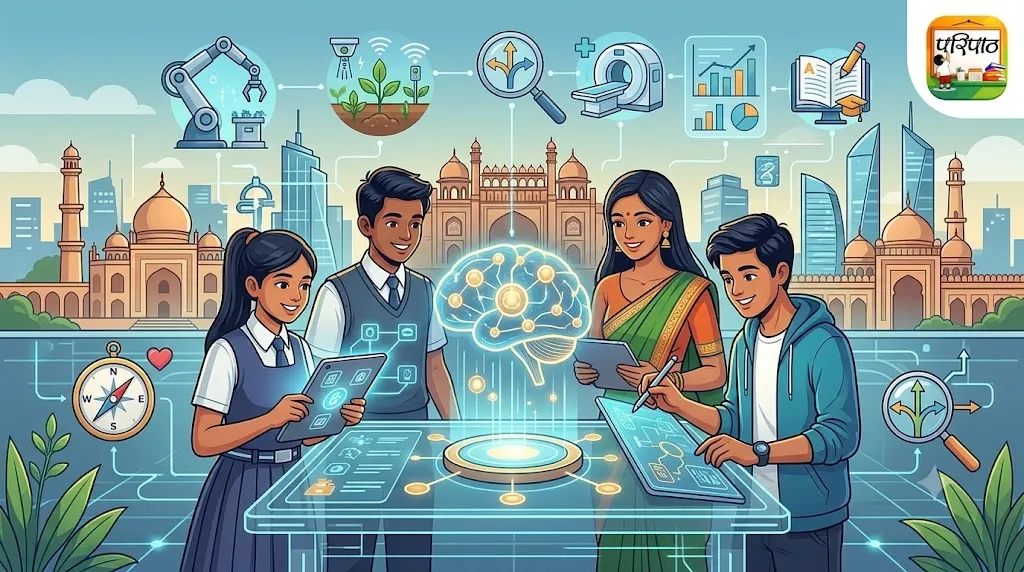
Today, we're going to explore a topic that is rapidly changing our world and shaping our future: Artificial Intelligence, commonly known as AI. You've probably heard the term 'AI' many times, but understanding what it truly is and how it impacts our lives is crucial for everyone, especially for students like you.
Imagine asking your phone's voice assistant (like Google Assistant, Siri, or Alexa) a question and getting an instant, accurate answer. Or consider how YouTube suggests videos you might like, or how Google Maps guides you through traffic. All these everyday conveniences are powered by AI! Far from being just a concept in science fiction, AI has become an integral part of our daily lives.
As we celebrate the fifth day of Ganesh Chaturthi, a festival dedicated to Ganesha, the deity of wisdom, it's fitting to delve into this new form of intelligence – Artificial Intelligence. Let's embark on this exciting journey to understand the basics of AI, its benefits, the challenges it presents, and how you, as students, can prepare for an AI-driven future. We'll also touch upon the important ethical considerations that come with this powerful technology.
What Exactly is Artificial Intelligence (AI)?
In simple terms, Artificial Intelligence (AI) refers to the ability of machines to 'think' and 'learn' like humans. It's a field of computer science dedicated to creating systems that can perform tasks that typically require human intelligence, such as problem-solving, decision-making, understanding language, and learning from experience.
Key Types of AI:
- Narrow AI (Weak AI): This type of AI is designed and trained for a specific task. Examples include facial recognition systems, recommendation engines, or chess-playing software. Narrow AI can perform its designated task exceptionally well but cannot perform any other tasks spontaneously. Most of the AI we encounter today falls into this category.
- General AI (Strong AI): This AI would possess human-level intelligence and could perform any intellectual task that a human can. It would be able to learn, understand, and apply knowledge across a wide range of problems. General AI is still largely a theoretical concept and is a subject of ongoing research.
- Superintelligence: This refers to AI that surpasses human intelligence in virtually every field, including creativity, general knowledge, and problem-solving. This is currently in the realm of science fiction and long-term speculation.
Machine Learning (ML) and Deep Learning (DL): The Pillars of AI
AI isn't a single technology but an umbrella term for various techniques. Among these, Machine Learning (ML) and Deep Learning (DL) are fundamental.
- Machine Learning (ML): This is a subset of AI that enables systems to learn from data without being explicitly programmed. Instead of telling the machine exactly what to do, you provide it with vast amounts of data and allow it to identify patterns and make predictions or decisions based on those patterns. For example, a spam filter learns to identify spam emails by analyzing countless examples of both spam and legitimate emails.
- Deep Learning (DL): A more advanced form of Machine Learning, Deep Learning uses artificial neural networks inspired by the structure and function of the human brain. These networks can process vast amounts of complex data, like images, sounds, and text, to identify intricate patterns. Deep Learning powers applications like facial recognition, speech recognition, and natural language processing.
AI in Your Daily Life (Everywhere You Look!)
You might think AI is only used in sophisticated labs or by giant tech companies. Think again! AI is present in countless aspects of your daily life, often without you even realizing it.
Here are some common examples:
- Voice Assistants: Your smartphone's Siri, Google Assistant, or Amazon's Alexa are prime examples of AI. They understand your spoken commands, answer your questions, play music, and set reminders, all by processing your voice using AI.
- Recommendation Systems: Ever wondered how Netflix knows what movies you might like, or how YouTube suggests your next video? These are AI-powered recommendation engines. They analyze your past viewing history, preferences, and even what similar users watch to suggest new content.
- Online Search Engines: When you type a query into Google, AI algorithms work behind the scenes to sift through billions of web pages and deliver the most relevant and accurate results within seconds.
- Digital Cameras and Photo Editing: Your smartphone camera uses AI for features like facial recognition, scene optimization, and even automatically enhancing your photos or applying filters.
- Video Games: Many non-player characters (NPCs) in video games are controlled by AI. They react to your actions, make strategic decisions, and provide a challenging gaming experience.
- Smartphones: Beyond voice assistants, AI optimizes your phone's battery life, manages app performance, and even predicts the next word you're likely to type on your keyboard.
- Spam Filters: AI-powered spam filters protect your email inbox by identifying and isolating unwanted or malicious emails, keeping your communication safe.
Did You Know? The term 'Artificial Intelligence' was first coined in 1956 by John McCarthy, who is often referred to as the 'Father of AI'.
Benefits and Potential Challenges of AI
AI has the potential to make our lives easier and better in many ways, but it also comes with its own set of challenges that we need to be aware of.
Benefits of AI:
- Healthcare: AI assists doctors in early disease diagnosis, drug discovery, and personalized treatment plans. Robotic surgery can also enhance precision.
- Education: AI can offer personalized learning experiences, adapting content and pace to individual student needs, identifying areas where a student struggles, and providing tailored support.
- Safety and Security: AI can monitor surveillance footage for suspicious activities, detect and prevent cyberattacks, and power self-driving cars that could significantly reduce accidents.
- Efficiency and Productivity: In businesses and industries, AI can automate repetitive tasks, optimize processes, and analyze vast amounts of data, leading to increased efficiency and cost savings.
- Scientific Discovery: AI accelerates scientific research by analyzing complex data sets, identifying patterns, and helping scientists make new discoveries in various fields.
Challenges of AI:
- Job Displacement: As AI and robots become capable of performing certain tasks, some human jobs might be automated, leading to job displacement. This highlights the importance of adapting and learning new skills.
- Privacy and Data Security: AI systems require large amounts of data to function. How this data is collected, stored, and used raises significant concerns about individual privacy and data security.
- Bias: If the data used to train AI systems contains biases (e.g., reflecting societal prejudices), the AI's decisions can also become biased, potentially leading to unfair or discriminatory outcomes against certain groups.
- Misuse: AI can be misused for malicious purposes, such as sophisticated cyberattacks, surveillance, or creating deceptive content like deepfakes, which can spread misinformation and cause societal disruption.
- Ethical Dilemmas: As AI gains more decision-making capabilities, complex ethical questions arise. For example, how should an autonomous vehicle be programmed to react in an unavoidable accident scenario?
Ethical Considerations and Responsible AI
When discussing AI, understanding its ethical implications is crucial. The positive or negative impact of AI systems largely depends on how they are designed, used, and governed.
Important Ethical Considerations:
- Fairness: Ensuring that AI systems do not discriminate against any individual or group. This requires careful consideration of data collection and algorithm design to prevent bias.
- Transparency: Understanding how AI systems arrive at their decisions. Avoiding the 'black box' problem, where the reasoning behind an AI's output is unclear.
- Accountability: Establishing who is responsible when an AI system makes a mistake or causes harm. This involves defining the accountability of developers, companies, and users.
- Human Control: Maintaining human oversight and control over AI systems, especially in critical decision-making processes, rather than allowing them to become fully autonomous without human intervention.
- Privacy: Given AI's reliance on vast data, protecting individual privacy is paramount. People should be informed about how their data is used and have control over it.
By addressing these ethical considerations, we can develop 'Responsible AI' that truly benefits society.
Preparing for an AI-driven Future
It's clear that AI will be an integral part of your future. So, how can you, as students, prepare yourselves for this evolving landscape?
Here are some key skills to focus on:
- Critical Thinking: AI can provide information, but you'll need to use your critical thinking skills to evaluate its accuracy, identify potential biases, and question its conclusions. Don't just accept AI-generated answers; learn to analyze and scrutinize them.
- Creativity: While AI can be creative to some extent, genuine human creativity and imagination remain unparalleled. Developing your artistic, musical, writing, and problem-solving creativity will be invaluable.
- Problem-Solving Skills: AI will assist in solving complex problems, but identifying the problem, analyzing its components, and formulating the right questions to ask AI will remain a uniquely human skill.
- Digital Literacy: Understanding how to use AI tools effectively, staying safe online, and having a fundamental grasp of technology is essential. Learning to code can also be a significant advantage.
- Emotional Intelligence: AI cannot understand or replicate human emotions. Skills like empathy, collaboration, leadership, and building relationships will become even more critical in an AI-powered workplace.
- Lifelong Learning: Technology is constantly evolving. Cultivate a mindset of continuous learning and adaptability. Be prepared to acquire new skills and update your knowledge throughout your life.
Conclusion
Artificial Intelligence (AI) is a remarkable and transformative technology that holds the potential to bring about numerous positive changes in our lives. From the voice assistants in our smartphones to advancements in healthcare and education, AI's influence is widespread. While it offers immense benefits like efficiency and groundbreaking discoveries, it also presents challenges such as potential job displacement, privacy concerns, and ethical dilemmas.
To thrive in this AI-driven future, students must focus on developing skills such as critical thinking, creativity, problem-solving, digital literacy, and emotional intelligence. Remember, AI is a tool designed to augment human intelligence, not replace it. By using AI responsibly and ethically, we can collectively build a better and safer future.
By staying informed about this technology and preparing yourselves with the right skills, you can become an active and valuable participant in this exciting journey. Let's embrace this new era and leverage its opportunities to the fullest!
Did You Know?
- The world's first AI-powered chatbot, 'ELIZA,' was developed in 1966.
- Google's DeepMind developed 'AlphaGo,' an AI program that became the first to defeat a world champion Go player in 2016.
- AI is also used for weather forecasting, predicting natural disasters, and optimizing crop management in agriculture.
- The 'Turing Test' is a method for determining whether a machine can exhibit intelligent behavior equivalent to, or indistinguishable from, that of a human.
- 'Generative AI' is a type of AI that can create new content like text, images, or music, exemplified by tools like ChatGPT or DALL-E.