Hello students and respected teachers,
Today, we embark on a fascinating journey to explore a crucial aspect of India's rich history and engineering prowess: ancient Indian water management systems. In an era where water scarcity and conservation are pressing global concerns, it is truly inspiring to delve into how our ancestors meticulously managed water thousands of years ago. These ancient systems offer profound insights, particularly relevant during the monsoon season when abundant rainfall necessitates effective water harvesting and management.
As an agrarian society, water has always held paramount importance in India. References to water management can be found in ancient texts like the Rigveda and Atharvaveda. From the Indus Valley Civilization to the Gupta Empire, various periods witnessed remarkable advancements in water management. Let's explore this incredible legacy!
A Glimpse into Ancient Indian Water Wisdom
Ancient Indian civilizations, especially the Indus Valley Civilization, set benchmarks in water management that continue to astound us today. The meticulous planning of their cities, sophisticated drainage systems, and provisions for potable water clearly demonstrate their foresight. They not only ensured access to drinking water but also developed advanced irrigation techniques for agriculture.
Harappan Civilization: Pioneers of Water Management
The Harappan Civilization (Indus Valley Civilization), which flourished around 4,500 years ago, boasted highly advanced water management systems. Major cities like Mohenjo-Daro and Harappa featured well-organized drainage systems, public baths, and private wells in almost every house. Even more remarkable was the water management at Dholavira in Gujarat. This city was divided into three parts, and large reservoirs (tanks) were constructed to supply water to each section. They skillfully harvested rainwater and stored it for year-round use. Extensive stone-built reservoirs discovered here collected monsoon water, distributing it throughout the city.
“The reservoirs at Dholavira stand as a testament to ancient Indian engineering, reflecting the profound awareness of water conservation among its people.”
In this civilization, clay pottery, bricks, and stones were used for water storage and distribution. Wells and stepwells were constructed after a careful study of groundwater levels, indicating a sophisticated understanding of hydrology among the people of that era.
Architectural Marvels: Stepwells, Reservoirs, and Dams
In the post-Indus Valley period, various water management systems evolved across different parts of India. These included stepwells (baori/vav), large reservoirs (talav), and dams (bandhare), which not only managed water but also created stunning architectural masterpieces.
Stepwells (Baori/Vav): Art and Engineering Combined
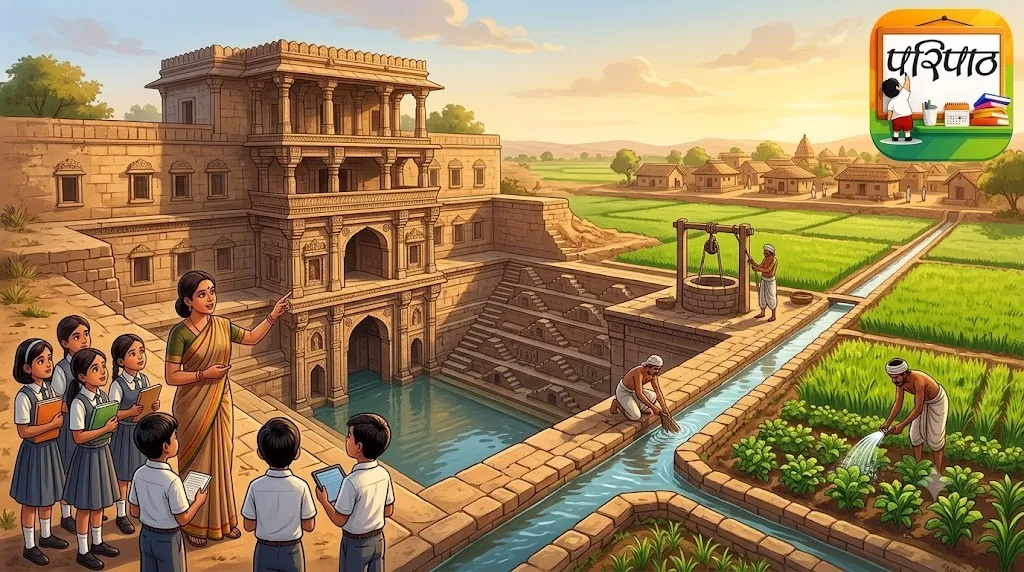
Stepwells, known as ‘baori’ or ‘vav’ in local languages, were not just water sources but also vital social and cultural hubs. Many such stepwells still exist in Rajasthan, Gujarat, and Delhi. These structures feature intricate staircases leading down to the water level, ensuring access to water regardless of the season. Their design was not merely functional; it was artistic and aesthetically breathtaking. Rani-ki-Vav in Gujarat and Chand Baori in Rajasthan are excellent examples.
- Rani-ki-Vav (Patan, Gujarat): Built in the 11th century, this stepwell is a UNESCO World Heritage Site. It is seven stories deep, adorned with exquisite sculptures on each level. It was originally built to mitigate flood damage from the Saraswati River and later to access groundwater.
- Chand Baori (Abhaneri, Rajasthan): Constructed in the 8th century, this is one of India's largest and deepest stepwells. Its geometric staircase patterns are a marvel to behold.
Stepwells played a crucial role in maintaining groundwater levels and recharging aquifers by allowing rainwater to seep into the ground.
Lakes and Reservoirs: Lifelines of Communities
Ancient India saw the construction of numerous large lakes and reservoirs, used for drinking water, agriculture, and sometimes even flood control. These reservoirs served as lifelines for many villages and towns.
- Bhojtal (Bhopal, Madhya Pradesh): This massive lake was constructed in the 11th century by the Parmar king Bhoj. Spanning approximately 250 square kilometers, it supplied water to many villages. Its construction cleverly utilized natural hills and valleys.
- Sudarshan Lake (Gujarat): Built during the reign of Chandragupta Maurya (4th century BCE) of the Mauryan Empire, this lake was later renovated by Emperor Ashoka. Located near the Girnar mountain, it was primarily used for irrigation.
- Angampoor Lake (Karnataka): Constructed during the Vijayanagara Empire, this lake was vital for agriculture in the region.
The construction of these reservoirs involved a deep understanding of local topography and rainfall patterns. Trees were often planted along their banks to reduce water evaporation and prevent wastage.
Dams and Embankments: Sustaining Agriculture
Recognizing the critical need for water in agriculture, ancient Indians began building dams and embankments on rivers. These structures diverted river water into canals, which then carried it to agricultural fields.
- Grand Anicut (Kallanai Dam, Tamil Nadu): Built on the Kaveri River, this is one of the world's oldest dams still in use. It was constructed around 2,000 years ago (2nd century CE) by the Chola king Karikalan. Although only about 18 feet high, it efficiently diverted the Kaveri's waters into numerous canals, irrigating thousands of acres in the delta region. Its engineering design was so robust that it remains functional to this day.
- Dams in Rajatarangini (Kashmir): The text ‘Rajatarangini’ by Kalhana describes various water management projects, including several dams and canals, built by kings in Kashmir.
These dams served multiple purposes: flood control, irrigation, and ensuring the availability of drinking water.
Sophisticated Irrigation Techniques
Simply storing water was not enough; delivering it to agricultural fields was equally important. Ancient Indians developed various irrigation methods for this purpose.
Canals and Wells: The Backbone of Irrigation
To supply water to fields located away from rivers, extensive networks of canals were built. Kautilya's Arthashastra (4th century BCE) provides detailed information on various irrigation methods and the maintenance of canals. During the Mauryan period, large canals were dug and maintained by state machinery.
Wells and artesian wells were used to extract groundwater. Especially in regions with low rainfall, wells were the primary source of water. Mechanical devices like the 'rahatgadge' (Persian wheel) were used to draw water from wells.
Underground Aqueducts (Karez/Surangam): Invisible Systems
In some regions, particularly those with low rainfall or rocky terrain, an ingenious system of underground aqueducts (known as 'karez' or 'surangam') was employed. In this system, horizontal tunnels were dug into the base of hills or mountains to collect groundwater. These tunnels gently sloped downwards, allowing water to flow by gravity to villages or fields. Some 'surangams' are still operational in the Kasaragod district of Kerala. This system minimizes water evaporation and ensures sustainable use of groundwater.
Sustainability and Lessons for the Modern Era
Ancient Indian water management systems were not just engineering marvels; they were founded on principles of sustainability. They respected natural resources and utilized them in a way that ensured their availability for future generations. Their key characteristics included:
- Use of Local Resources: Structures were built using local stone, soil, and vegetation.
- Ecological Balance: The balance of water sources and ecosystems was meticulously maintained.
- Community Participation: Active involvement of local communities in water management ensured effective maintenance and conservation.
- Foresight: Not just immediate needs, but long-term water availability was secured.
Today, as we face severe challenges of climate change and water scarcity, these ancient Indian systems offer invaluable lessons. They teach us how to effectively plan for and utilize the abundant water received during the monsoon season throughout the year, how to increase groundwater levels, and how to cherish every drop of water.
Did You Know?
- One of the world's oldest water management systems was discovered at Dholavira, a UNESCO World Heritage Site.
- The Kallanai Dam, also known as the Grand Anicut, was built approximately 2,000 years ago and is still functional today.
- Some ancient stepwells utilized natural filters, consisting of layers of sand, gravel, and charcoal, to purify water.
- Chanakya's Arthashastra mentions regulations for water management and water taxes, ensuring efficient water use.
- The 'surangam' (underground aqueduct) system in Kerala is still used by some tribal communities, demonstrating sustainable groundwater utilization.
Conclusion
Ancient India's water management was more than just engineering skill; it was a philosophy of living in harmony with nature. Structures like stepwells, reservoirs, dams, canals, and underground aqueducts fulfilled the needs of society then and continue to offer invaluable lessons in sustainable living and water conservation today. By respecting the foresight of our ancestors, we too must recognize the importance of water in our time, use it judiciously, and secure water resources for the future. Utilizing this knowledge, we can build a water-rich India.
Thank you!