
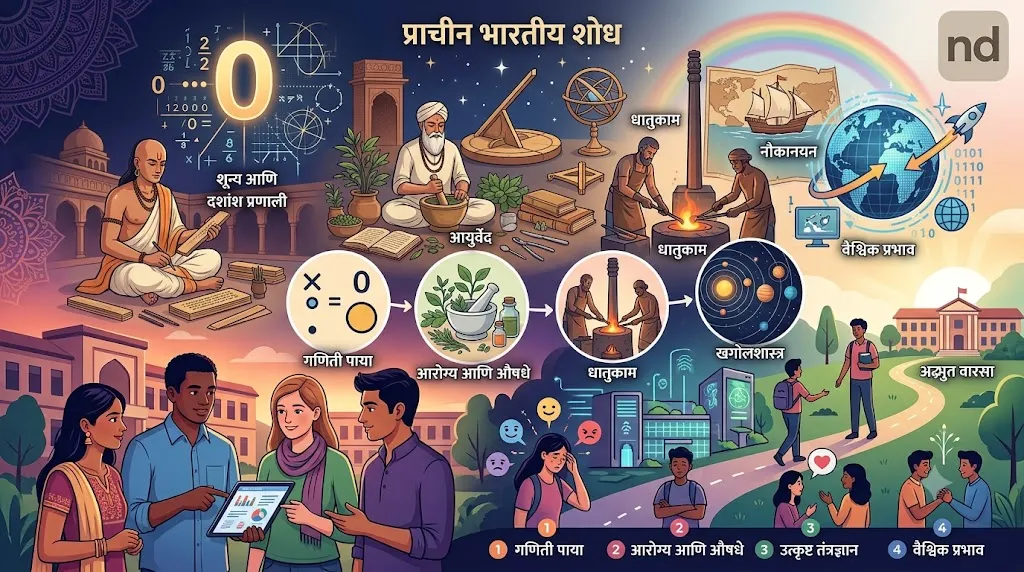
As we celebrate Sharadiya Navratri and Ghatasthapana today, October 11, 2026, a festival dedicated to the divine feminine energy, knowledge, and creativity, let us also reflect on the extraordinary intellectual heritage of ancient India. India has not only bequeathed a rich spiritual and cultural legacy but has also pioneered countless innovations in science, mathematics, technology, and medicine that have profoundly shaped the course of human civilization. Let's embark on a journey to explore these incredible contributions and take pride in the brilliance of our ancestors.
Mathematics and the Number System: The Zero Revolution
Mathematics is the bedrock of all sciences, and ancient India's most significant gift to the world in this field was the concept of Zero and the Decimal System. The numerical system we use globally today has its roots firmly planted in Indian mathematics.
The Concept of Zero: A Paradigm Shift
Zero is not merely a digit; it's a profound concept that revolutionized mathematics. Before its discovery, performing calculations with large numbers was incredibly cumbersome. Zero enabled the Place Value System, allowing for the easy representation of any number, no matter how large. The earliest known mention of zero as a number in its own right appears in the 7th-century text 'Brahmasphutasiddhanta' by Brahmagupta, though its conceptual origins might be even older. Zero made advanced mathematical branches like Algebra and Calculus possible. In today's digital age, computers and the internet, which operate on binary code (0s and 1s), would be inconceivable without the concept of zero. Zero is arguably India's greatest intellectual gift to humanity.
The Decimal System and Place Value
Alongside zero, ancient Indians developed the Decimal System and the Place Value System. This system allows us to represent any number, however large, using just ten digits (0-9). This ingenious system traveled to Europe via Arab traders and subsequently spread across the globe. It laid the foundation for modern science and technology. In contrast, Greek and Roman civilizations used letters for numbers, making calculations complex. The Indian system offered unparalleled simplicity and efficiency.
Ayurveda: The Ancient Science of Life
Ayurveda, meaning 'the science of life,' is one of the world's oldest and most comprehensive healthcare systems, originating in India. It focuses not just on treating diseases but also on promoting a healthy lifestyle and preventing illness, emphasizing a holistic approach to well-being.
Charaka Samhita and Sushruta Samhita
The two pillars of Ayurveda are the Charaka Samhita and the Sushruta Samhita. Acharya Charaka, in the 8th century CE (though some place him earlier), authored the 'Charaka Samhita,' a detailed treatise on internal medicine, diagnostics, and therapeutics. It describes around 600 medicinal plants.
Acharya Sushruta, revered as the 'Father of Surgery,' penned the 'Sushruta Samhita' in the 6th century BCE (or later, depending on scholarship). This monumental work describes over 300 surgical procedures and 121 types of surgical instruments. He detailed complex surgeries such as plastic surgery, cataract removal, bone fracture reduction, and even organ transplantation. Rhinoplasty (nose reconstruction) is a prime example of Sushruta's surgical prowess, techniques of which are still recognized and utilized in modern medicine.
Ayurveda provided deep insights into human anatomy, the properties of medicinal plants, and the importance of balanced diet, yoga, and meditation for maintaining health. Today, a growing number of people worldwide are turning to Ayurvedic practices for holistic wellness.
Architecture and Urban Planning: The Indus Valley Legacy
Around 4500 years ago, when many world civilizations were still in nascent stages, ancient India saw the rise of a highly advanced civilization – the Indus Valley Civilization. This civilization set global benchmarks for urban planning and architecture.
Mohenjo-Daro and Harappa
Cities like Mohenjo-Daro and Harappa were meticulously planned. They featured grid-patterned streets, houses built with standardized baked bricks, and impressive public structures. Most remarkably, these cities boasted an exceptionally advanced drainage system. Wastewater from every house flowed into main drains, which were underground and regularly cleaned. This sophisticated system of public baths, granaries, and water management was incredibly modern for its time, serving as an inspiration for urban design even today.
Metallurgy and Engineering: The Iron Pillar of Delhi
Ancient Indians achieved astonishing progress in metallurgy and engineering. Their mastery of metalwork continues to baffle and impress scientists globally.
Wootz Steel
Wootz steel, produced in India, was considered the strongest and sharpest steel in the world. This steel gained fame in Europe and the Middle East as 'Damascus steel.' Swords made from Wootz steel were renowned for their sharpness and durability. The process of making this steel was so complex that European scientists struggled for centuries to unravel its secrets.
The Iron Pillar of Delhi
The Iron Pillar of Delhi, located in the Qutub Minar complex, stands as a living testament to ancient Indian metallurgical prowess. Erected around 1600 years ago (during the Gupta period), this pillar has defied rust to this day. Made of 99.7% pure iron, it continues to withstand all climatic onslaughts. The secret to its rust-resistance remains a subject of ongoing research for modern scientists, underscoring the incredible knowledge of ancient Indian engineers.
Other Engineering Marvels
- Ajanta and Ellora Caves: These rock-cut temples and caves are magnificent examples of ancient Indian architecture and engineering, showcasing intricate carvings and structural ingenuity.
- Embankments and Water Management: Ancient India saw the construction of numerous reservoirs, tanks, and embankments to manage water resources efficiently for agriculture and daily life.
Astronomy and Cosmology: Aryabhata's Insights
Ancient Indian astronomers possessed profound knowledge of celestial bodies, their movements, and eclipses. Their observations and calculations often align remarkably well with modern scientific understanding.
Aryabhata and the Surya Siddhanta
The great 5th-century mathematician and astronomer Aryabhata proposed revolutionary ideas in his treatises 'Aryabhatiya' and 'Surya Siddhanta.' He stated that the Earth rotates on its own axis, causing day and night. He also provided scientific explanations for solar and lunar eclipses. Aryabhata calculated the Earth's diameter and circumference with remarkable accuracy, very close to modern measurements. He also accurately approximated the value of 'Pi' (π) to 3.1416.
Brahmagupta and Bhaskara II
Following Aryabhata, Brahmagupta (7th century CE) put forth some theories about gravity, while Bhaskara II (12th century CE) made significant contributions to various branches of mathematics in his text 'Siddhanta Shiromani.' He described the gravitational force of the Earth, attracting objects towards it, centuries before Newton.
Other Significant Innovations and Contributions
Beyond mathematics, science, and engineering, ancient India enriched the world in numerous other fields.
Chess
The game of Chess, popular worldwide today, originated in ancient India under the name 'Chaturanga.' This game symbolizes strategy, tactics, and intelligence, with mentions dating back to the 6th century CE.
Yoga and Meditation
Yoga and Meditation have been integral parts of ancient Indian lifestyle. Patanjali's Yoga Sutras systematized Yoga, providing a framework for physical, mental, and spiritual well-being. The importance of Yoga for holistic health is now globally recognized, with the United Nations declaring June 21st as 'International Yoga Day,' a testament to India's global contribution.
Cotton and Textiles
The cultivation of cotton and the art of weaving textiles from it developed in India during the Indus Valley Civilization. Indian cotton textiles were renowned globally for their exquisite quality. Fabrics like 'Muslin' from India were highly sought after worldwide.
Dyes and Chemicals
Ancient India was proficient in producing natural dyes, such as 'Indigo.' Progress was also made in chemistry, with chemical processes used for purifying metals, preparing medicines, and creating cosmetics.
Did You Know?
- The world's oldest universities, such as Nalanda and Taxila, were in India, attracting students from across the globe.
- Cataract surgery was first performed in ancient India by Acharya Sushruta.
- The concepts of 'Sine' and 'Cosine' in Trigonometry were introduced by Aryabhata.
- The game of Snakes and Ladders was created in ancient India as 'Mokshapat,' based on the principles of karma and destiny.
- India gave the world Shampoo. The word 'shampoo' is derived from the Sanskrit word 'champu,' meaning to massage.
Conclusion
On this International Day of the Girl Child and amidst significant events like the groundbreaking ceremony for the Dr. Ambedkar Memorial, we remember the glorious history of our nation. The contributions of ancient India are not just historical; they remain an integral part of our modern lives. Innovations like zero, the decimal system, Ayurveda, sophisticated urban planning, advanced metallurgy, and astronomical insights laid the foundation for human progress. We should take immense pride in this legacy and draw inspiration from it to pursue new discoveries, acquire knowledge, and strive to make our nation even more prosperous. Through Paripath, we encourage you to join this journey of learning and exploration.
